Yemen’s Social Affairs Minister and UNICEF Review Progress on Child and Social Protection Frameworks
 Yemen Herald News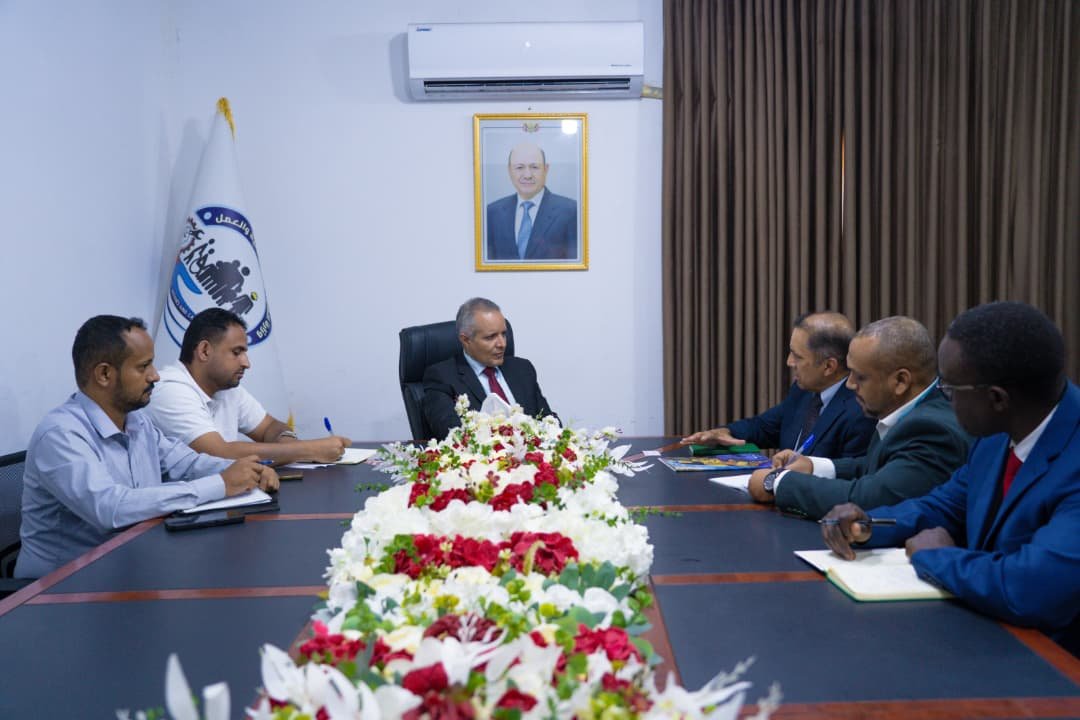
Yemen’s Minister of Social Affairs and Labour, Mukhtar al-Yafeai, held talks in the interim capital Aden with senior UNICEF officials on joint coordination and partnership in social protection and child protection, the state news agency Saba reported. The minister met the agency’s Acting Resident Representative, Akil Ayer, and its Deputy Resident Representative, Obia Ashing, in a meeting that focused less on emergency appeals than on the architecture Yemen will need if assistance to its poorest households is ever to become predictable.
According to Saba, the discussions reviewed progress in finalising the national social protection framework and the child protection plan, and covered UNICEF’s country programme for Yemen for 2027 to 2029. The two sides also went over preparations for an expanded consultative meeting with partners due to be held in Aden, a forum intended to bring government bodies, United Nations agencies and non-governmental organisations around a single set of priorities rather than a patchwork of separate projects.
Social protection in Yemen has been reduced, over more than a decade of conflict, to a fraction of what it was. The Social Welfare Fund, which before the war delivered modest cash transfers to poor households across the country, suspended payments as the fighting spread and public finances collapsed. Much of what replaced it has been humanitarian cash assistance funded year to year by donors, which means families cannot count on it and government institutions gain little capacity from administering it.
A national framework is meant to change that logic by defining who is eligible, how they are identified, how payments are delivered and which institution is accountable. UNICEF has been supporting work in this direction, including a cash plus approach that combines financial transfers with referrals to services, targeting vulnerable households, families caring for children with disabilities and cases identified through nutrition and education case management. Linking money to services matters because a transfer alone rarely gets a malnourished child into treatment or a girl back into a classroom.
The child protection plan addresses a separate but overlapping set of risks. Years of war have exposed Yemeni children to recruitment by armed groups, unexploded ordnance, child labour, early marriage and separation from their families during displacement. Case management, family tracing, psychosocial support and mine risk education are the practical tools available, and all of them depend on trained social workers who are in short supply and unevenly distributed across a country split between rival administrations.
The scale of need is difficult to overstate. According to the United Nations 2026 Humanitarian Needs and Response Plan, more than 22 million people in Yemen require humanitarian assistance and protection this year, including 5.2 million internally displaced people. Some 18.3 million Yemenis are acutely food insecure, and more than 2.2 million children under the age of five are acutely malnourished. Aid agencies launched an appeal in March seeking 2.16 billion dollars to reach 12 million of the most vulnerable people.
Funding has not kept pace with those requirements, and shortfalls have already forced reductions in programmes across sectors. That gap is one reason officials in Aden have pushed to place social protection on a more durable footing: a system owned by national institutions and financed at least partly from the public budget is harder to switch off when a donor’s priorities move elsewhere, even if the amounts involved are smaller than those humanitarian appeals can mobilise in a good year.
UNICEF’s next country programme, covering 2027 to 2029, is the vehicle through which much of that work would be planned. Country programme documents set out agreed results, budgets and government counterparts for a multi-year period, and drafting one for Yemen requires assumptions about access, security and the political situation that nobody can make with confidence. The fact that planning for 2027 is under way at all reflects an expectation that the agency’s role will remain substantial for years to come.
The government side of the partnership faces its own constraints. Public salaries are paid irregularly in many areas, the rial has lost much of its value against the dollar, and institutions from the central bank to the customs service operate in duplicate on either side of the front lines. The Presidential Leadership Council, which has led the internationally recognised government since 2022, has made restoring basic services and stabilising the currency central to its stated agenda, with limited results so far.
Yemen’s war has deep roots. The Houthi movement seized the capital, Sanaa, in late 2014, and a Saudi-led coalition intervened in March 2015 in support of the internationally recognised government. Front lines have moved relatively little since a United Nations-brokered truce in 2022, but no political settlement has followed, and the recent escalation in the Red Sea has renewed concern that the stalemate could give way to broader fighting.
For the households these frameworks are designed to reach, the practical question is narrower than any of that. It is whether a payment arrives when expected, whether a social worker follows up on a child identified as at risk, and whether a clinic referral leads to treatment. Meetings such as the one held in Aden do not answer those questions on their own, but the systems being negotiated in them determine whether the answers can eventually be yes.
About the Author