Yemen’s Health Minister Urges Italy to Expand Medical Cooperation in Talks with Ambassador Baldocci
 Yemen Herald News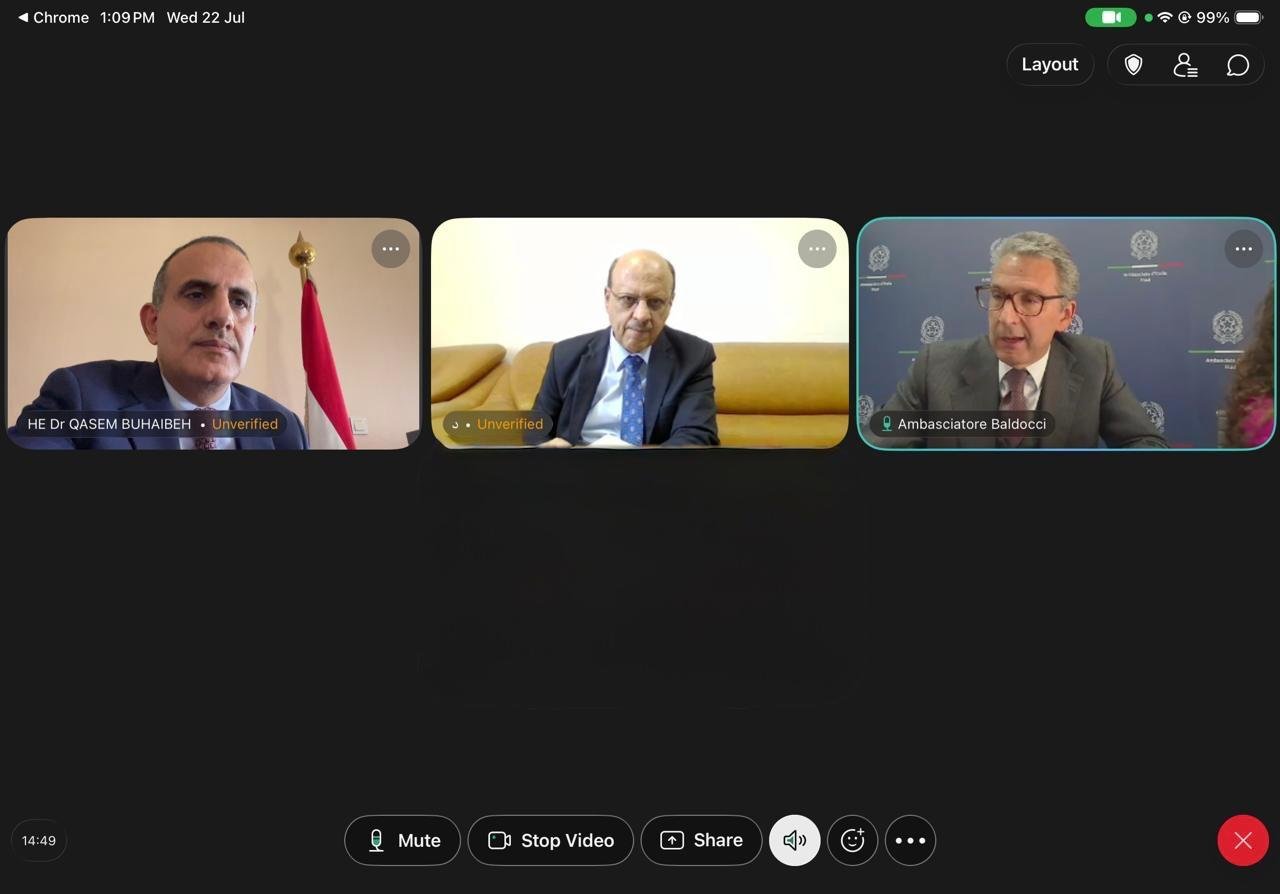
Yemen’s Minister of Public Health and Population, Dr. Qasem Buhaybeh, has urged Italy to deepen its role in supporting the country’s battered health system, using a video conference with the Italian Ambassador to Yemen, Carlo Baldocci, to press for a broader partnership between Rome and the internationally recognized government. The state news agency Saba reported the talks, which centred on practical ways to improve health care and medical services as Yemen struggles through one of the world’s most severe humanitarian crises.
During the call, Buhaybeh praised the existing cooperation between the two countries and singled out Italy’s decision to take the lead in dispatching Italian doctors to provide medical services inside Yemen. He thanked Rome for that support and said the current circumstances make active Italian engagement in the health sector more necessary than ever. Years of civil war, recurring epidemics and chronic shortages of staff, medicines and equipment have left millions of Yemenis without reliable access to even basic care.
The minister said his government looks forward to greater Italian involvement in sustaining its efforts to develop health facilities and raise the standard of medical services across the country. Rebuilding hospitals and clinics, training health workers and securing steady supplies of medicines all require resources the government cannot marshal alone, and Buhaybeh presented the partnership with Italy as one channel through which those gaps might gradually be closed.
Baldocci, for his part, affirmed that Italy is interested in supporting Yemen, particularly in the health sector. He said the Italian government wants to promote cooperation and coordination with the Ministry of Public Health and Population to help improve health services, according to Saba’s account of the meeting. The commitment fits a wider pattern in Italian foreign policy, which has long emphasized humanitarian assistance and capacity building in conflict-affected countries.
The scale of the challenge facing any such partnership is stark. The World Health Organization says only around 60 percent of Yemen’s health facilities remain fully functional, leaving millions of people without dependable access to essential care. Funding shortfalls and insecurity have pushed some health partners to phase out operations in northern governorates, widening gaps in primary and secondary care precisely where needs are greatest.
Disease outbreaks compound the strain. Yemen is contending with concurrent outbreaks of cholera, measles, dengue fever and polio, driven by low immunization coverage, unsafe water and sanitation, large-scale displacement and limited access to treatment. The WHO has reported hundreds of thousands of suspected cholera cases, alongside a rise in vaccine-preventable diseases that health workers struggle to contain with depleted cold chains and interrupted vaccination campaigns.
In its 2026 emergency appeal for Yemen, the WHO is seeking 38.8 million dollars to deliver life-saving health assistance to 10.5 million people. The agency says the funds would strengthen disease surveillance and rapid response, keep essential medicines flowing, deploy mobile clinics and surgical teams, support immunization drives and build the national capacity needed to sustain basic services. United Nations agencies estimate that more than 20 million Yemenis will need some form of humanitarian assistance this year.
Displacement adds a further layer of pressure. The United Nations counts more than five million internally displaced people in Yemen, many of them living in camps or informal settlements where clean water is scarce and disease spreads quickly. Displaced families frequently arrive in districts whose clinics were already overstretched, and the continuous movement of people makes routine services such as childhood vaccination and maternal care far harder to deliver.
Behind these figures lies more than a decade of conflict. The Houthi movement seized the capital, Sanaa, in late 2014, and a Saudi-led coalition intervened in March 2015 in support of the internationally recognized government. The war has split the country between rival administrations, fragmented public institutions and left health workers in many areas unpaid for long stretches. Hospitals have been damaged or destroyed, and the import restrictions and economic collapse that accompanied the fighting have made medicines and medical equipment scarce and expensive.
Italian engagement in Yemen has largely flowed through humanitarian channels, including United Nations agencies and non-governmental organizations working in health and nutrition. The prospect discussed by Buhaybeh and Baldocci — Italian doctors and specialists working alongside Yemeni colleagues — carries value beyond immediate treatment, because it allows the transfer of skills and knowledge that can strengthen the resilience of local services over time. For a system that has lost many experienced professionals to emigration, that kind of exchange addresses one of its deepest weaknesses.
Whether the video conference translates into concrete programmes will depend on funding, access and the security environment, none of which can be taken for granted in Yemen. But officials in Aden hope the partnership can also serve as a model that draws other governments into the health sector, spreading the burden of reconstruction across a wider group of donors.
For now, the conversation between the minister and the ambassador signals that both sides see health as a field where cooperation is possible even amid political uncertainty. If Rome follows through on the commitments described by its ambassador, Yemenis in areas served by the ministry stand to gain expanded services, better-equipped facilities and a health workforce less isolated from international expertise than it has been at any point in the long years of war.
About the Author