
Yemen’s Ambassador Urges Canada to Shift From Emergency Aid to Long-Term Recovery Support
 Yemen Herald News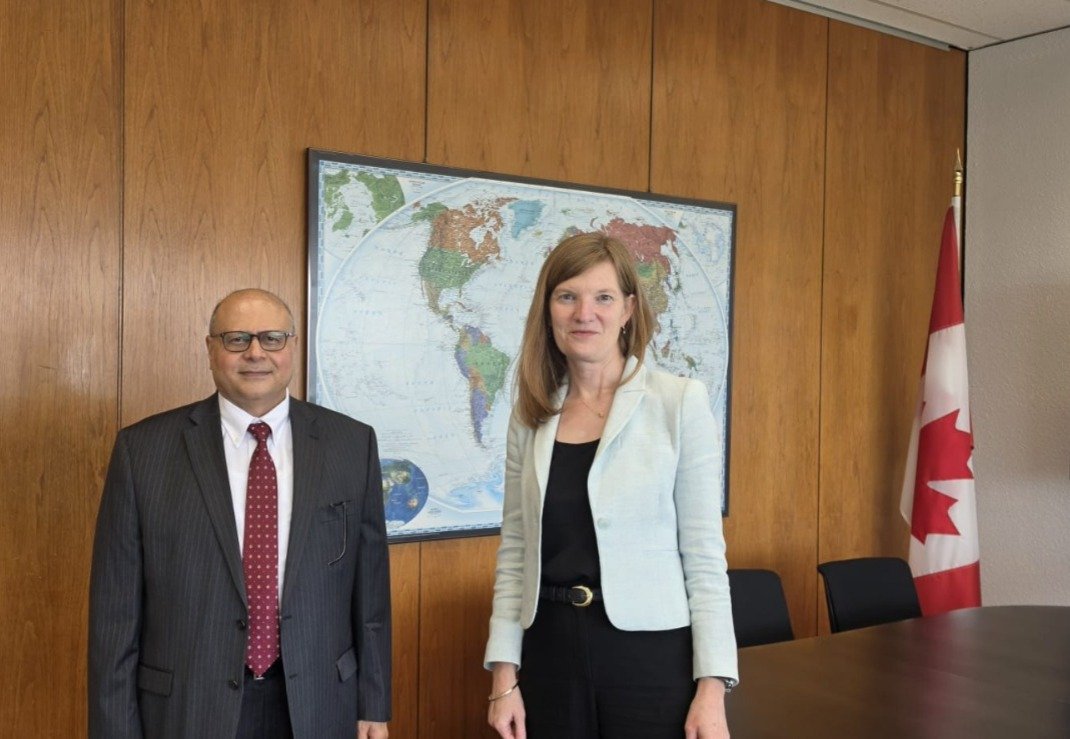
Yemen’s ambassador to Canada has urged Ottawa to move gradually beyond emergency relief and help fund the country’s recovery, telling a senior Canadian development official that Yemen needs investment in institutions and infrastructure alongside the aid that keeps millions of people alive.
Ambassador Jamal al-Sallal met Cynthia Termorshuizen, Canada’s Deputy Minister of International Development, in Ottawa on Tuesday. Their discussion covered the Yemeni government’s recovery and economic reform priorities and ways of widening cooperation across humanitarian, development and investment work, according to the Yemeni state news agency Saba, which reported the meeting.
Al-Sallal praised Canada’s humanitarian and development assistance, describing the country as one of Yemen’s leading humanitarian partners. He said his government hoped for increased support and stressed the importance of a gradual transition from relief to recovery, sustainable development and what he framed as a long-term strategic partnership between the two countries.
The ambassador set out a list of priority areas for closer cooperation: food security, health, education, water and sanitation, early recovery and reconstruction, the empowerment of women and young people, renewable energy, and building the capacity of state institutions. He also pressed for greater Canadian investment in sectors he described as promising, naming renewable energy, oil and gas, mining, agriculture, fisheries, ports and logistics.
Al-Sallal argued that Yemen’s strategic location and economic potential mean that support for the Yemeni government amounts to an investment in regional stability and international maritime security rather than charity. The readout of the meeting did not include any new Canadian funding commitment.
The ambassador is a familiar figure in the Canadian capital. In addition to representing Yemen in Ottawa, he serves as dean of the Council of Arab Ambassadors there, a role that gives him a coordinating position among Arab missions to Canada. He held a separate round of talks with officials at Canada’s foreign ministry on regional developments and bilateral cooperation.
The case he is making rests on figures that have grown steadily worse. United Nations planning estimates for 2026 put the number of people in Yemen needing humanitarian assistance and protection services at 22.3 million, more than two-thirds of the population. That caseload includes 5.2 million people displaced inside the country, roughly 329,000 migrants and about 63,000 refugees and asylum seekers.
Food insecurity remains the sharpest edge of the crisis. Some 18.3 million people are acutely food insecure, and aid monitors have recorded districts shifting from crisis into emergency levels of hunger. Humanitarian agencies have requested 2.16 billion dollars for 2026 to reach 12 million people, with 9.4 million prioritised for targeted assistance according to the severity of their needs, a plan that leaves a substantial share of those in need outside the response.
That funding gap is central to al-Sallal’s pitch. Relief operations of this scale cannot be sustained indefinitely by annual appeals, and Yemeni officials have argued for several years that rebuilding the capacity of ministries, utilities and local authorities offers the only path towards reducing dependence on imported assistance. Efforts to restart the Aden refinery, inspected earlier this year by Yemen’s oil minister, illustrate the sort of institutional repair the government has in mind.
The maritime security argument has become harder to ignore in recent weeks. Yemen sits alongside the Bab al-Mandab Strait, the narrow passage between the Red Sea and the Gulf of Aden through which a significant share of global trade moves. Yemen’s Houthi movement declared a maritime blockade of Saudi Arabia on 20 July and has claimed attacks on Saudi oil facilities and tankers, prompting several vessels to change course to avoid the strait. Reuters has reported that the group is weighing fees on commercial ships passing through it.
Those disruptions matter directly for aid delivery, because most of the food, fuel and medicine that reaches Yemen arrives through its ports. Shipping insurance costs and rerouting decisions taken far from Yemen feed through into prices in Yemeni markets and into the operating costs of the agencies working there.
The meeting also comes during a reshuffle of Yemen’s diplomatic leadership. A presidential decree issued on 23 July by Rashad al-Alimi, chairman of the Presidential Leadership Council, appointed Afrah al-Zouba as minister of foreign affairs and expatriates, making her the first woman to hold the post in Yemen’s history. She was sworn in before the council chairman this week, and Yemen’s newly reshuffled cabinet took the oath of office in Riyadh earlier in the month.
Al-Zouba’s appointment has been read as a signal about the government’s diplomatic priorities. She trained as a pharmacist at Sanaa University, later studied community health and health economics in Malaysia, and spent more than 25 years working in development and peacebuilding before entering government, a background closer to the development agenda al-Sallal was promoting in Ottawa than to traditional statecraft.
Whether the Ottawa talks translate into concrete programmes will depend on Canada’s own development budget decisions and on conditions inside Yemen, where insecurity continues to constrain access for aid workers and investors alike. For now the meeting registers as a statement of intent: Yemen’s representatives are asking donors to think in terms of years rather than emergency cycles, and to treat the country’s recovery as a shared interest in a region where instability travels quickly across borders and shipping lanes.
About the Author




