
Afrah al-Zouba Sworn In as Yemen’s First Female Foreign Minister
 Yemen Herald News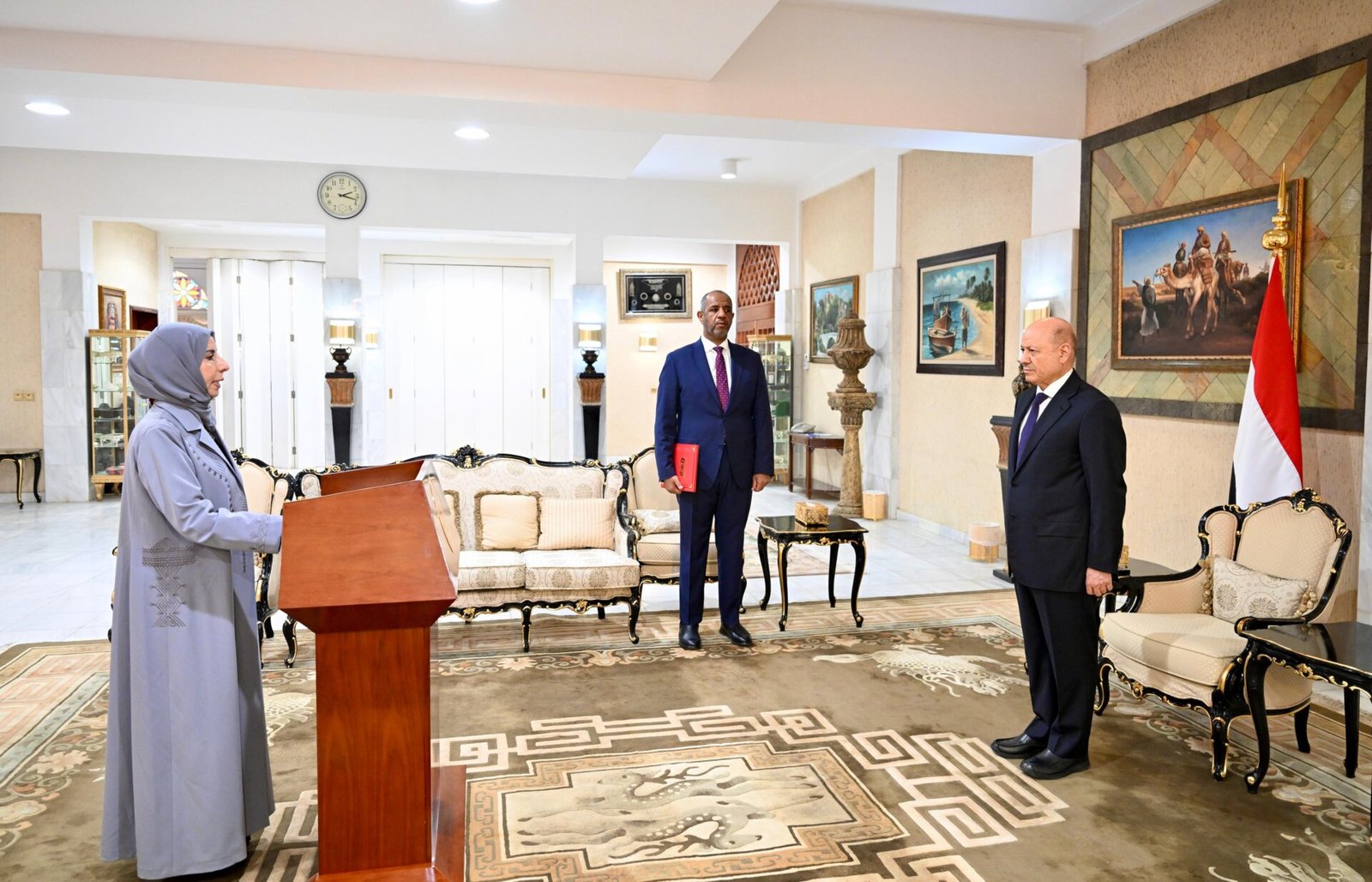
Dr Afrah Abdulaziz al-Zouba has taken the constitutional oath before President Dr Rashad al-Alimi, chairman of Yemen’s Presidential Leadership Council, becoming the first woman to hold the post of Minister of Foreign Affairs and Expatriates in the country’s history. Her appointment came by presidential decree issued on 23 July as part of a wider reshuffle of the internationally recognised government, which has operated largely from the southern port city of Aden since the Houthi movement seized the capital, Sanaa, in 2014. The moment carried symbolic weight in a country where women have rarely reached senior government office.
At the ceremony the president congratulated the new minister and pressed for a change in the way Yemen conducts its diplomacy. He argued that the foreign ministry should move away from what he described as reactive and largely ceremonial contacts and pursue a more active international presence, helping to set the terms of discussion about Yemen rather than responding to them after the fact.
Al-Alimi also called on the government to speak with a single voice abroad, saying that contradictory messaging gives the Iran-aligned Houthi movement openings to exploit political gaps and shape perceptions of the conflict. He framed the task in terms of international law and the United Nations Security Council resolutions that recognise his administration as Yemen’s legitimate authority. Those are the government’s characterisations; the Houthis present themselves as the de facto authority in the north.
The president told Yemen’s missions abroad that their responsibilities have widened during the war. Embassies, he said, should function as advocates for the state, correcting claims the government regards as false and ensuring that allies and neutral governments understand its position. He accused the Houthis of following an agenda set in Tehran; the group denies taking instructions from Iran.
He singled out the partnership with Saudi Arabia as central to efforts to restore state authority and ease humanitarian pressure on ordinary Yemenis. Riyadh has led a military coalition backing the government since 2015 and remains one of its principal financial and humanitarian backers.
Al-Zouba brings an unusual professional route to the ministry. Originally from al-Bayda in central Yemen, she trained first as a pharmacist at Sanaa University, then took a master’s degree in community health and health economics in Malaysia and an MBA at the University of Science and Technology in Yemen. That combination shaped a career spent largely in development policy rather than classical statecraft.
She spent more than 25 years in development and peacebuilding before moving into government. Her early work with SOUL for Development, a Yemeni non-governmental organisation, took her into some of the poorest rural districts on poverty reduction, health and education projects. She later worked with the United States Agency for International Development on programmes covering governance, conflict mitigation and opportunities for women and young people. In 2019 she advised the then prime minister, Maeen Abdulmalik, on humanitarian relief and development, and two years later became executive director of the bureau responsible for channelling foreign aid into the country.
She first came to national prominence after the 2011 uprising. Between 2013 and 2015 she served as first deputy secretary-general of the National Dialogue Conference, the transitional forum convened to move Yemen beyond the rule of former president Ali Abdullah Saleh and to prepare a new constitution. She oversaw much of its technical and organisational work and helped prepare its final document, later joining the Constitution Drafting Committee. That process collapsed when the Houthis, who had themselves taken part in the dialogue, rejected its outcomes and marched on Sanaa in September 2014.
Her peacebuilding record continued through the conflict. In 2016 and 2017 she was among a small number of Yemeni women invited by the United Nations to join consultations tied to the peace talks then being held in Kuwait, part of a broader effort to widen women’s participation in a process from which they have largely been excluded. In February 2026 she was appointed minister of planning and international cooperation, the post she held until this reshuffle.
Her promotion follows another milestone for Yemeni women. In April the government named Jamila Ali Rajaa, a career diplomat known for her peacebuilding work, as Yemen’s first female ambassador to the United States. Britain’s ambassador to Yemen, Abda Sharif, said the new foreign minister would bring “extensive expertise, high professionalism and dedication” to her duties.
The portfolio she inherits is a demanding one. After roughly four years of relative calm, fighting has escalated again, and the government is attempting to bring anti-Houthi forces under a single chain of command while consolidating its authority across the south and east. Regional pressure has sharpened in recent weeks: the Houthis announced a maritime embargo on Saudi Arabia, which they described as a response to a blockade of Yemen, raising fears for Gulf trade and for the Bab al-Mandeb corridor that carries a substantial share of Europe’s energy imports.
Some observers have questioned whether a minister without a conventional diplomatic career is equipped for a portfolio this sensitive. Her supporters counter that two decades of negotiating with donors, United Nations agencies and foreign governments is precisely the background the ministry now needs, at a point when Yemen’s international case rests as much on aid, economics and questions of legitimacy as on formal diplomacy. Much of her work is expected to be done in regional capitals, in Western foreign ministries and at the United Nations.
About the Author




