EU and Gulf States Harden Joint Stance on Iranian Attacks in the Strait of Hormuz
 Yemen Herald News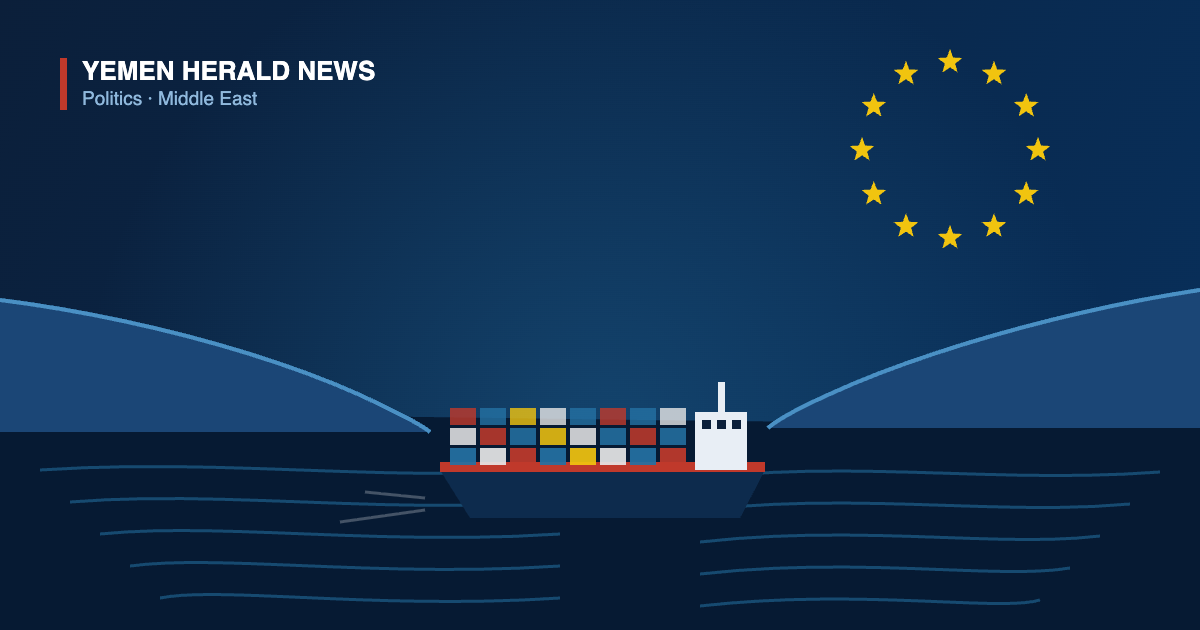
Yemen Herald editorial illustration
The European Union and the Gulf Cooperation Council have drawn markedly closer over the past five months in response to Iranian attacks on commercial shipping and on Gulf territory, issuing joint statements that commit both blocs to defending freedom of navigation through the Strait of Hormuz. The most detailed of those texts emerged from Brussels on 13 July 2026, when the EU High Representative for Foreign Affairs and Security Policy, Kaja Kallas, and Bahrain’s Foreign Minister, Abdullatif bin Rashid Al Zayani, co-chaired a High-Level Forum on Regional Security and Cooperation. Al Zayani attended as president of the GCC Ministerial Council, and the two issued a joint statement in the names of both blocs.
That statement condemned in the strongest terms the attacks carried out by Iran against commercial vessels passing through the Strait of Hormuz and against the sovereign territory of states in the region. It named Bahrain, Kuwait, the United Arab Emirates, Qatar, Oman and Jordan among those hit, and said the attacks had endangered civilian lives and the lives of mariners, violated international law and breached United Nations Security Council Resolution 2817. The two sides called the attacks wholly unjustifiable and extended full solidarity to the states affected and to seafarers of all nationalities placed in danger.
The legal core of the statement is a defence of passage rights. The EU and the GCC reaffirmed that freedom of navigation, including the right of passage through Hormuz as a strait used for international navigation, is guaranteed under international law as reflected in the United Nations Convention on the Law of the Sea. Those rights belong to the ships of all states and cannot be suspended, impeded or made conditional by any state. The co-chairs also rejected as unlawful any assertion of sovereignty or control over the strait, and opposed any regime of permits, transit tolls or service fees imposed on international shipping.
The demands directed at Tehran were specific. The statement called on Iran to cease immediately and unconditionally all attacks and all interference with maritime navigation, to keep the strait open without condition, toll or fee, and to comply fully with international law and with Resolution 2817. It urged states to work through the bodies responsible for maritime governance and safety, singling out the International Maritime Organisation, and closed by calling for restraint and reaffirming a commitment to dialogue and diplomacy.
The July text built on an extraordinary meeting of GCC and EU foreign ministers held on 5 March 2026, as the escalation across the Middle East widened. That session produced a joint statement in which the European Union reaffirmed its solidarity with GCC countries over Iran’s attacks against them.
One point of attribution needs correcting. Several accounts circulating in the region have credited the EU’s declaration of solidarity to Charles Michel, described as president of the European Council. That title is out of date. Michel led the European Council from December 2019 until the end of November 2024 and was succeeded on 1 December 2024 by the former Portuguese prime minister Antonio Costa, who holds the post today. Michel has continued to speak publicly about Iran since leaving office, telling the Free Iran World Summit in June 2026 that appeasing the Iranian leadership has not worked, but he does so as a private figure rather than an EU office holder. The Union’s formal positions are set by the European Council under Costa and voiced externally by Kallas.
The stakes explain the vocabulary. Hormuz is a narrow channel between Iran and Oman through which a large share of the world’s seaborne crude oil and liquefied natural gas is carried, and Gulf producers have no fully equivalent alternative route for most of that volume. Any sustained interruption is felt first in freight and insurance costs, then in energy prices well beyond the region.
The diplomatic track has run alongside open fighting. United States Central Command has conducted repeated waves of strikes on southern Iran through July, including on Qeshm Island, at Bandar Abbas and at Sirik near the strait, describing them as a response to Iranian attacks on shipping and on American forces. Iranian state media reported that strikes hit an airport, a railway station and bridges in the south of the country. The strikes followed Iranian missile and drone attacks on a base housing American troops in Jordan.
For Yemen the confrontation has a familiar shape. Houthi forces seized Sanaa in 2014 and a Saudi-led coalition intervened the following year in support of the internationally recognised government, and the group has since attacked vessels in the Red Sea and the Bab al-Mandab strait. The Yemeni government and Western states say the Houthis receive Iranian weapons and training, an allegation the group rejects. If passage through Hormuz is disrupted while Red Sea routing remains difficult, two of the region’s principal maritime corridors are under strain at once. That combination weighs most heavily on import-dependent economies, and Yemen brings in the overwhelming majority of its food and fuel through a small number of ports.
What the statements do not contain is an enforcement mechanism. Both rest on legal argument, coordination through maritime institutions and appeals for restraint, and neither says what either bloc would do if Iran ignored them. Whether the language changes behaviour in Tehran is unresolved, but it leaves the Gulf states with a written commitment from Brussels they did not have at the start of the year.
About the Author