US Strikes Qeshm Island as Iran Fires Missiles at American Base in Jordan
 Yemen Herald News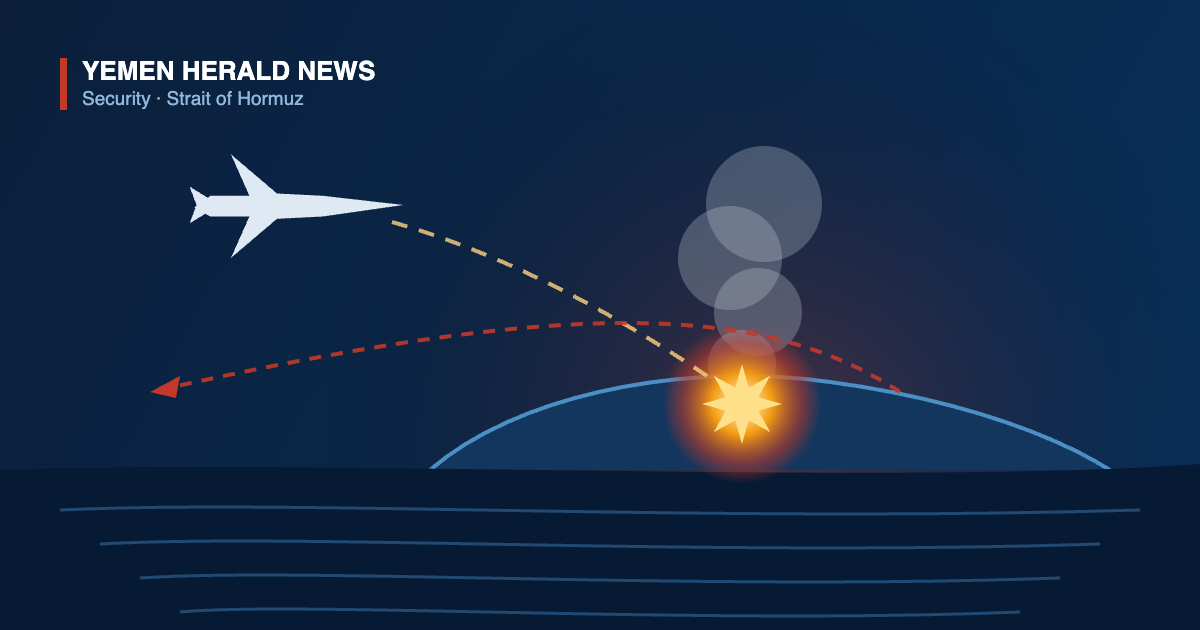
Iranian state media reported a series of explosions on and around Qeshm Island and the nearby port city of Bandar Abbas as the United States carried out a fresh round of strikes on Iranian targets. The state-run IRNA news agency said residents heard blasts shortly before 4 a.m. local time and that a site near Qeshm was hit at around 3:40 a.m. Early accounts reported no civilian casualties, but Iranian media later said a couple and their two-year-old child had been killed on the island. The United States has not confirmed those deaths.
US Central Command said fighter jets, drones and warships had used precision weapons against dozens of military targets on Qeshm Island and near Bandar Abbas, among them air-defence and coastal surveillance sites, logistics infrastructure and maritime capabilities. It said the operation was intended to degrade Iran’s capacity to threaten commercial shipping in the Strait of Hormuz and to punish Islamic Revolutionary Guard Corps units that had attacked American service members in Jordan. Iran has not confirmed the extent of the damage, and disputes American accounts of how effective the strikes have been.
Qeshm matters because of where it sits. The island lies just inside the Strait of Hormuz, the channel through which roughly a fifth of the world’s oil and gas moves in peacetime, and it has long been associated with Iranian naval infrastructure. Washington reimposed a naval blockade of Iranian ports near the strait earlier in the month, and Tehran has kept the waterway closed to much commercial traffic since the spring, forcing Gulf producers to curtail output.
The trigger for the latest American action came earlier the same week. The Revolutionary Guard launched multiple ballistic missiles at Muwaffaq Salti Air Base near Azraq in north-eastern Jordan at about 1:45 p.m. Gulf Standard Time on Wednesday. Central Command said air defences intercepted every missile and that there were no casualties or damage. It was Iran’s first ballistic missile attack on an American base since President Donald Trump paused the US bombing campaign the previous Friday to give diplomacy more room.
That pause had followed a far deadlier episode at the same base. Central Command said two American service members were killed on 17 July as US and partner forces defended against Iranian missile and drone attacks in Jordan, with a third soldier initially listed as missing; the Army later confirmed he had also been killed, bringing the toll at Muwaffaq Salti to three. A fourth service member died in Iraq the next day during the controlled detonation of a downed Iranian drone. They were the first American military deaths of the war since March.
Iraq has become the war’s newest theatre. Central Command said American and Saudi aircraft had struck militia logistics and weapons sites across eastern Iraq, calling it a response to more than 30 Guard-directed drone attacks in 72 hours, several aimed at oil facilities in Saudi Arabia’s Eastern Province. Iraq’s Popular Mobilisation Forces, the Iran-aligned paramilitary groups formally folded into the Iraqi security establishment, said at least 20 of its members were killed and 32 wounded, and condemned the operation as a violation of Iraqi sovereignty. It was the first time Riyadh has publicly claimed a role in strikes inside Iraq.
Energy markets responded quickly. Brent crude climbed back above $90 a barrel on Wednesday, gaining more than 6 percent, and edged higher again the following day. Traders were weighing the closure of the Strait of Hormuz, the widening of attacks into Iraq, and the vulnerability of the Red Sea routes shippers had been using instead. Prices had already spiked earlier in the month, briefly topping $100 a barrel after Yemen’s Houthi movement said it had struck two Saudi oil tankers, the Encelia and the Layla.
The group said large fires broke out on both vessels and reported no casualties. Saudi state media confirmed that the Encelia was hit while transiting the Red Sea, causing a fire at the bow, though the UK Maritime Trade Operations agency logged a strike on only one tanker. The Houthi military spokesman said the Bab el-Mandeb Strait was now closed to Saudi-flagged tankers. The group framed the campaign as retaliation for Saudi support of the American war effort and for the bombing of the runway at Sanaa international airport on 13 July, which Yemen’s internationally recognised government said it carried out to stop an Iranian aircraft landing.
For Yemen itself, the escalation lands on an already severe humanitarian emergency. The United Nations estimates that more than 22 million people need assistance and protection in 2026, including 5.2 million internally displaced. Some 18.3 million face acute food insecurity and more than 2.2 million children under five are acutely malnourished, while aid agencies have appealed for $2.16 billion to reach 12 million people this year. The UN secretary-general has urged the Houthis to stop attacking shipping.
Fighting on several fronts at once has narrowed the space for mediation. Trump said the earlier halt came at Iran’s request and warned that attacks would resume unless a ceasefire was reached, while Tehran’s foreign ministry said it had no negotiations under way with Washington and that its only formal talks were with Oman, over the Strait of Hormuz. The pause ended within days. Whether this exchange settles into contained retaliation or widens further remains the central question for the region and for the industries that depend on the Gulf staying open.
About the Author