Yemen’s Prime Minister Chairs Meeting to Align Trade and Finance Ministry Procedures
 Yemen Herald News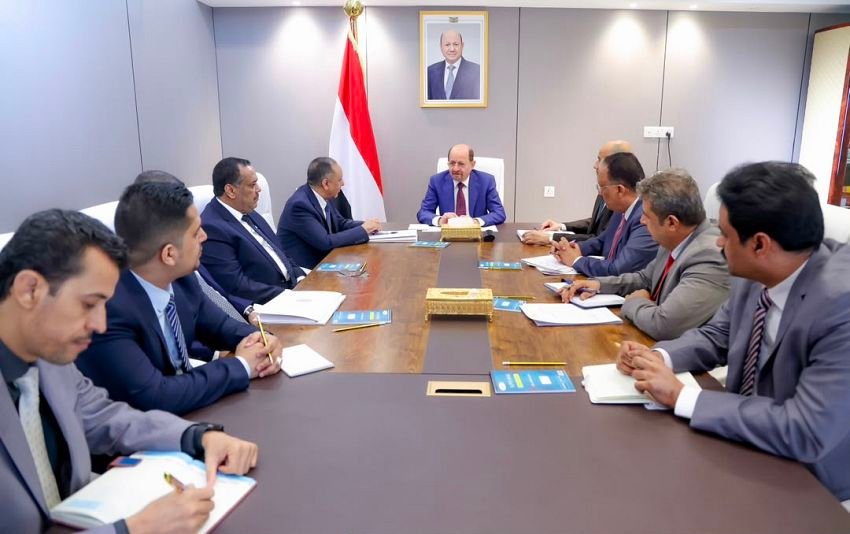
Yemen’s Prime Minister, Shaya Mohsen Zindani, chaired a joint meeting on Tuesday with the Minister of Industry and Trade, the Minister of Finance and senior officials from both ministries, convened to tighten coordination between the two departments and simplify the commercial procedures that businesses must navigate to import, clear and sell goods.
Customs formed the core of the discussion. Officials examined the procedures governing the movement of goods across Yemen’s borders and the overlapping administrative steps that slow clearance, with the stated aim of striking a workable balance between regulatory oversight and the practical need to keep commercial traffic moving. Where two ministries each require documentation covering the same shipment, the duplication adds cost and delay without adding much control, and reducing that overlap was presented as an immediate and achievable gain.
Zindani argued that governance during the current phase of the country’s recovery has to be collaborative rather than compartmentalised. He pressed for continuous coordination and faster information sharing between government bodies, and for clearly defined institutional roles, on the grounds that public sector performance improves when it is obvious which agency owns a decision. He also said enforcement of the existing laws and regulations governing economic activity must be synchronised across the relevant institutions, describing inconsistent application as a source of the bureaucratic friction that deters trade and investment.
The emphasis on enforcement rather than new legislation is notable. Yemen’s commercial statute book is not the binding constraint; the difficulty lies in applying it uniformly across a state whose institutions have been fragmented by more than a decade of conflict. Traders operating between governorates routinely encounter different interpretations of the same rule, and each divergence functions as an informal tax on moving goods.
The meeting comes at a point when the government’s economic position has improved from its recent low but remains fragile. The Yemeni rial, which had fallen to roughly 2,900 to the United States dollar in government-controlled areas, has recovered to around 1,400 to 1,500 following a package of measures that institutionalised import financing, restricted currency speculation and required the rial to be used in domestic transactions. The Central Bank of Yemen in Aden has conducted on-site inspections of exchange outlets and revoked licences from dozens of entities it found engaged in speculation.
That stabilisation has not translated into ease of doing business. Residents and traders in Aden and other government-held cities have reported an acute shortage of physical rial banknotes, with banks and exchange houses refusing conversions or capping daily transactions. A currency that has stopped falling but is difficult to obtain in cash creates its own drag on commerce, particularly for smaller importers who settle in cash and lack access to formal credit.
The country also continues to operate with two effective currencies. In areas under Houthi control, the older rial notes have traded in a much narrower band, between roughly 531 and 534 to the dollar through the first half of 2026, because the authorities there banned the newer notes printed by the Aden central bank. A single national market is therefore priced in two different currencies at rates that differ by a factor of nearly three, which complicates any attempt to standardise customs valuation or tax assessment across the country.
Against that backdrop, coordination between trade and finance carries direct fiscal weight. Customs and import duties are among the more reliable revenue streams available to the government, and revenue collection depends on the same procedures the meeting was convened to simplify. Faster clearance widens the tax base by drawing trade into formal channels; slow and unpredictable clearance pushes it toward informal routes where nothing is collected at all.
The prime minister’s involvement reflects the priority the cabinet has placed on economic administration. Zindani took office as prime minister in February 2026, moving across from the foreign ministry after the resignation of his predecessor, Salem Saleh bin Braik, and has framed institutional discipline and revenue management as central to the government’s programme. His government operates from Aden, which has served as the seat of the internationally recognised authorities since Sanaa fell outside their control.
Officials at the meeting discussed establishing a standing mechanism for coordination between the two ministries rather than relying on periodic high-level meetings to resolve disputes as they arise. A permanent channel would allow procedural conflicts to be settled at working level and would give traders a single point at which to raise problems, though its effectiveness would depend on whether it is given authority to make binding decisions or merely to make recommendations. Similar coordination bodies have been announced in the past without altering practice on the ground, and officials acknowledged that the value of any new mechanism lies in whether it is actually convened and whether its rulings are applied at the ports rather than in whether it is formally established.
No specific timetable or set of measures was announced at the conclusion of the meeting, and the government did not publish a list of the customs procedures identified for revision. What was described was a direction of travel rather than a decision: fewer overlapping steps, consistent enforcement across institutions, and clearer lines of responsibility. Whether those intentions produce measurable change will depend on implementation at ports and border crossings, where the procedures traders actually encounter are applied.
About the Author