Yemen’s Health Minister and WHO Consultant Review National Emergency Medical Teams Project
 Yemen Herald News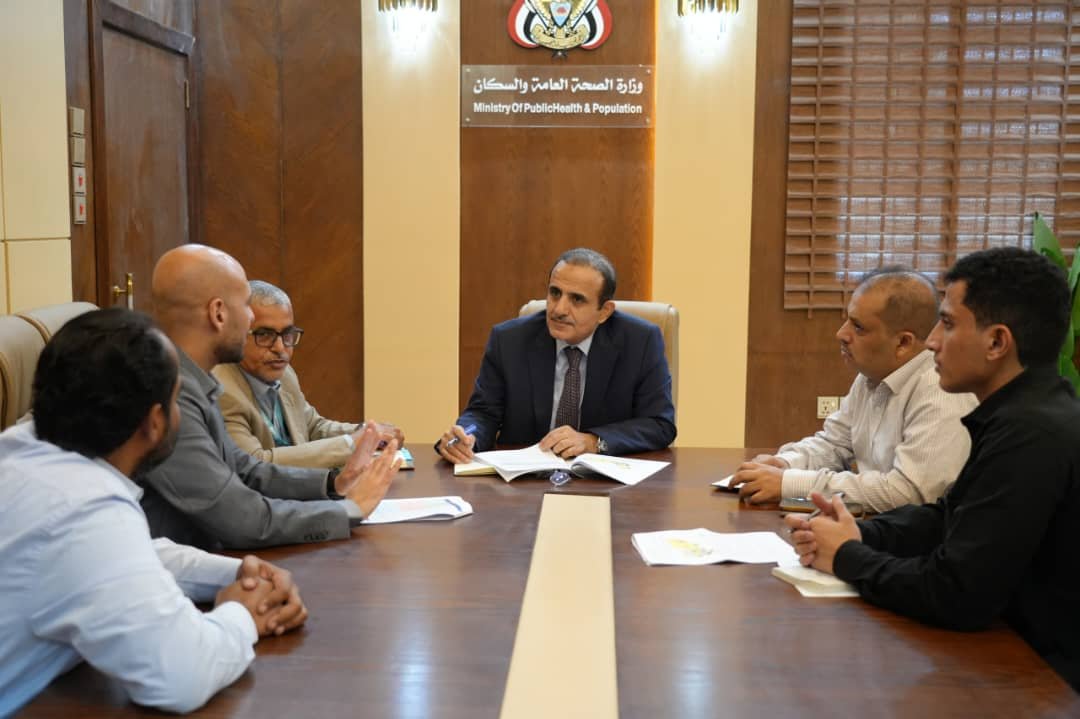
Yemen’s Minister of Public Health and Population, Dr. Qasem Buhaibeh, met in Aden with Dr. Mohammed Rashad, a World Health Organization consultant specialising in emergency and disaster medicine, to review progress on the country’s National Emergency Medical Teams project. The ministry said the two sides examined how far the programme has come in building trained national teams capable of responding to health emergencies and disasters in line with international standards.
The discussion centred on three practical questions: how quickly national teams can be mobilised once an emergency is declared, how command and coordination should work between the ministry and governorate health offices, and what sequence of training and equipment purchases the strategic development plan should follow. The ministry said the review covered both the capabilities already assembled and the gaps that remain before teams can be certified to a recognised standard.
Dr. Buhaibeh said the ministry remains committed to working with the World Health Organization on establishing qualified national emergency medical teams able to deliver prompt care across the governorates, describing the effort as a strategic necessity rather than a discretionary project and as an investment in the country’s wider health security.
The Emergency Medical Teams initiative is a World Health Organization framework that sets minimum standards for clinical teams deploying into disasters and outbreaks, covering everything from surgical capacity and infection control to the requirement that teams arrive self-sufficient rather than drawing on the resources of an already strained local health system. Countries that develop their own certified national teams reduce their dependence on foreign deployments, which typically arrive days after an emergency begins and leave once the acute phase passes.
For Yemen, that self-sufficiency argument carries particular weight. More than a decade of conflict has left the health system operating well below capacity. According to the United Nations Office for the Coordination of Humanitarian Affairs, close to 40 per cent of health facilities in the country are either only partially functional or not functioning at all, which limits access to both routine and emergency care for millions of people. Facilities that remain open frequently do so with intermittent electricity, shortages of medicines and staff who have gone long stretches without regular salaries.
The scale of need is substantial. OCHA’s 2026 humanitarian planning figures put the number of people requiring humanitarian assistance and protection in Yemen at 22.3 million, more than two thirds of the population. That total includes 5.2 million internally displaced people along with migrants, refugees and asylum seekers. Some 18.3 million people are assessed as acutely food insecure, and more than 2.2 million children under five are acutely malnourished. A further 14.4 million people need water, sanitation and hygiene assistance.
Those conditions are precisely the ones that generate the emergencies a national medical team would be built to absorb. Yemen has faced repeated large-scale cholera outbreaks since 2016, and vaccine-preventable diseases including measles and diphtheria have resurged as routine immunisation coverage fell during the conflict. Displacement camps, where sanitation infrastructure is often improvised, tend to amplify transmission and compress the time available to respond. Flooding during the rainy season regularly damages shelters and contaminates water sources in the same governorates.
Aden has served as the seat of the internationally recognised government since the capital, Sanaa, fell outside its control, and the Ministry of Public Health and Population operates from there. The division of health administration between authorities in Aden and those in the north has complicated national planning, and programmes designed to reach every governorate depend heavily on the cooperation of international agencies that maintain access across the front lines.
Funding remains a persistent constraint on any such plan. The United Nations and its partners have appealed for 2.16 billion dollars to reach 12 million people in Yemen during 2026, with 9.4 million of those prioritised for targeted assistance on the basis of severity of need. Yemen’s humanitarian appeals have been chronically underfunded in recent years, and shortfalls have forced agencies to cut programmes mid-year, including health services. A national emergency medical team capability, once established, would represent a comparatively durable asset that does not have to be renegotiated with donors each cycle.
Practically, certification under the WHO framework would require Yemen to define team composition, standardise clinical protocols, establish a roster of trained personnel who can be recalled at short notice, and maintain pre-positioned stocks of equipment and supplies. It would also require a functioning national coordination cell able to receive requests from governorates and match them to available teams. The ministry indicated that the strategic plan under discussion addresses these components in phases rather than attempting them simultaneously. Sequencing matters in a system with limited absorptive capacity: training staff for whom no equipment yet exists, or stockpiling supplies before a recall roster is in place, tends to produce paper capability rather than teams that can actually deploy. Phasing also allows each element to be tested on a smaller emergency before the system is relied upon at scale.
Neither the ministry nor the World Health Organization has published a timeline for when the first Yemeni teams might be certified, and the meeting in Aden was described as a review of progress rather than the announcement of a new phase. The ministry said work on building team capabilities and refining rapid response mechanisms would continue, and thanked the World Health Organization for its technical support to the health sector.
About the Author