Reports say Houthi drone expertise is spreading across the Red Sea to Sudan
 Yemen Herald News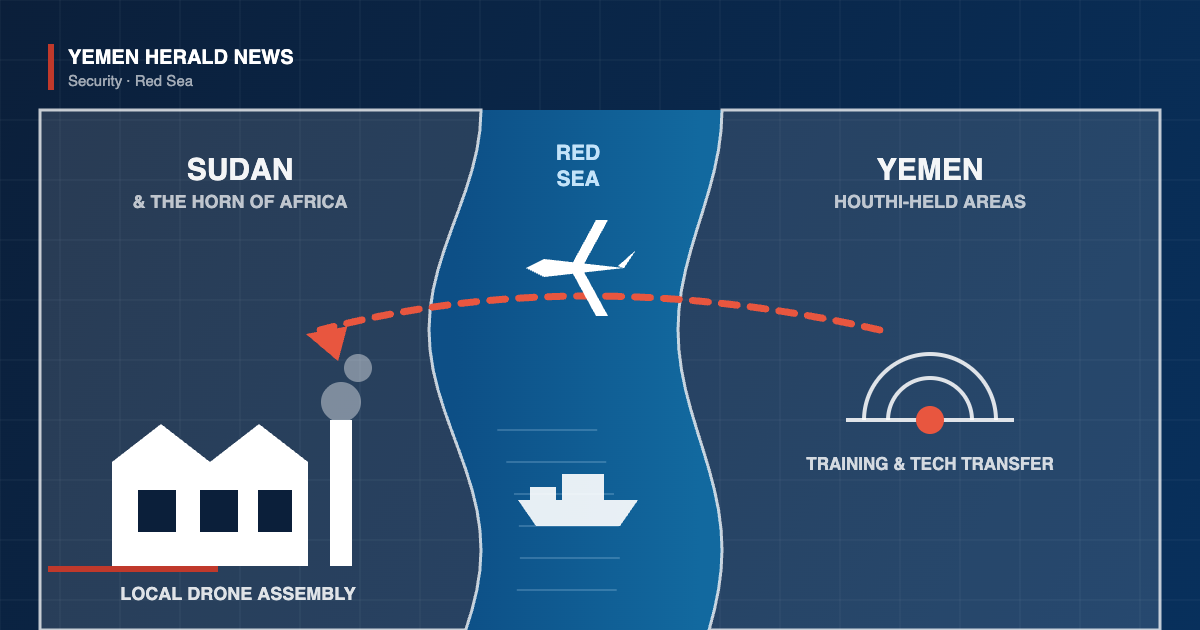
Yemen’s Houthi movement has moved from being a recipient of Iranian military technology to a supplier of the expertise behind it, according to regional and Western officials cited in a series of recent assessments of Iran’s position in the Red Sea and the Horn of Africa. The reported shift — from shipping finished weapons to teaching others how to build and operate them — would represent a change in the character of Tehran’s regional influence, and one that is considerably harder for outside powers to interdict.
The clearest example in the reporting concerns Sudan. Officials quoted in several accounts say Houthi operatives, working alongside elements of Iran’s Islamic Revolutionary Guard Corps, have been training Islamist factions aligned with the Sudanese army in the production and use of one-way attack drones. Houthi personnel have reportedly been observed in and around Port Sudan, the Red Sea city that has served as the Sudanese army’s administrative base for much of that country’s civil war. None of these claims has been publicly confirmed by the governments involved.
If accurate, the arrangement would matter for reasons of geography as much as capability. Port Sudan sits on the western shore of the Red Sea, roughly opposite the Arabian coast, and a foothold there would give Iranian-aligned actors positions on both sides of a corridor that carries a significant share of trade between Asia and Europe. Yemen already provides the eastern anchor of that corridor through Houthi control of much of the coastline north of Bab al-Mandab.
The Houthis’ own trajectory explains why they are in a position to teach. The movement began the war in 2015 with limited long-range capability and relied heavily on Iranian supply. Over the following decade it developed the ability to assemble drones and modify missiles locally, and it accumulated operational experience in launching them at ships, at Saudi Arabia and further afield. That combination — assembly know-how plus the practical experience of using the systems — is exactly what an armed group starting from a lower base would need.
Similar reporting has described Houthi instructors teaching basic drone operation to fighters from the Somali group al-Shabab at sites inside Yemen. Analysts who track the movement have noted that the exchanges are not purely ideological: Houthi networks have long-standing commercial and smuggling links across the Gulf of Aden, and training relationships have in some cases been described as transactional rather than doctrinal.
Iran’s own investment in Yemen appears to have continued in parallel. Reports published this year, sourced to officials speaking anonymously, describe Iranian aircraft delivering Revolutionary Guard commanders, military advisers and missile- and drone-related equipment to Houthi-held areas. The United Kingdom told the United Nations Security Council this month that Iranian aircraft have violated Yemeni airspace and called on Tehran to end what it described as long-standing support for the movement. Iran has consistently denied arming the Houthis.
For Sudan, the reported involvement sits within a wider realignment. Khartoum’s relations with Tehran, severed in 2016, were restored in 2023, and reporting since has described Iranian drone deliveries to the Sudanese armed forces. The step described in the newer assessments — local production rather than imported systems — would be more consequential, because it would survive interdiction of any particular shipment and would leave capability in place after external support ended.
Verification of any of this is difficult. The claims rest largely on unnamed officials and on analysts working from partial visibility, and the parties involved have obvious incentives to overstate or deny. What can be observed independently is the pattern of use: drone attacks in Sudan’s civil war have grown more frequent and more precise, and attacks on shipping in the southern Red Sea have continued despite years of interdiction efforts and naval deployments.
The practical difficulty for governments trying to respond is that expertise does not show up on a manifest. Interdiction regimes, including the United Nations arms embargo applying to the Houthis, are built around intercepting physical shipments. A trainer travelling on a commercial flight, or a set of assembly instructions, presents no comparable target. Officials quoted in the reporting have described this as the central reason the trend is treated as significant rather than incremental.
The immediate consequences are being felt at sea. A missile strike on the cargo vessel Tihama in the Bab al-Mandab Strait this month killed six people, including three Pakistani crew members, and a further missile struck the rescue operation. The UN special envoy warned the Security Council that Yemen risks being drawn into a wider regional conflict, and several member states condemned the attacks on shipping.
Inside Yemen, the escalation has coincided with renewed fighting on multiple fronts and with a humanitarian response that is contracting rather than expanding. Aid agencies have suspended field movements in parts of the west coast, and the International Organization for Migration has recorded more than 10,000 people displaced since January, over half of them from Marib.
Whether the reported transfer of expertise to Sudan turns into a durable capability there is not yet clear. What the reporting does establish is that the Houthi movement is being treated by regional and Western analysts as an exporter of military know-how rather than solely as a client, and that assumption is now shaping how Yemen is discussed in forums well beyond the country itself.
About the Author