Houthis renew ballistic missile strikes on Yemen’s Mokha port, government forces say
 Yemen Herald News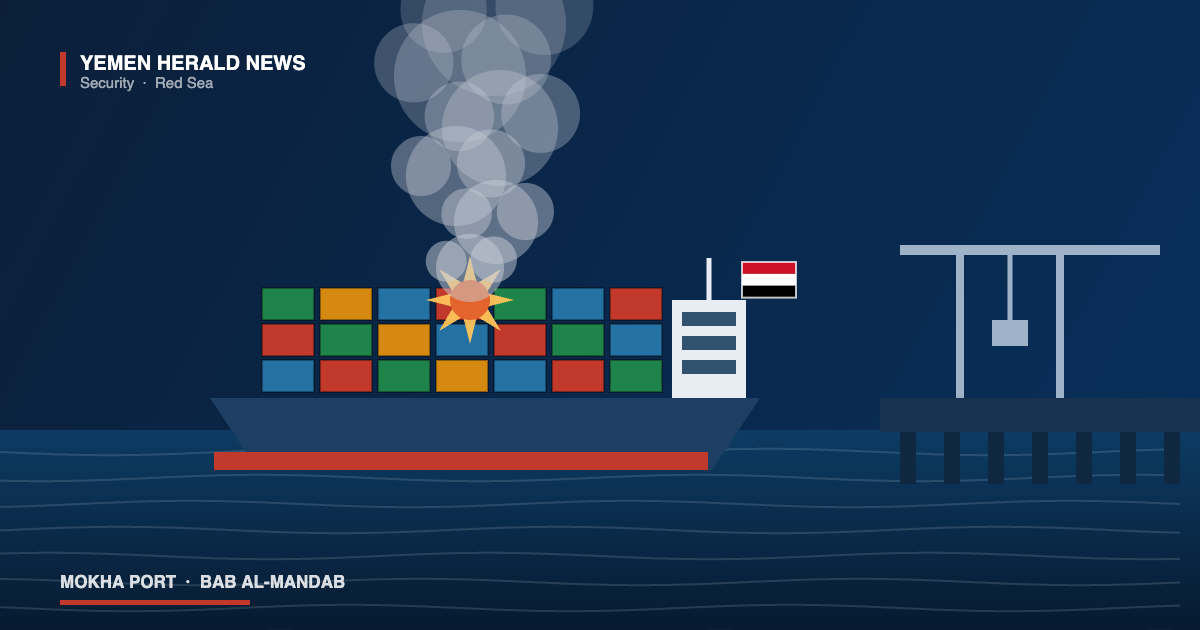
Yemeni government forces said Houthi fighters renewed ballistic missile attacks on the Red Sea port of Mokha on Wednesday, 12 August, striking a berth at one of the few sizeable maritime facilities still under government control on the country’s west coast. The state-run Saba news agency, which reports for the internationally recognised government based in Aden, carried a brief item saying the port had been targeted with ballistic missiles, without giving further detail.
Waddah al-Dubaish, spokesman for the government-aligned Joint Forces on the West Coast, said on the social platform X that two ballistic missiles struck the port’s marine berth at about 11.35am local time, or 08.35 GMT, according to preliminary information. He said authorities were still assessing the extent of the damage and whether anyone had been killed or wounded. There was no immediate comment from the Houthi movement on that particular strike.
The attack came a day after government forces said the Houthis had directed 10 ballistic missiles and four drones at Mokha. On the evening of Tuesday 11 August, the Houthi military spokesman, Yahya Saree, said in a statement carried by the Houthi-run Saba news agency that the group had struck what he described as military gatherings, weapons depots and command headquarters in the Mokha area, along with the Tadawin military camp in the central province of Marib. Government officials reject that description, saying the strikes have repeatedly damaged civilian infrastructure rather than military targets.
Mokha lies on the Red Sea coast of Taiz governorate, north of the Bab al-Mandab strait, and is one of the few working ports on the west coast held by forces loyal to the internationally recognised government. Its berths handle commercial cargo and serve a large local fishing fleet, and the town has been a forward position for the Joint Forces since they advanced north along the coastline in 2017 and 2018.
The renewed missile fire followed a far heavier barrage on 9 August, when missiles and drones struck the port and nearby residential areas. Al Jazeera reported that seven people, among them both military personnel and civilians, were killed and about 30 wounded, with extensive damage across the port area. The director of Mokha port said afterwards that the missiles had hit the berth where a dredger was moored, and that the intention appeared to be to disable and sink the vessel, wreck its equipment and halt maritime traffic at the facility.
The escalation has not been confined to land. On 11 August, a Houthi missile attack on a commercial vessel in the Bab al-Mandab strait killed three crew members, one of the most serious incidents involving merchant shipping in the waterway this year.
Attacks on Mokha continued after the 12 August strike. The government said that on Friday 14 August the Houthis fired six ballistic missiles at the town, killing at least four civilians and setting several fishing boats alight. Yemen’s armed forces said that round of fire again targeted civilian infrastructure and national assets at the port. The Houthis have generally framed their operations on the west coast as a response to what they describe as a Saudi military build-up and the reinforcement of allied forces there.
Yemen’s cabinet met on Tuesday 11 August in the interim capital, Aden, to weigh the consequences of the escalation for the country’s security, economy and humanitarian situation. Ministers reviewed the attacks on Mokha alongside strikes on sites in Hadramout, Marib and al-Dhalea, as well as attacks directed at Saudi Arabia. The government said afterwards that it would not tolerate attempts to impose a new reality by force.
The exchanges mark the sharpest deterioration in years. A UN-brokered truce that took effect in April 2022 was never formally extended beyond that October, but it delivered a long period of relative calm on most front lines. That calm began to break down in early July 2026, when intermittent clashes resumed and left dozens of people dead and wounded. The Houthis have controlled the capital, Sanaa, and a string of northern provinces since September 2014.
The humanitarian backdrop is severe. In its 2026 Humanitarian Needs and Response Plan, the UN Office for the Coordination of Humanitarian Affairs estimated that more than 22 million people in Yemen require humanitarian assistance and protection services, including 5.2 million internally displaced people. Some 18.3 million people are acutely food insecure, and more than 2.2 million children under five are acutely malnourished. The UN and its partners are seeking 2.16 billion dollars to reach 12 million people this year.
Damage to Mokha’s berths carries consequences beyond the town. Yemen imports the overwhelming majority of its food and fuel, and disruption at any functioning port narrows the routes through which commercial and relief cargo can reach the population. Insurance costs and the willingness of shipowners to call at Yemeni terminals are sensitive to incidents of this kind.
The Bab al-Mandab strait remains one of the world’s most closely watched maritime chokepoints, linking the Red Sea to the Gulf of Aden and, through the Suez Canal, to European markets. Sustained attacks in and around the strait push carriers towards the longer route around the Cape of Good Hope, with knock-on effects for freight rates and delivery times. Whether the current round of fighting widens further is likely to become clearer in the coming weeks.
About the Author