Yemen’s health minister orders costed emergency preparedness plans in every governorate
 Yemen Herald News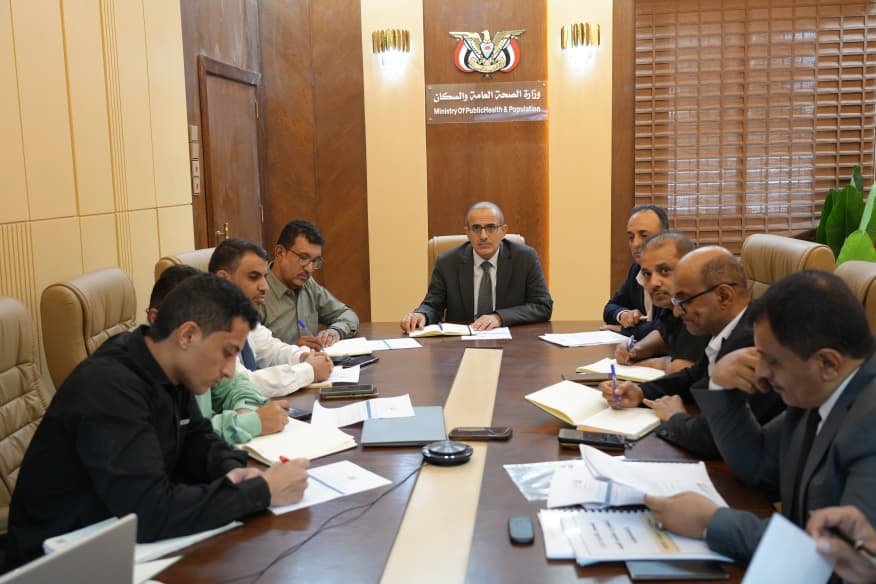
Yemen’s Minister of Public Health and Population, Dr. Qasim Buhaibeh, has called on health authorities across the country’s governorates to draw up detailed, costed emergency preparedness plans, warning that the health system’s ability to absorb a sudden outbreak or a mass-casualty event depends almost entirely on planning done before the emergency arrives. The ministry said the minister made the appeal during a meeting with directors of governorate health offices, at which officials reviewed the capacity they currently have and set out where the largest gaps lie.
Buhaibeh told the meeting that preparedness plans have to be practical rather than declaratory, and that they must work at both the central and the local level. According to the ministry’s account of the meeting, he asked directors to build their plans around a realistic inventory of what each governorate actually holds — the number of functioning hospital beds, the availability of doctors, nurses and paramedics, stocks of essential medicines, and the state of ambulance and referral networks — rather than around what the system was designed to provide before the war.
That distinction matters in a country where much of the health infrastructure no longer works as intended. The World Health Organization estimates that only around 60 per cent of Yemen’s health facilities are fully functional, a figure that has shifted little in recent years and that leaves millions of people dependent on a small number of overstretched referral hospitals. Where facilities have closed or lost specialist staff, patients travel long distances, sometimes across active front lines, or go without care altogether.
The emphasis on emergency planning comes as Yemen continues to face several disease outbreaks at once. WHO has described the country as experiencing concurrent epidemics of cholera, measles, dengue fever and polio, driven by low routine immunisation coverage, unsafe water and sanitation, mass displacement and restricted access to treatment. Yemen has recorded the world’s highest cholera burden, according to the United Nations, and measles has continued to kill children in areas where vaccination campaigns have been interrupted.
Coordination was the meeting’s second theme. Buhaibeh said stronger communication between governorate health offices and the central ministry would allow limited supplies and staff to be directed to the facilities best placed to handle emergency cases, instead of being spread thinly across sites that cannot treat serious injuries. He also pressed for closer working between the health sector and the other agencies involved in emergency response, on the grounds that outbreak control, water and sanitation, and food security cannot be separated in practice.
For their part, the health directors set out what they lack. They presented an overview of the resources currently available in their governorates and identified gaps they said require action by the central government, including shortages of medicines, fuel for generators and ambulances, and health workers who have gone unpaid or left the sector. Several argued that plans drawn up centrally tend to miss local realities, and that decisions on where to place stockpiles or surge teams should reflect the specific risks each governorate faces — flooding in some areas, front-line casualties in others, and seasonal cholera transmission in most.
The push follows a series of steps by the ministry and its international partners to put more formal structures around emergency response. In August 2026 the ministry convened the first meeting of a National Emergency Medical Team steering committee, supported by WHO and the European Union, intended to give Yemen its own rapidly deployable medical capacity rather than leaving it reliant on international teams. A month earlier, the government held the third steering committee meeting of a Pandemic Preparedness and Response Project run with WHO, UNICEF and the Food and Agriculture Organization, aimed at strengthening the country’s ability to detect and contain new health threats through a coordinated approach across human and animal health.
Funding remains the binding constraint. WHO has appealed for US$38.8 million to deliver emergency health assistance to 10.5 million people in Yemen during 2026, and has acknowledged that shrinking resources have forced it to prioritise the most critical, life-saving interventions and scale back support elsewhere. The wider health cluster went through a substantial reprioritisation in 2025, cutting its financial requirement from US$262 million to US$171.6 million and reducing the number of people it aimed to reach from 10.5 million to seven million. WHO has warned that further reductions in services would translate quickly into preventable deaths and outbreaks that are harder to bring under control.
The ministry has said the planning effort sits within a broader National Health Strategy for 2026 to 2030, which includes a proposal for a national health financing fund intended to make the sector less dependent on year-to-year donor decisions. Whether that materialises will depend on public revenues and political conditions largely outside the health ministry’s control.
Yemen’s health system also remains administratively divided, with separate authorities operating in areas held by the internationally recognised government and in areas under Houthi control — a split that complicates disease surveillance, procurement and the movement of medical supplies across the country. Aid agencies have repeatedly said that outbreak data and vaccination coverage are hardest to establish precisely where need is greatest. Against that backdrop, the ministry’s argument is a comparatively modest one: that plans grounded in an accurate picture of what each governorate can actually do, and agreed before the next emergency, will save time the system does not have once one has already begun.
About the Author