Yemen’s Foreign Minister Afrah al-Zouba Meets Saudi Counterpart in Riyadh to Deepen Strategic Partnership
 Yemen Herald News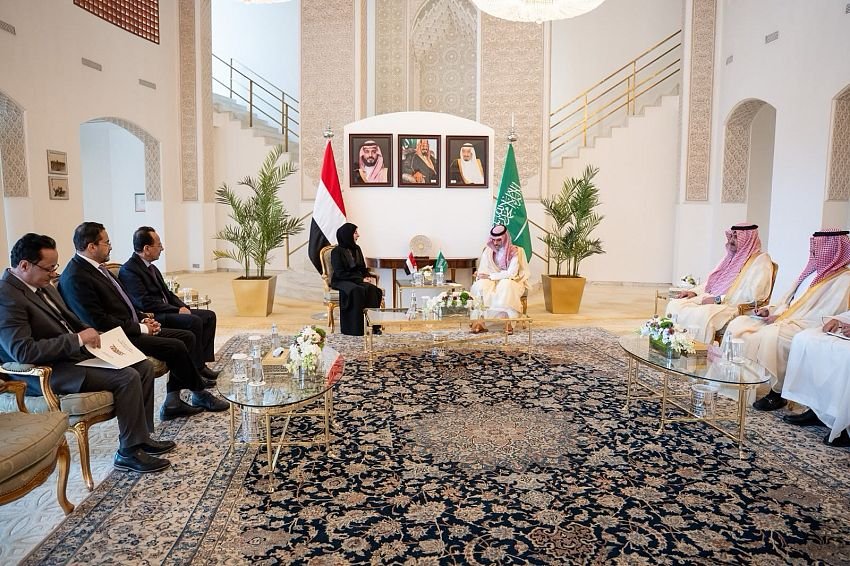
Yemen’s Minister of Foreign Affairs and Expatriates, Dr. Afrah al-Zouba, held talks in Riyadh with Saudi Arabia’s Foreign Minister, Prince Faisal bin Farhan Al Saud, on deepening the strategic partnership between the two countries and on the security challenges both governments say they now face. Yemen’s state news agency Saba reported the meeting, and the Saudi Press Agency published its own account, describing discussions that ranged across bilateral relations, institutional cooperation between the two foreign ministries, and the Yemeni government’s response to renewed Houthi military activity.
Al-Zouba conveyed the appreciation of Yemen’s leadership and people for what she described as Saudi Arabia’s sustained political, economic and development support. Riyadh has been the principal external backer of Yemen’s internationally recognised government since the war escalated in 2015, and it hosts much of the country’s political leadership. The Presidential Leadership Council that now heads the government was formed in the Saudi capital in April 2022, and Saudi financial support to the Central Bank of Yemen in Aden has been one of the few dependable props under a public budget badly weakened by the loss of crude oil exports.
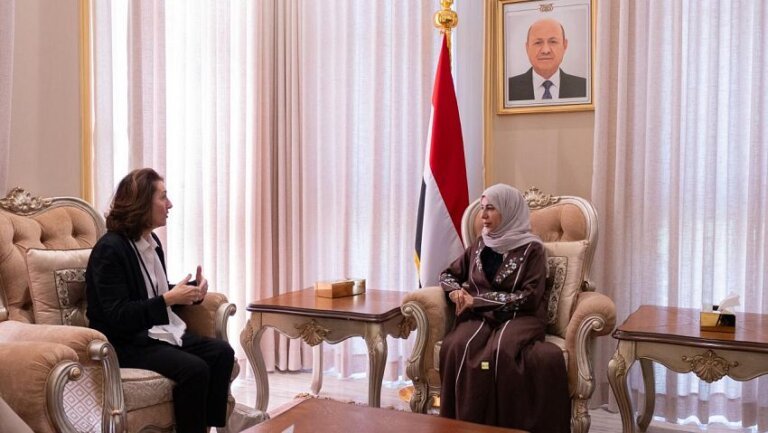
The meeting counted among the earliest foreign engagements of al-Zouba’s tenure. She was appointed foreign minister in July 2026, becoming the first woman to hold the portfolio in Yemen’s history, an appointment that drew considerable international attention at a moment when the government is trying to widen its diplomatic reach. Since taking office she has concentrated on the Gulf and Arab capitals that carry the most weight in Yemen’s file, meeting the Secretary-General of the Gulf Cooperation Council, Jasem Albudaiwi, in Riyadh in early August, and holding talks with the Secretary-General of the League of Arab States shortly afterwards.
A practical strand of the Riyadh discussions concerned cooperation between the two foreign ministries themselves. The ministers examined how Saudi diplomatic experience might be used to train and qualify Yemeni diplomatic staff, a form of capacity building that matters more than it may appear. Years of conflict have hollowed out Yemeni state institutions, and the foreign service has been among the casualties, with missions abroad understaffed and under-resourced. Building a professional diplomatic corps is closely tied to the government’s ability to argue its case in international forums, secure funding and manage the affairs of Yemenis living overseas.
The expatriate half of al-Zouba’s brief was also on the agenda. Saudi Arabia hosts one of the largest Yemeni expatriate communities in the world, and money sent home by Yemenis working abroad remains one of the country’s most significant sources of foreign currency, in many households outweighing any income earned inside Yemen. Arrangements affecting residency, employment and the transfer of remittances therefore carry direct consequences for ordinary families, and successive Yemeni governments have treated them as a standing item in dealings with Riyadh.
A substantial part of the meeting was given over to what the two governments characterised as a recent escalation by Houthi forces. Al-Zouba rejected attacks directed at Saudi territory and said Yemen’s government opposes any operation that threatens the Kingdom’s security, adding that Yemeni soil should not serve as a launching ground for hostile activity against neighbouring states. Those characterisations reflect the position of the internationally recognised government; the Houthi authorities in Sanaa describe their operations in different terms, and independent verification of individual incidents is often difficult.
Prince Faisal, for his part, reaffirmed the Kingdom’s support for Yemen’s internationally recognised government and for the Presidential Leadership Council, and restated Saudi backing for Yemen’s security, stability, unity and territorial integrity. That formulation has been a constant of Saudi public messaging on Yemen, and it carries weight domestically because questions of unity and territorial integrity remain contested, particularly in the south, where the Southern Transitional Council retains its own political demands while sitting inside the leadership council.
The talks unfolded against a humanitarian emergency that continues to deepen. In its 2026 Humanitarian Needs and Response Plan, the United Nations Office for the Coordination of Humanitarian Affairs estimated that more than 22 million people in Yemen require humanitarian assistance and protection this year, among them 5.2 million internally displaced people. Some 18.3 million people are judged acutely food insecure, and more than 2.2 million children under five are acutely malnourished. Aid agencies appealed for 2.16 billion dollars to reach 12 million of those in need, a plan that, like its predecessors, has been chronically underfunded.
Economic conditions have compounded the strain. Government-held areas have contended with a sharply depreciated currency, recurrent fuel and cooking gas shortages and long interruptions to electricity supply, while salaries for public employees have gone unpaid or arrived late. External budget support and predictable fuel deliveries have consequently become as central to the relationship with Riyadh as any security question, and Yemeni officials have repeatedly framed economic stabilisation as the precondition for any durable political recovery.
Neither ministry announced new agreements, financial commitments or a timetable arising from the meeting, and the published accounts described it in the general language customary for such encounters. No breakthrough in the United Nations-mediated peace process has been announced, and the roadmap negotiated in earlier rounds of Saudi-Omani diplomacy remains unimplemented. What the Riyadh talks did register was continuity: a new foreign minister making an early call on Yemen’s most important regional partner, and both sides restating positions that have defined the relationship for several years.
About the Author