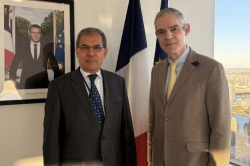
EU ambassador Simonnet warns Yemen must not become an arena for regional rivalries
 Yemen Herald News
The European Union’s ambassador to Yemen has warned that the country must not be allowed to become a battleground for regional rivalries, urging international and regional actors to back de-escalation and a political settlement rather than pursue competing agendas through Yemeni proxies.
Patrick Simonnet made the remarks in an interview with the South24 Center for News and Studies, reported from Aden on Monday. He argued that a durable outcome in Yemen depends on preventing further internal fragmentation and on halting the erosion of state institutions, which he framed as the machinery any eventual agreement would have to be implemented through. A settlement signed over a hollowed-out administration, on that reading, would have little practical effect.
Simonnet took up the post on 1 September 2025. He is a career EU diplomat who previously served as the bloc’s special envoy for the Mediterranean between 2023 and 2025, and as EU ambassador to Saudi Arabia from 2020 to 2023, having earlier headed the External Action Service’s Horn of Africa division and represented the EU in Iraq. The delegation he leads has widened its presence inside Yemen over the past year: in May the EU marked Europe Day in Aden for the first time since the war began, and Simonnet completed a week-long visit to Taiz around the same period.
A substantial part of the interview concerned southern Yemen. Simonnet described the southern question as a politically important and complex matter that needs to be addressed seriously rather than deferred, and said southern voices and perspectives should be given genuine and meaningful representation in any inclusive political process. He added that a sustainable settlement would have to reflect the diversity of the south, and that Yemenis themselves should determine the mechanisms for resolving the issue rather than have a formula imposed from outside.
He welcomed the call by Rashad al-Alimi, chairman of the Presidential Leadership Council, to convene a southern dialogue conference, and Saudi Arabia’s offer to host it. That proposal is the most concrete attempt so far to reopen a formal channel on the constitutional status of the south, a question successive rounds of UN-brokered negotiation have set aside in favour of first securing a nationwide ceasefire.
The context for those remarks is a sharp change in southern politics since December 2025. On 2 January 2026 Aidarous al-Zubaidi, then president of the Southern Transitional Council and deputy chairman of the Presidential Leadership Council, issued a unilateral constitutional declaration announcing a two-year transitional phase to be followed by a referendum on southern self-determination. The council treated the move as a rebellion, and on 7 January al-Alimi issued a decree expelling him from the leadership council and referring him to the public prosecutor on charges including high treason. Al-Zubaidi ceased to head the STC two days later.
The rupture removed the main institutional channel through which southern separatist opinion had been represented in the recognised government’s leadership since the council was formed in 2022. That absence gives the ambassador’s insistence on meaningful southern representation its weight: the mechanism that previously performed the function no longer exists in the same form, and the dialogue conference al-Alimi has proposed would be the vehicle for rebuilding one. Southern political currents remain divided over whether to take part.
The interview ranged wider than the south alone. Simonnet also discussed developments in southern Yemen since December 2025, the future of the political process and the shape of regional competition around the country, alongside Red Sea security, files the EU has increasingly treated as one problem rather than separate tracks.
Simonnet also addressed maritime security. He highlighted recent attacks on shipping and referred to the role of the EU’s two naval operations in the region, Aspides, established in 2024 to escort and protect merchant vessels in the Red Sea and Gulf of Aden, and Atalanta, the longer-running counter-piracy mission off the Horn of Africa, as well as the bloc’s position on the Saudi-led multinational naval coalition operating in the same waters.
Those comments land at a difficult moment for the corridor. Attacks attributed to the Houthis have resumed after the collapse of the truce that had broadly held since 2022, and a cargo ship transiting the Bab al-Mandab Strait was struck by missiles in early August with the loss of six lives, the first reported fatalities from attacks on Red Sea shipping in more than a year. Yemeni officials have also reported a missile attack on Mokha port on the south-western coast.
On assistance, the ambassador discussed European support for economic recovery, human rights and media freedom, and underlined the EU’s intention to maintain a presence and a partnership inside the country rather than operate at a distance. The delegation’s return to working from within Yemen, after years in which much diplomatic activity was conducted from Riyadh, Amman or Brussels, is presented as part of that commitment.
The EU is not a mediator in the Yemeni file, where the lead sits with the UN special envoy, Hans Grundberg, and where Saudi and Omani channels have carried much of the substantive negotiation. Its influence rests instead on funding, on its naval presence and on its weight as a donor and trading partner. Simonnet’s argument, that regional actors should coordinate rather than compete and that no military outcome will substitute for a negotiated one, is therefore addressed as much to Yemen’s external backers as to its domestic factions.
About the Author