Eight people were killed in a Houthi missile attack on Mokha port
 Yemen Herald News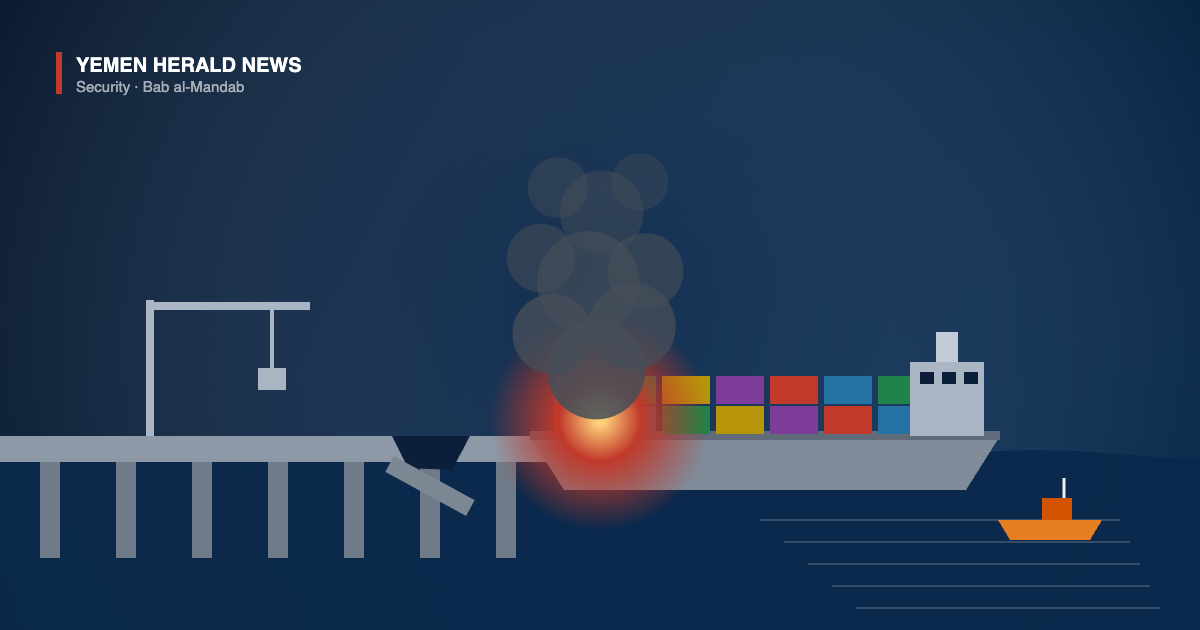
Eight people were killed in a Houthi missile attack on Mokha port on Yemen’s south-western coast, according to a Yemeni military official, in a strike that set commercial vessels alight at the quayside and renewed concern about the safety of a waterfront lying close to the Bab al-Mandab Strait.
The official said five missiles were fired at two commercial ships that had docked at the port to unload cargo, igniting fires that engulfed both vessels. He put the dead at two security officers and six civilians. The attack took place on Friday, and the casualty figures were carried the following day by Yemeni outlets citing the military official. No independent assessment from the site itself has been published, and the numbers should be read as the government’s account rather than a confirmed toll.
Mokha sits in the western part of Taiz province, on the stretch of coastline facing the southern approaches to the Red Sea. Its harbour is one of the few commercial entry points on that coast held by forces aligned with the internationally recognised government, rather than by the Houthi authorities who control the larger port of Hodeidah further north. That position has made it both a practical lifeline for imports into the south-west and an exposed target.
Control of the Mokha area rests with forces on the Red Sea coast commanded by Tariq Saleh, a member of the Presidential Leadership Council, whose units have held the town and its surroundings since the west-coast campaign of 2017 and 2018. The port was subsequently reopened to limited commercial traffic, and its handling role has grown as an alternative to routes running through Hodeidah.
The Houthi movement gave a different description of what it had hit. Its military spokesman, Yahya Saree, said the group had targeted Saudi military reinforcements and warboats at Mokha with a large number of ballistic missiles, and claimed precise hits that destroyed vessels and weapons and caused what he called dozens of casualties. The two accounts cannot be reconciled: the government describes civilian cargo ships being unloaded, while the Houthis describe a military resupply operation. Neither version has been independently verified.
Yemen’s Ministry of Health condemned the attack and warned that damage to ports and other vital infrastructure carries costs beyond the immediate material and economic loss. Strikes on harbours, it said, directly threaten food security, the functioning of the health system and the humanitarian supply chains much of the population depends on. The ministry did not publish a separate casualty count.
That warning reflects a structural vulnerability. Yemen imports the large majority of its food, fuel and medicine, and almost all of it arrives by sea. Damage to a berth, a crane or a fuel line can translate quickly into shortages far inland, and the cost of rerouting cargo to alternative harbours is usually passed on to consumers in a country where a majority of households already struggle to afford a basic diet.
The strike came during the sharpest escalation in Yemen in several years. The Houthis have suspended the truce with the Yemeni government that had broadly held since 2022, and fighting has resumed along a number of fronts. Yemeni military sources have reported repeated missile salvoes aimed at government positions near Bab al-Mandab and, separately, at the city of Marib, while government forces say they are carrying out drone strikes on Houthi command posts in Taiz province.
The escalation has also drawn Yemen back into a wider confrontation. The Houthis said they had struck an Aramco facility in Najran, in south-western Saudi Arabia, with a drone, and had hit the company’s refinery at Jazan the previous day. Saudi authorities did not immediately confirm damage at either site. The claims place the group’s operations within the broader regional standoff involving Iran and the United States that has intensified through 2026.
At sea, the picture has deteriorated in parallel. On 11 August the Egyptian-owned cargo ship Tihama was struck by ballistic missiles while transiting the Bab al-Mandab Strait, and a further missile hit the site while rescue personnel were evacuating casualties. Six people were killed, among them crew members and rescuers, and about ten were wounded. It was the first reported loss of life from attacks on Red Sea shipping in more than a year.
Taken together, the strikes on shipping in the strait and on the quayside at Mokha suggest a widening of the target set from vessels under way to port infrastructure itself. Insurers and operators had already priced additional risk into voyages through the southern Red Sea. Attacks on berths, and on cargo in the process of being discharged, raise the further prospect that ships avoid calling at Yemeni ports altogether, with consequences for the volume of goods reaching the country.
Several details remain unresolved. The identities and flags of the two vessels reported to have been hit have not been released, nor has any assessment of the damage to the port’s berths and handling equipment. It is also unclear how long operations at Mokha will be interrupted, though reporting in the days after the attack indicated the port was not working normally. Until an independent inspection is published, the scale of the disruption will remain a matter of competing claims.
About the Author