Houthis claim missile strike on Saudi landing ship off Yemen’s Mokha coast
 Yemen Herald News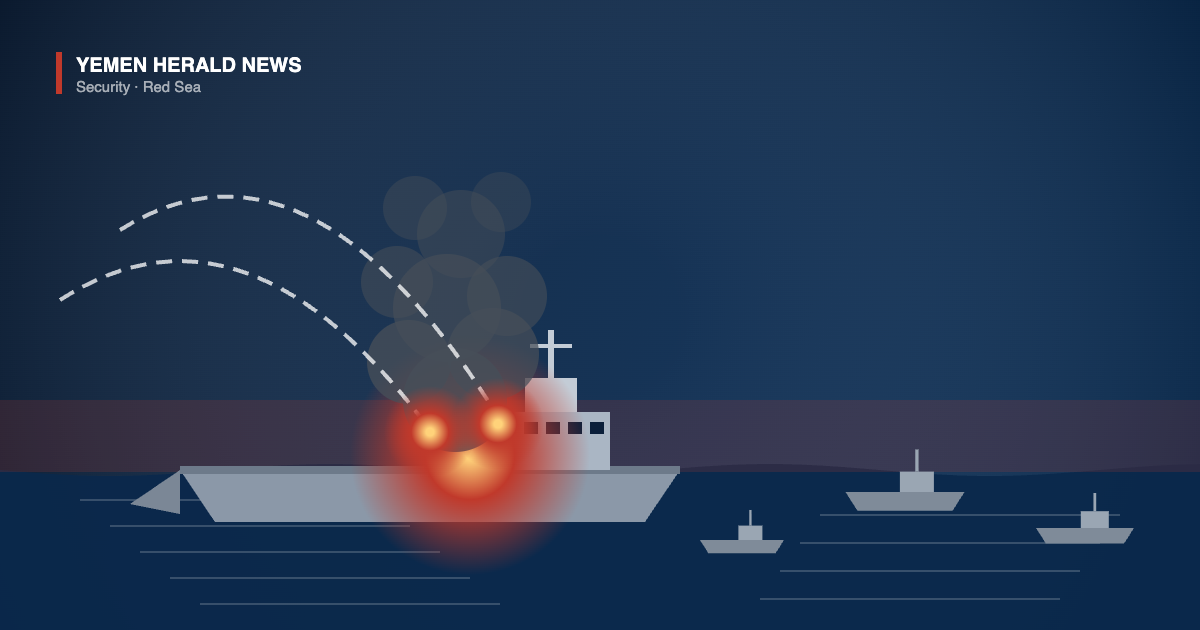
Yemen’s Houthi movement said on Monday that its forces had fired ballistic missiles at a Saudi military landing ship and four accompanying patrol boats in the Red Sea off the coast of Mokha, an attack the group presented as part of the maritime blockade it declared against Saudi Arabia last month. Saudi authorities did not confirm the strike in the hours that followed, and no independent assessment of the damage has been produced.
In a statement carried by Houthi-run media, the group’s military spokesman, Yahya Saree, said several ballistic missiles had been used against the landing ship and its four escorts. The accompanying military statement asserted that the landing ship had been completely burned, that several of the smaller boats had been sunk and that others had caught fire. Saree also said Houthi forces were monitoring Saudi naval movements along Yemen’s western coastline.
Those damage figures remain the claim of one party to the conflict. No imagery, salvage report or third-party verification has been offered to support the assertion that vessels were sunk, and Riyadh has acknowledged no losses. Battlefield tallies announced by combatants in Yemen have repeatedly proved hard to substantiate, and the outcome described by the Houthi military should be read as an unverified assertion.
The Houthis declared a maritime blockade of Saudi Arabia on 20 July, saying they would target Saudi shipping passing through the Bab al-Mandab Strait. That channel, which narrows to roughly 30 kilometres between Yemen and Djibouti, links the Red Sea to the Gulf of Aden and carries a substantial share of the cargo and energy traffic moving between Asia and Europe. Its exposure has grown more consequential in recent weeks, with the Strait of Hormuz effectively closed and Bab al-Mandab serving as an alternative artery for crude oil shipments.
Separately, Yemen’s internationally recognised government in Aden said Houthi forces had launched a barrage of missiles toward the Bab al-Mandab Strait and the country’s Red Sea coast on Monday. The Taiz military command said it detected two hypersonic ballistic missiles heading toward Mokha and the coastline, and said they had been fired from the former headquarters of the 170th Air Defence Brigade on Mount Oman, east of Houthi-controlled Taiz. Other Yemeni military sources put the number of launches higher and pointed to sites in Ibb province and the al-Houbban area east of Taiz. Those accounts have not been reconciled, and the government has not published evidence for either figure.
The UN Human Rights Office said missile and drone attacks on Mokha port in Taiz governorate on 9 August killed three port workers and injured four others, and that it was verifying reports of further attacks on the port on 14 and 15 August that may have caused additional civilian casualties. Photographs taken at the port on 10 August showed a partially destroyed warehouse and the navigation bridge of a sunken vessel protruding above the waterline. Fuel storage facilities and a residential compound at the Saudi field hospital in Mokha were also reportedly among the civilian sites hit.
On 11 August, a cargo ship was struck in the Bab al-Mandab Strait. The UN Human Rights Office said four crew members were killed, three Pakistanis and one Indonesian, and several others were injured. Yemen’s government put the toll at six, saying two Yemeni rescuers who reached the vessel also died. Earlier, on 7 August, a missile hit the Jaw al-Naseem camp for displaced people in Marib, injuring six civilians including a child, according to the same UN office.
The pattern prompted a public intervention from Geneva. UN High Commissioner for Human Rights Volker Turk said on Monday that he was alarmed by the rising civilian toll and urged all sides to “halt immediately any actions that risk returning Yemen to full-scale conflict”. His office recorded at least seventeen civilian casualties from Houthi attacks in government-held areas since 6 August, and two casualties in Houthi-controlled areas in late July.
The escalation follows the collapse of the relative calm that had held since the truce agreed in 2022, which had reduced front-line fighting even though it was never converted into a durable political settlement. Alongside the maritime attacks, the Houthis have claimed drone strikes on Saudi Aramco’s Jizan refinery, another assertion that has not been independently confirmed. Yemen’s government has described the sequence as a deliberate attempt to reopen multiple fronts simultaneously.
The humanitarian backdrop shapes how much any of this can be absorbed. The UN Human Rights Office says at least 18 million Yemenis are already food insecure, a figure that leaves little margin when ports, fuel depots and medical facilities come under fire. Aid agencies have warned for years that disruption to Red Sea port infrastructure translates quickly into higher prices and thinner supply in inland governorates that depend on imported staples.
For now the central claim of Monday’s announcement stands unconfirmed. Saudi Arabia has a long record of declining to comment on losses at sea, and unless wreckage, satellite imagery or an official statement emerges, the fate of the landing ship and its escorts is likely to remain contested. What is not contested is the direction of travel: missile and drone fire around Bab al-Mandab has risen sharply since July, narrowing the margin of safety for crews and coastal communities along the route.
About the Author