Al-Alimi meets Japan’s foreign minister in Riyadh on aid and Red Sea shipping security
 Yemen Herald News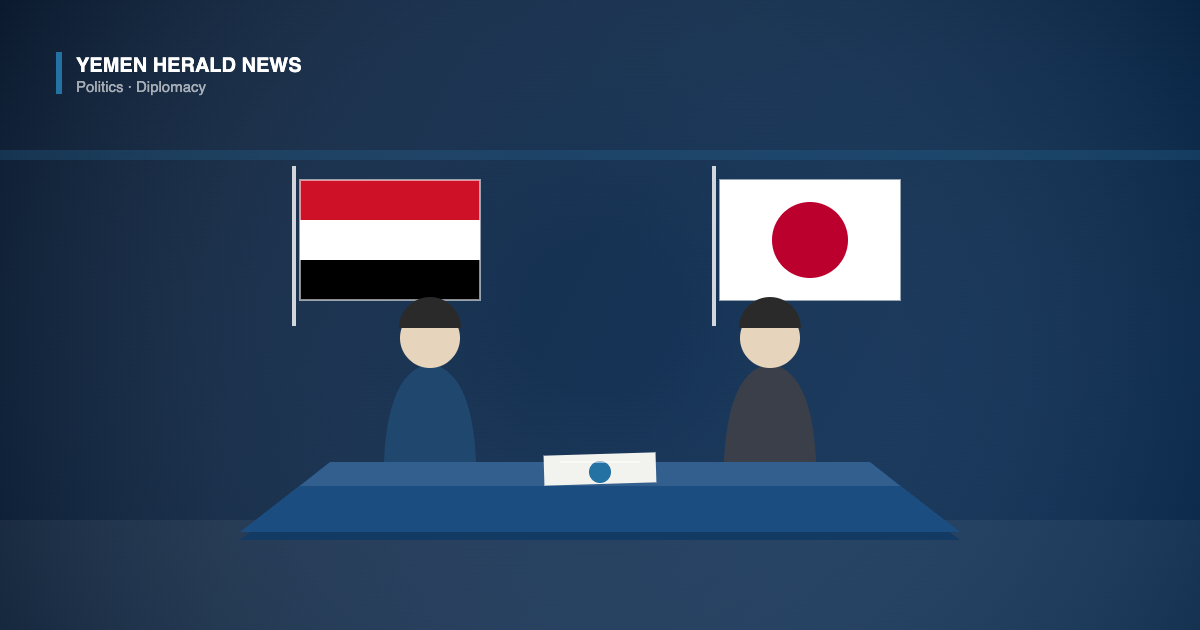
Yemen’s President Rashad Mohammed al-Alimi met Japanese Foreign Minister Toshimitsu Motegi in Riyadh on Tuesday for talks on Japanese assistance to Yemen and on the security of the shipping lanes running along the country’s western coast. The meeting formed part of a short regional tour by Motegi that Tokyo announced last week, taking in Saudi Arabia and Oman.
Japan set the trip up primarily around maritime access. Motegi was expected to press his Saudi and Omani counterparts on keeping navigation open and predictable through the Strait of Hormuz and the Bab al-Mandab Strait, the two chokepoints on which Japan’s energy imports depend. With Hormuz effectively closed in recent weeks, Bab al-Mandab has become an alternative route for crude oil moving out of the Gulf region, which places Yemen’s coastline at the centre of a calculation that reaches well beyond the country’s own war.
In Oman, Motegi was expected to argue against any charging of fees for passage through Hormuz. In Saudi Arabia, his discussions with Foreign Minister Prince Faisal bin Farhan were expected to cover Bab al-Mandab directly. The meeting with al-Alimi, whose Presidential Leadership Council is based in Riyadh, was framed by Japanese officials as a discussion of support for stabilisation in Yemen.
According to the Yemeni presidency, al-Alimi thanked Japan for what he described as long-standing and consistent support, and characterised Tokyo as one of the most significant donors to Yemen’s relief and development effort. He singled out assistance in education, healthcare and food security, three sectors where public provision has been hollowed out by more than a decade of conflict and where most services now depend on external funding.
The president also commended Japanese assistance to the Yemeni Coast Guard and asked for it to be expanded. He linked the request to training, equipment and surveillance capacity, and to the coast guard’s role in monitoring the country’s territorial waters, countering smuggling and interdicting the movement of weapons and fighters. Yemen’s government has argued for several years that its maritime services are the weakest link in its security architecture, and that building them is a precondition for any credible control of the coastline.
That argument has taken on immediate weight. The Houthis declared a maritime blockade of Saudi shipping through Bab al-Mandab on 20 July, and attacks in and around the strait have escalated since. A cargo ship struck on 11 August lost four crew members, three Pakistanis and one Indonesian according to the UN Human Rights Office, with Yemen’s government putting the toll at six including two Yemeni rescuers. The Red Sea port of Mokha, held by the Aden-based government, has been hit repeatedly this month.
Bab al-Mandab narrows to roughly 30 kilometres between Yemen and Djibouti, and everything moving between the Red Sea and the Gulf of Aden funnels through it. A coast guard capable of routine patrolling, incident response and search and rescue changes what happens in the minutes after a vessel is hit, which is the part of the problem that naval task forces operating further offshore are least able to solve.
Beyond security, al-Alimi raised cooperation in electricity and renewable energy. Yemen’s grid has been among the most visible casualties of the war, with generation capacity in government-held areas heavily dependent on imported fuel and on emergency arrangements that are expensive to sustain. Solar installations have spread widely at household and community level, but the government has struggled to convert that into planned generation at any scale.
The president framed the request as part of a broader shift he said Yemen needs to make, moving from emergency response towards recovery, job creation and durable development. He referred to Japan’s own post-war economic reconstruction and technological development as a point of reference for a country attempting to rebuild institutions after prolonged conflict. The presidency did not announce any new funding commitment arising from the meeting, and no joint statement was issued.
Japan has for years channelled much of its Yemen assistance through United Nations agencies and international organisations rather than through bilateral projects, an approach that reflects both the fragmentation of authority inside the country and the practical difficulty of implementing programmes across front lines. That structure has kept Japanese money flowing during periods when direct engagement was not possible, but it also limits how much the government in Aden can direct.
The talks took place against a sharply deteriorating backdrop. UN High Commissioner for Human Rights Volker Turk said on Monday that he was alarmed by the rising civilian toll of renewed hostilities and urged all parties to pull back, noting at least seventeen civilian casualties from Houthi attacks in government-held areas since 6 August. His office estimates that at least 18 million Yemenis are food insecure, a figure that frames every conversation about aid volumes and sequencing.
For the Presidential Leadership Council, meetings of this kind serve a dual purpose: securing practical assistance, and reinforcing the argument that Yemen’s coastline is now a shared international interest rather than a peripheral concern. For Japan, the calculation is more direct. Its shipping and energy supply routes pass within missile range of a war that has entered its most volatile phase in years, and its diplomacy in the region this month has been organised around keeping those routes usable.
About the Author