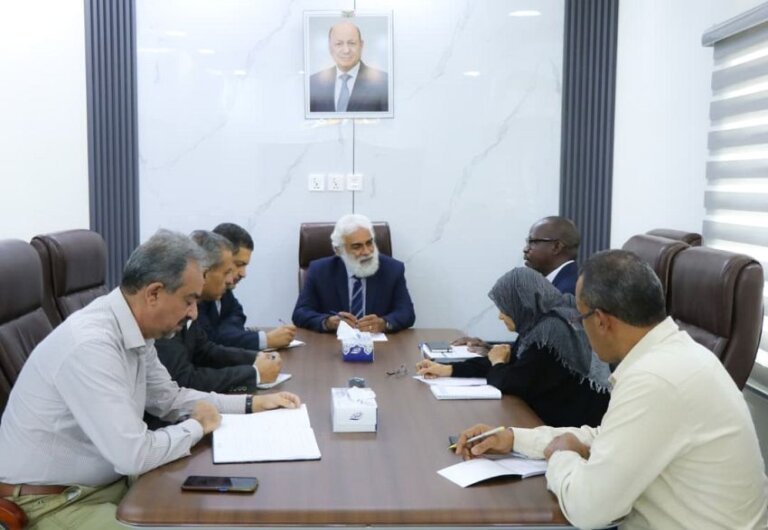
Yemen’s ambassador to Lebanon holds fresh Beirut talks on bilateral ties and developments at home
 Yemen Herald News
Yemen’s ambassador to Lebanon, Abdullah al-Duais, has held a further round of talks in Beirut on bilateral relations between the two countries and on recent political, security and humanitarian developments in Yemen. Yemen’s official news agency reported that the two sides reviewed the state of cooperation between Yemen’s internationally recognised government and Lebanon, and exchanged assessments of a regional environment that both describe as increasingly unsettled.
The session forms part of a steady pattern of activity by Yemen’s mission in Beirut through 2026. In July, al-Duais met the secretary-general of Lebanon’s Ministry of Foreign Affairs and Emigrants, Ambassador Abdel Sattar Issa, for discussions on coordination between the two foreign ministries. Later the same month he met Lebanon’s information minister, Paul Morcos, in talks that dealt in part with cooperation in the media sector. Both encounters were reported by the Yemeni foreign ministry and by the state news agency.
Those earlier meetings give a clear indication of the file the embassy carries into Lebanese offices. Al-Duais has used them to set out the government’s position on air traffic into territory controlled by the Houthi movement, arguing that flights arranged without the authorisation of Yemen’s civil aviation authorities amount to a breach of national sovereignty. He has also pointed to the government’s backing for a Jordanian proposal to operate regular services between Sana’a and Amman through internationally recognised procedures, presenting it as a way to ease pressure on civilians without conceding the licensing question.
Lebanese officials, in the readouts published after those meetings, voiced support for Yemen’s security, stability and unity. The phrasing is standard in Arab diplomatic exchanges and stops well short of specific undertakings, but it matters to a government that measures much of its foreign policy in expressions of recognition. Lebanon and Yemen maintain full diplomatic relations while conducting little practical business; trade between them is negligible and both states are absorbed by domestic emergencies.
Lebanon has spent the past several years managing the consequences of a financial collapse that began in 2019 and wiped out much of the banking sector’s deposit base, alongside the aftermath of fighting on its southern border. Its foreign ministry has limited bandwidth for Red Sea and Gulf files. That constraint is well understood in Aden, which is why the embassy’s activity in Beirut is weighted towards visibility and message discipline rather than the pursuit of concrete agreements.
The Yemeni case put to foreign capitals rests on a humanitarian picture that has deteriorated rather than stabilised. The United Nations and its partners estimate that 22.3 million people in Yemen need humanitarian assistance and protection in 2026, among them 5.2 million people displaced inside the country. The humanitarian needs and response plan for the year, published in March, seeks 2.16 billion dollars to reach 12 million people, with 9.4 million prioritised for targeted assistance on grounds of severity. By early May the appeal had drawn roughly 13 per cent of that sum.
Aid agencies have warned that funding at that level forces them to narrow programmes and reduce the number of people they can reach, with the sharpest effects falling on nutrition, water and health services. The United Nations has described the response as operating well below assessed need, and has said the shortfall is limiting the ability of humanitarian organisations to keep pace with requirements that continue to grow.
Economic conditions underpin much of that distress. Yemen’s currency has lost the greater part of its value in government-held areas since the start of the war, driving up the cost of imported food and fuel in a country that buys most of its staples abroad. Public salaries have gone unpaid or been paid irregularly for years across large parts of the country, and the suspension of crude exports after attacks on southern oil terminals in late 2022 removed the government’s single largest source of hard currency.
The political framework the ambassador represents dates to April 2022, when Abd Rabbuh Mansour Hadi transferred his powers to an eight-member Presidential Leadership Council chaired by Rashad al-Alimi. The council governs from Aden and holds Yemen’s seat internationally, while the Houthi authorities administer Sana’a and much of the densely populated north. The war itself dates to the Houthi seizure of the capital in September 2014 and the Saudi-led military intervention that followed in March 2015.
The Red Sea dimension has given Yemen’s diplomacy an audience beyond the region. Houthi attacks on merchant shipping in the Red Sea and the Bab al-Mandab strait, launched in late 2023, pushed a substantial share of Suez traffic around the Cape of Good Hope and drew naval deployments by the United States and the European Union. The government in Aden has argued in successive diplomatic contacts that the security of the waterway cannot be separated from the balance of power on Yemeni soil.
What meetings such as the one in Beirut deliver is difficult to measure. For a government whose leverage is limited, sustained contact of this kind is among the cheaper instruments available. It keeps Yemen’s case in front of counterparts, maintains channels that can be used when something more urgent arises, and reinforces the sovereignty argument the government makes about its airspace, its ports and its coastline. Whether that translates into support capable of changing conditions on the ground is a separate question, and one the past decade has answered cautiously.
About the Author