Yemeni embassy briefs Sudanese media in Port Sudan on Houthi threats to Red Sea shipping
 Yemen Herald News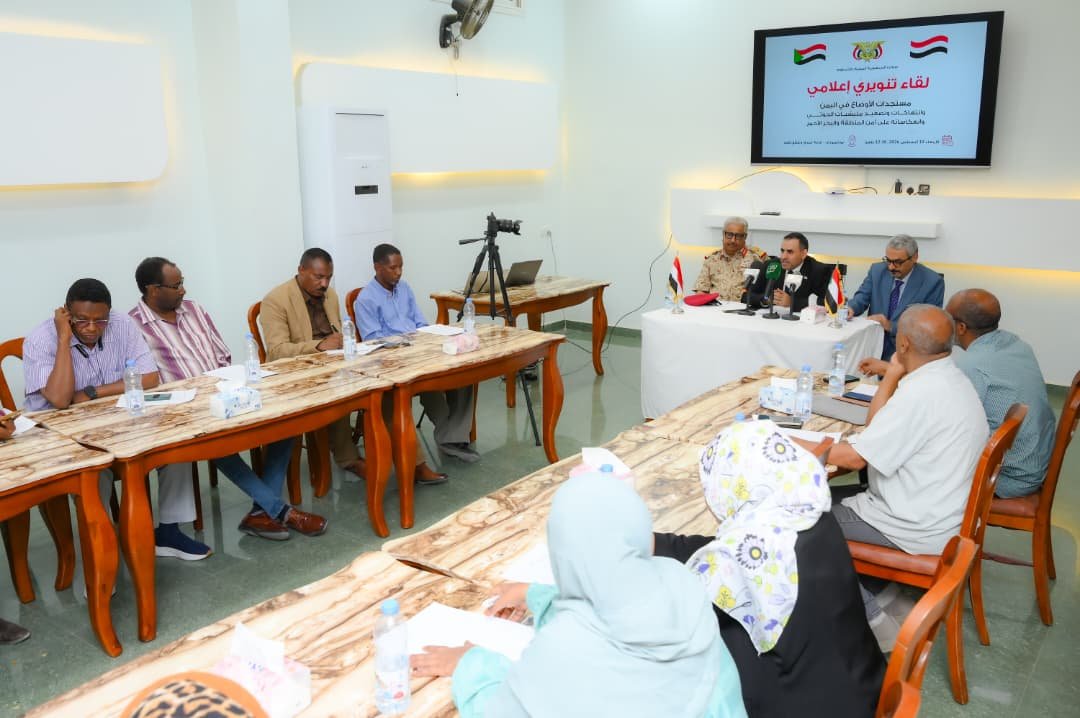
The Yemeni embassy in Sudan held a briefing in Port Sudan on Wednesday for Sudanese journalists, media professionals and the directors of television channels, radio stations and news websites, setting out the government’s account of developments in Yemen and of what it describes as escalation and violations by the Houthi movement. The state news agency Saba reported the meeting on 19 August 2026.
The session focused on the consequences of that escalation for Yemen’s security and stability, for the wider region, and for the Red Sea and international navigation, according to Saba’s report.
The chargé d’affaires at the Yemeni embassy, Dr Abdulhaq Yaqoub, reviewed recent developments in Yemen and stressed the responsibility of the media to source information reliably and to raise public awareness of national and regional questions. He also emphasised what he called the deep-rooted and fraternal ties between the Yemeni and Sudanese peoples, recalling Sudan’s support for Yemen’s internationally recognised government since 2015.
That reference is a pointed one. Sudan contributed ground troops to the Saudi-led coalition that intervened in Yemen in March 2015, and Sudanese soldiers were deployed for years along Yemen’s western coast, taking significant casualties before Khartoum wound the commitment down. The relationship invoked at the briefing therefore rests on a concrete and costly military history rather than on diplomatic courtesy alone.
The choice of Port Sudan as the venue is itself a marker of how far circumstances in both countries have shifted. The city on Sudan’s Red Sea coast has served as the effective seat of the Sudanese authorities since the war between the army and the Rapid Support Forces broke out in April 2023 and made Khartoum untenable as an administrative centre. Yemen’s own government has likewise operated from Aden and from abroad since losing the capital, Sanaa.
Both states now sit on opposite shores of the same waterway, and both have an immediate interest in whether it functions. Sudan depends on Port Sudan for the great majority of its imports, including humanitarian supplies, at a moment when the UN classes the country as facing one of the world’s largest displacement crises. Disruption in the southern Red Sea raises shipping and insurance costs on precisely the routes that serve it.
The Bab al-Mandab Strait, which separates Yemen from the Horn of Africa, is the southern entrance to that corridor and one of the busiest maritime chokepoints anywhere. Attacks on and near commercial vessels from late 2023 onward led many operators to divert ships around the Cape of Good Hope instead, lengthening voyages between Asia and Europe by thousands of miles and sharply reducing traffic through the Suez Canal. Egypt, Sudan, Djibouti and Yemen itself have all absorbed part of the economic cost.
For Yemen, the effects are direct as well as regional. Reduced calls at Red Sea ports, higher war-risk insurance premiums and the disruption of routine commercial traffic complicate the delivery of both commercial goods and aid to a country that imports the overwhelming majority of its food and fuel.
Briefings of this kind form part of a sustained effort by Yemen’s government to shape how the conflict is understood outside the country, and to keep the Houthi maritime campaign framed as a threat to shared regional interests rather than as a peripheral dispute. Embassies have held comparable sessions with journalists and officials in a number of capitals over the past two years.
The government’s characterisation of the Houthis as an Iran-backed force is contested by the movement itself, which describes its maritime operations as a response to events in the wider region and denies acting as a proxy. UN reporting has documented the transfer of Iranian-origin weapons components to Houthi-held areas, while the extent of Iranian operational direction remains a matter of dispute among analysts.
What is less disputed is the effect on shipping. The UN Special Envoy for Yemen, Hans Grundberg, warned the Security Council this month that Yemen risks being drawn further into a wider regional confrontation, and several council members condemned the escalation of attacks. That warning has framed much of the diplomatic activity around Yemen through August.
What is less disputed is the effect on shipping, and the direction of travel. The UN Special Envoy for Yemen, Hans Grundberg, told the Security Council on 13 August that Yemen faces a more serious risk of a return to large-scale conflict than at any point since the UN-mediated truce of 2022, and warned that attacks on critical waterways were imperilling global trade and threatening to draw the country into the wider regional war. He pointed to a series of incidents in July, among them missile attacks on Saudi targets and a Houthi missile strike on a commercial vessel in which several crew members were killed. Several council members condemned the escalation. That warning has framed much of the diplomatic activity around Yemen through August, including the effort by Yemeni missions abroad to press the case in friendly capitals.
Its significance lies less in what was said than in where it was said. Two governments displaced from their own capitals, facing separate wars, are using a shared coastline as the basis for a common argument about regional security. Whether that argument gains traction with Sudanese audiences, and whether it translates into any practical coordination between the two states on Red Sea security, will only become clear over a longer period than a single briefing can indicate.
About the Author