Al-Muharrami tells British ambassador that restoring state institutions is the key to Yemen’s stability
 Yemen Herald News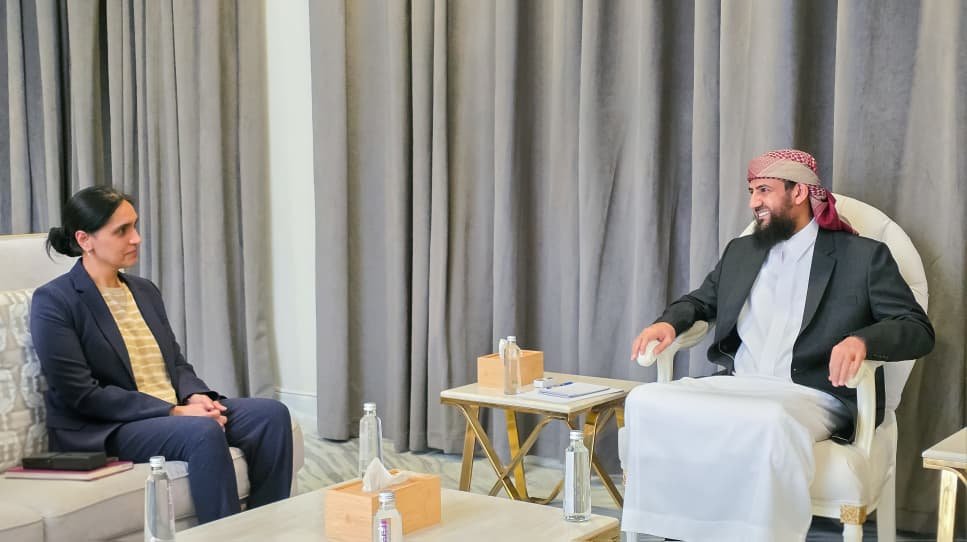
Presidential Leadership Council member Abdulrahman al-Muharrami has said that restoring the Yemeni state and its institutions, and ending the Houthi coup, are fundamental to achieving peace and stability in the country. He made the remarks during a meeting in Riyadh with the British Ambassador to Yemen, Abda Sharif, which the state news agency Saba reported on 19 August 2026.
The two discussed political, military and security developments in Yemen and the wider region, bilateral relations between the two countries, and efforts to strengthen security and stability and to support Yemen’s state institutions.
Al-Muharrami argued that any sustainable settlement would have to address the root causes of the crisis rather than its symptoms, restore the authority and sovereignty of state institutions, and create the conditions in which a lasting peace could hold. It is a formulation the internationally recognised government has used consistently in its dealings with Western envoys, and it marks out the distance between its position and proposals for a settlement that would leave the current division of territory largely in place.
The meeting also covered what the government describes as the continued threat posed by the Iran-backed Houthi movement to Yemen and the region, including risks to Red Sea security, international shipping lanes and global trade. The Houthis reject that characterisation of their position and present their maritime campaign as a response to events in the wider region.
Al-Muharrami said the group’s continued escalation and its threats to international navigation undermine the prospects for a settlement and prolong the crisis. He added that Yemen’s armed forces and security agencies remain on high alert and are prepared for a range of scenarios, according to Saba’s account of the meeting.
He called on the international community to maintain pressure on the Houthis to halt their attacks, to cut off their sources of funding and weapons, and to hold accountable those responsible for violations and for attacks that threaten Yemen, the region and international shipping.
Al-Muharrami praised Britain’s role in supporting Yemen and peace efforts, and stressed the importance of continued international backing for the Presidential Leadership Council and the legitimate government, and for the strengthening of state institutions more broadly.
For her part, the British ambassador reaffirmed her country’s support for the Presidential Leadership Council and the government and their efforts to restore security and stability. She stressed the United Kingdom’s commitment to continuing its partnership with Yemen and to expanding bilateral cooperation.
Al-Muharrami, widely known by the kunya Abu Zaraa, is among the more militarily consequential figures on the eight-member council. Born in the Yafa region of Abyan province in southern Yemen, he came to prominence as commander of the Giants Brigades, a force that played a central role in fighting on the Red Sea coast and later in Shabwa. He was appointed to the Presidential Leadership Council in April 2022, when power was transferred from former president Abd Rabbuh Mansur Hadi.
Abda Sharif took up the post of British ambassador to Yemen in 2023. A lawyer by training, she previously headed the Iraq and Arabian Peninsula department at the Foreign, Commonwealth and Development Office, served as deputy ambassador to Lebanon between 2012 and 2016, and led the UK office in Benghazi in 2011. Like most foreign missions accredited to Yemen, the British embassy has operated from outside the country for much of the war, which is why meetings of this kind are frequently held in Riyadh.
The Presidential Leadership Council was created in April 2022 as a collective executive intended to unify the anti-Houthi camp under a single body, with Rashad al-Alimi as chairman. Its members come from politically and militarily distinct constituencies, and holding them to a common line has been a recurring challenge. Statements such as al-Muharrami’s, which restate the council’s core demand in unambiguous terms, are partly aimed at that internal audience as well as at foreign governments.
The Red Sea dimension gives the meeting a weight beyond Yemen’s borders. The Bab al-Mandab Strait, which separates Yemen from the Horn of Africa, is one of the world’s most heavily used maritime chokepoints and the southern gateway to the Suez Canal. Attacks on and near commercial shipping since late 2023 pushed many carriers to route vessels around the Cape of Good Hope instead, adding time and cost to voyages between Asia and Europe and reducing traffic through the canal.
That is the context in which the Yemeni government has pressed Britain and other states to treat the maritime threat and the domestic political settlement as a single problem rather than two. Its argument, restated by al-Muharrami, is that the shipping lanes will not be reliably secure while the group that controls Yemen’s Red Sea coastline remains outside any settlement and beyond the reach of state authority.
No new commitments, funding figures or timelines were announced at the meeting, and Saba’s report describes it in the terms usual for such encounters: an exchange of positions and a restatement of support. The practical question is whether continued British engagement translates into the sustained pressure al-Muharrami asked for, or whether it remains, as it has largely been, diplomatic backing for a UN-led process that has yet to produce a durable agreement.
About the Author