Yemen’s Foreign Ministry Receives Credentials of Nigeria’s Non-Resident Ambassador
 Yemen Herald News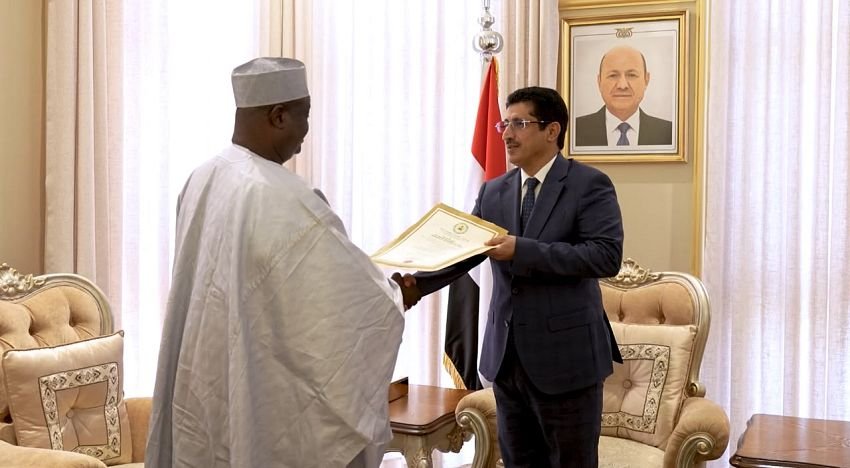
Yemen’s Ministry of Foreign Affairs and Expatriates has formally received the paperwork accrediting Nigeria’s new envoy to the country. Dr. Mansour Baggash, the ministry’s Under-Secretary for Political Affairs, received on Thursday a copy of the credentials of Dr. Yakoub An Gambo as Non-Resident Ambassador of the Federal Republic of Nigeria to the Republic of Yemen. The state news agency Saba reported the meeting from Riyadh on 20 August 2026.
According to Saba’s account, Baggash welcomed the Nigerian ambassador and promised him the support needed to carry out his diplomatic mission, together with an undertaking to further promote bilateral cooperation between the two countries in the service of their mutual interests. Gambo, for his part, affirmed his country’s support for the Yemeni political leadership and government, and said he hoped to work on developing relations between the two states. The agency reported no agreements, no timetable and no further detail.
The handover of a copy rather than the original document is standard diplomatic procedure rather than a hedge. Under the practice codified in the 1961 Vienna Convention on Diplomatic Relations, an incoming head of mission presents original letters of credence to the receiving state’s head of state, a ceremony that formally begins the ambassador’s tenure. A copy is lodged first with the foreign ministry, which in most states allows the envoy to begin working while the head-of-state ceremony is arranged.
Baggash is the senior official responsible for political affairs at the ministry and routinely receives foreign envoys on its behalf; the ministry’s own record of his activity shows him meeting ambassadors from Germany, Japan and other states in the same capacity. Saba’s English headline described him as deputy foreign minister while the body of its report used the fuller title of under-secretary for political affairs. Both refer to the same office.
The non-resident designation is equally routine, and equally revealing. Nigeria maintains no resident embassy inside Yemen; its ambassador is based in another capital and covers Yemen alongside a primary posting. Dual accreditation of this kind is common wherever a state wants formal representation without the cost or the risk of a permanent mission. In Yemen’s case it reflects security conditions on the ground: most foreign embassies suspended operations in Sanaa in 2015, and those that continue to deal with the government now do so from outside the country.
The Riyadh dateline on Saba’s report points to the same reality. Yemen’s internationally recognised government has operated substantially from Saudi Arabia since the Houthi movement took control of Sanaa, and much of the foreign ministry’s accreditation business is transacted there rather than in Aden, the government’s declared temporary capital. Ambassadors accredited to Yemen therefore frequently complete protocol steps in a third country, and may serve a full term without taking up residence in Yemen itself.
The Nigerian accreditation was not an isolated event. Saba’s English service reported in the same period that a non-resident ambassador from Thailand had presented a copy of her credentials to the same under-secretary, and that Foreign Minister Dr. Afrah al-Zouba had held separate telephone calls with her Mauritanian and Djiboutian counterparts, the latter covering Red Sea security alongside bilateral cooperation. Taken together, the items describe a ministry working steadily through routine diplomatic traffic rather than responding to any single development.
For the Yemeni government, that traffic carries weight beyond protocol. Formal recognition and working diplomatic channels underpin its standing at the United Nations and in multilateral bodies, its access to donor funding, and its ability to press its case on the conflict in international forums. Each new accreditation, however modest in immediate substance, adds to the roster of states that deal with it as the government of Yemen.
Nigeria is Africa’s most populous country and a member of both the African Union and the Organisation of Islamic Cooperation, forums in which Yemen’s government has sought diplomatic support. Saba’s report did not describe any existing programme of Nigerian-Yemeni cooperation, nor did it indicate where Gambo is resident or which other countries fall within his accreditation. Those details would ordinarily emerge only once a mission begins substantive work, and non-resident postings in particular are often announced with little supporting detail. For now the accreditation establishes a formal channel between the two governments rather than any specific undertaking.
The diplomatic activity runs alongside a humanitarian emergency that remains among the world’s largest. The United Nations Office for the Coordination of Humanitarian Affairs estimated in its March 2026 humanitarian needs and response plan that more than 22 million people in Yemen require assistance, with 18.3 million acutely food insecure and more than 2.2 million children under five acutely malnourished, of whom 516,157 are severely malnourished. Some 5.2 million people remain internally displaced. The plan seeks 2.16 billion US dollars to reach 12 million of those in need.
Saba is the sole source for the meeting, and the agency’s account is brief. No Nigerian government statement on the accreditation was available at the time of writing, and the commitments attributed to either official amount to expressions of intent rather than concrete undertakings. Whether the accreditation leads to substantive cooperation between the two countries will depend on steps that neither side has yet announced.
About the Author