Tawakkol Karman Blocked from Briefing the UN Security Council on Yemen
 Yemen Herald News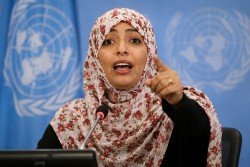
The Yemeni Nobel peace laureate Tawakkol Karman was prevented from addressing the United Nations Security Council during its session on Yemen on 13 August 2026, after members objected to her appearance. Karman had been invited to brief the council as an independent civil society voice, but was blocked from speaking because of what Denmark’s deputy ambassador, Sandra Jensen Landi, described as strong opposition. She delivered her remarks to reporters outside the council chamber instead.
Neither Landi nor the council identified which members raised the objection, and no formal explanation was entered into the record. Civil society briefers are a regular but discretionary feature of Security Council sessions, and any member may object to a proposed speaker. The mechanism does not require the objecting state to be named, which means the reasoning behind such decisions is frequently left unstated.
Some regional outlets have reported that the opposition related to Karman’s association with Yemen’s Islah party and, by extension, to the Muslim Brotherhood, an affiliation that several governments in the region regard with hostility. That explanation has not been confirmed by the council, by Denmark or by the international news agencies that covered the session, and it should be treated as unverified.
Speaking outside the chamber, Karman said the Houthi movement bears the primary responsibility for what she called the collapse of the state in Yemen. She did not confine her criticism to one party. She also blamed Iran for backing the Houthis, Saudi Arabia for its military intervention on behalf of the government the Houthis ousted, the United Arab Emirates for its involvement in the conflict, and the international community for failing to do enough to protect civilians.
Her recommendations to the council, delivered in the same setting, were for pressure on all parties to de-escalate, support for a Yemeni-led political process capable of reuniting the country, and pressure on the Houthis to transform themselves into a political party operating within a democratic framework rather than as an armed movement holding territory.
Karman shared the Nobel Peace Prize in 2011 with Ellen Johnson Sirleaf and Leymah Gbowee, recognised for her role in the protest movement that preceded the removal of the long-serving Yemeni president Ali Abdullah Saleh. She has remained a prominent and divisive figure since, admired internationally as a human rights campaigner and criticised by opponents for her political affiliations.
The session at which she was due to speak was a substantial one. Hans Grundberg, the United Nations special envoy for Yemen, told the council in a video briefing that the country faced a greater risk of returning to large-scale conflict than at any point since the truce of 2022 paused major hostilities. That assessment marked one of the bleaker evaluations the envoy has delivered in recent years.
The United Nations humanitarian chief, Tom Fletcher, told the same session that Yemen faced what he termed catastrophe from rising hunger and from health services crumbling under the pressure of renewed fighting. He said six million people in Yemen were experiencing emergency levels of food insecurity bordering on famine, which he described as the highest such figure anywhere in the world.
Those warnings were delivered against a background of intensifying combat. In the days surrounding the session, clashes between Houthi forces and government troops continued in the mountainous province of Taiz, where Yemeni military officials reported at least one soldier killed and another critically wounded. The military said dozens of government troops had been killed over the preceding week amid a series of Houthi attacks on government-held areas.
The conflict has also extended beyond Yemen’s borders. The Houthis said they had launched drone attacks on an Aramco oil refinery at Jazan in Saudi Arabia, following an earlier strike at the same site where the Saudi energy ministry reported a fire but no casualties. The group had announced a blockade of Saudi shipping the previous month, adding a further pressure point on regional trade routes.
The wider humanitarian picture remains among the world’s most severe. The United Nations Office for the Coordination of Humanitarian Affairs estimated in its March 2026 response plan that more than 22 million people in Yemen require assistance, that 18.3 million are acutely food insecure and that more than 2.2 million children under five are acutely malnourished, of whom 516,157 are severely malnourished. Roughly 5.2 million people remain internally displaced.
The truce Grundberg referred to took effect in April 2022 and, although it formally lapsed six months later, it substantially reduced front-line fighting and air strikes for a prolonged period afterwards. Much of the diplomatic effort since has been directed at converting that de facto calm into a negotiated settlement, a process that has repeatedly stalled over the sequencing of a ceasefire, the payment of public-sector salaries and the reopening of roads and ports. The envoy’s warning amounted to a statement that the residual benefit of that period is now eroding.
The exclusion of a civil society briefer is a procedural matter, and on its own it changed nothing about the council’s deliberations that day. Its significance lies in what it illustrates: that the question of who is entitled to speak for Yemeni civilians remains contested among the states that shape international policy on the conflict, at a moment when the officials who did address the council were describing conditions in unusually stark terms.
About the Author