Yemen’s foreign minister receives copy of credentials from new South Korean ambassador
 Yemen Herald News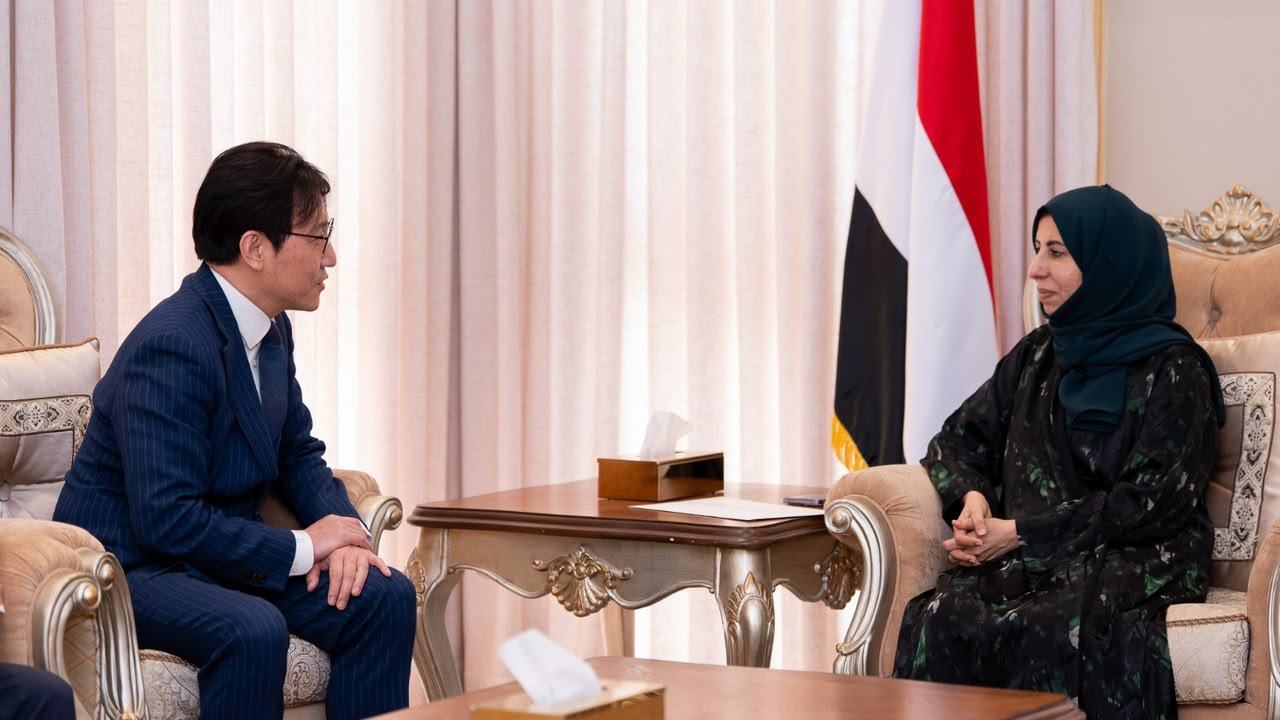
RIYADH, Saudi Arabia — Yemen’s foreign minister received a copy of the credentials of South Korea’s new ambassador in Riyadh on Monday, the state news agency Saba reported.
Afrah al-Zouba received the papers of Jeong Jae Hon, the extraordinary and plenipotentiary ambassador of the Republic of Korea to Yemen, Saba said.
Al-Zouba welcomed the ambassador and wished him well in his mission, according to the agency.
She promised him the support he needs to do his job and to develop Yemeni-Korean relations and cooperation further, Saba reported.
She praised relations between the two countries and said the government hoped to widen the scope of cooperation, the agency said.
Jeong said he was pleased to begin his duties in Yemen and that Seoul remained committed to developing bilateral relations across a range of fields, according to Saba.
The account of the meeting rests on Saba, the news agency of the internationally recognised government. South Korea’s embassy to Yemen posted a separate notice of the handover on its website. No independent news outlet has reported the meeting.
Ambassadors customarily give a copy of their credentials to the foreign ministry before presenting the originals to the head of state.
Korea and Yemen established diplomatic relations on Aug. 22, 1985, according to South Korea’s foreign ministry. The copy was handed over two days after the 41st anniversary of that date.
The two governments marked the 40th anniversary last year. The Korean embassy and Yemen’s foreign ministry jointly held a seminar in Riyadh on Aug. 21, 2025 under the title “Korea and Yemen: Friendship beyond 40 Years,” the Korean ministry said.
Korean Foreign Minister Cho Hyun and his Yemeni counterpart at the time, Shaya Mohsin al-Zindani, exchanged congratulatory letters on Aug. 22, 2025, according to the ministry.
Cho said the two countries had supported each other at international bodies, including the UN Security Council, and pointed to Korean humanitarian assistance to Yemen since 2015.
UNICEF lists a series of Yemen programmes funded by the Korean foreign ministry. Its current entry is a 2 million dollar water, sanitation and hygiene grant running from October 2025 to September 2026.
Earlier grants listed by UNICEF include 1 million dollars for healthcare from August 2024, 700,000 dollars for water and sanitation from July 2023, and 1 million dollars for water, sanitation and nutrition from April 2022.
UNICEF also lists 500,000 dollars for child protection and education in 2021, 500,000 dollars for child welfare, health and education in 2020, and 750,000 dollars for emergency child protection in 2018. The listed grants total about 6.45 million dollars.
South Korea’s embassy to Yemen is registered in Sanaa and runs a temporary office in Riyadh, according to its website.
Yemen’s internationally recognised government has operated from Aden and Riyadh since the Houthis took the capital in 2014.
Al-Zouba took office in July as Yemen’s first female foreign minister, Al Jazeera reported at the time. She succeeded al-Zindani.
The UN humanitarian plan for Yemen published in March estimates that more than 22 million people need assistance and that 18.3 million are acutely food insecure.
It puts the number of children under five who are acutely malnourished at more than 2.2 million, of whom 516,157 are severely malnourished, and the number of internally displaced people at 5.2 million.
The plan seeks 2.16 billion dollars to reach 12 million people this year.
South Korean companies hold a stake in Yemen’s main gas export project. Korea Gas Corporation, SK Innovation and Hyundai together hold 21.4 percent of Yemen LNG, alongside Total with 39.6 percent and Hunt Oil with 17.2 percent. Yemeni state entities hold a combined 21.7 percent.
The plant, at Balhaf on the Gulf of Aden, has not exported since the war began in 2015.
About 500 Yemenis applied for asylum on South Korea’s Jeju Island in 2018 after arriving under a visa-free tourism scheme, Al Jazeera reported at the time. The Jeju Immigration Office recorded 515 applications as of May that year.
The arrivals prompted a public debate in South Korea over its asylum rules.
Jeong’s predecessor, Do Bong-kae, met representatives of Yemen’s Islah party in Riyadh in June, the Korean ministry said.
Yemen LNG declared force majeure on its export contracts in April 2015 and shut the Balhaf terminal on Yemen’s southern coast. Total, the largest shareholder, evacuated its staff the same year. The plant has not resumed exports since, and the force majeure has not been lifted. The Korean shareholdings therefore sit in a project that is idle.
The Korean embassy’s website records other contacts during the year. It lists a meeting with Yemen’s deputy foreign minister and attendance at a briefing for diplomats hosted by the chairman of the Presidential Leadership Council.
Al-Zouba has met a run of envoys and officials in Riyadh since taking office. The Gulf Cooperation Council said its secretary-general, Jasem Albudaiwi, received her on Aug. 3 for talks on the partnership between Yemen and the bloc. Saba reported separate talks with France’s ambassador to Yemen this week.
Saba described Jeong as extraordinary and plenipotentiary ambassador, the standard rank for a resident head of mission.
Saba did not say when Jeong would present the original credentials.
About the Author