Yemen’s interior minister discusses security cooperation with China’s chargé d’affaires
 Yemen Herald News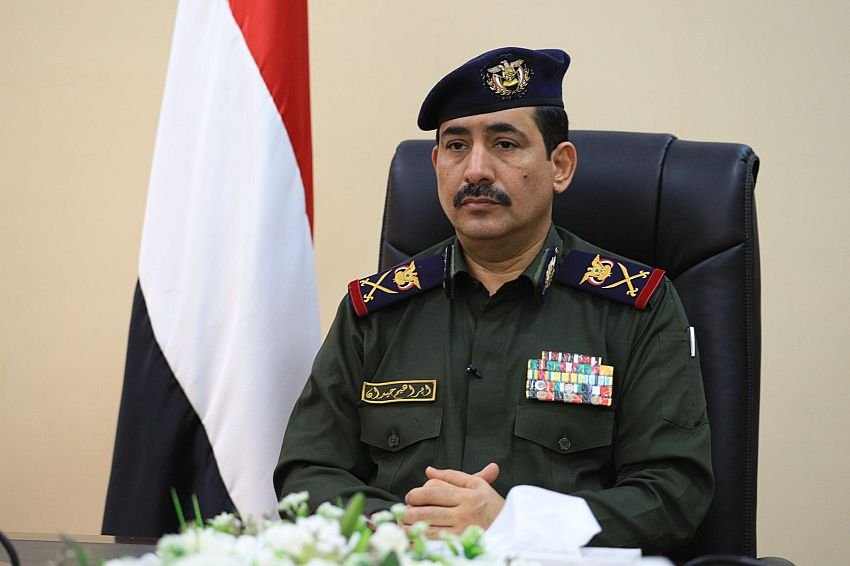
ADEN, Yemen — Yemen’s interior minister discussed security cooperation with China’s senior diplomat in the country during a video call on Monday, the state news agency Saba reported.
Maj. Gen. Ibrahim Haidan held the conference with Shao Qing, chargé d’affaires of the Chinese embassy to Yemen, the agency said.
The two reviewed areas of cooperation in the security field and ways to strengthen and develop them, according to Saba.
Haidan praised relations between the two countries, the agency reported.
He said joint cooperation mattered most in supporting Coast Guard forces and in combating terrorism, in order to deter threats and advance shared interests, Saba said.
The account of the call rests on Saba, which is run by Yemen’s internationally recognised government. No independent outlet has reported the meeting, and neither the Chinese embassy in Yemen nor China’s foreign ministry has published a readout of its own.
Shao affirmed his country’s commitment to strengthening relations between the two countries and to developing areas of joint security coordination, according to the agency.
Haidan reviewed the interior ministry’s work to consolidate security and stability, and the tasks being carried out by security agencies, Saba said.
He described that work as taking place amid continued escalation by what he called Iran-backed Houthi militias, the agency reported.
Haidan said the Houthis had targeted citizens’ homes and civilian facilities, threatened international shipping routes and struck neighbouring countries, according to Saba.
The Houthi authorities in Sanaa reject that characterisation. They present their operations as responses to Saudi and Israeli actions, and deny that Iran directs them.
Houthi attacks have reshaped traffic through the waters Haidan referred to. The group has targeted more than 100 merchant vessels since November 2023 and sunk two of them.
Throughput at Bab al-Mandab remains far below pre-crisis levels. The Suez and Red Sea route carries about 12 percent of global trade, and vessels routed around southern Africa add 10 to 14 days to a voyage.
The U.S. Maritime Administration keeps a standing advisory covering the Red Sea, the Bab el-Mandeb strait, the Gulf of Aden, the Arabian Sea and the Somali Basin.
The European Union runs its own naval mission in the corridor. Aspides began operations in February 2024 and escorts merchant ships through the Red Sea and the Gulf of Aden.
Interpol runs a parallel Red Sea Project on maritime crime covering the same waters.
The Coast Guard has been a focus of foreign assistance to the Aden government for several years.
A capacity project backed by Saudi Arabia, Britain and European Union donors aims to build up the force, the International Maritime Organization says.
Britain supported the deployment of two patrol vessels, the Aden and the Mayun, which are stationed on Perim Island, according to the IMO.
The organisation ran a four-day workshop for the internationally recognised government from June 22 to 25, held with the Crisis Response Project for the Red Sea and the Western Indian Ocean, which the European Union funds.
The workshop set out a roadmap for two bodies: a national maritime information-sharing centre at Yemeni Coast Guard headquarters, and a regional centre on the Aden dockside within the Yemen Maritime Affairs Authority, the IMO said.
A national training course on port facility security finished in Aden from Jan. 14 to 16 under the EU-funded Regional Programme for Maritime Security in the Red Sea Area, the organisation said.
That programme began in February 2021. The IMO runs it alongside Interpol, the U.N. Office on Drugs and Crime and the Intergovernmental Authority on Development.
China keeps its own naval presence in the waters off Yemen.
Its 49th escort task force left a military port in Sanya, in Hainan province, on Aug. 12 for the Gulf of Aden and waters off Somalia, China’s defence ministry said.
The group is made up of the guided-missile destroyer Kunming, the guided-missile frigate Yueyang and the supply ship Luomahu, with two helicopters and special operations personnel aboard, according to the ministry.
China has run escort missions in those waters since 2008. It says its ships have escorted more than 7,000 Chinese and foreign vessels over that period.
China opened ministerial-level relations with the Mutawakkilite Kingdom of Yemen on Sept. 24, 1956, and raised them to ambassadorial level on Feb. 13, 1963.
Beijing closed its embassy in Sanaa in 2015 as the war widened. A Chinese navy ship evacuated close to 600 Chinese citizens from the port of Aden that March.
Fighting inside Yemen has picked up since early August.
Al Jazeera reported that missile and drone attacks on the Red Sea port of al-Makha killed at least seven people on Aug. 10, a day after earlier strikes there killed at least 11.
Marib’s government media office said six ballistic missiles and four drones hit residential districts of the city on Aug. 15, wounding four people, the broadcaster reported.
Haidan has held a series of meetings with foreign envoys this year on the same subject.
Saba reported his talks with Britain’s ambassador on security cooperation. Yemen Monitor reported a separate meeting with Japan’s ambassador and the director of the Japan International Cooperation Agency, at which he thanked Tokyo for its support to the ministry and to the Coast Guard Authority.
About the Author