Al-Alimi urges tougher international line on Iran in talks with German defence official
 Yemen Herald News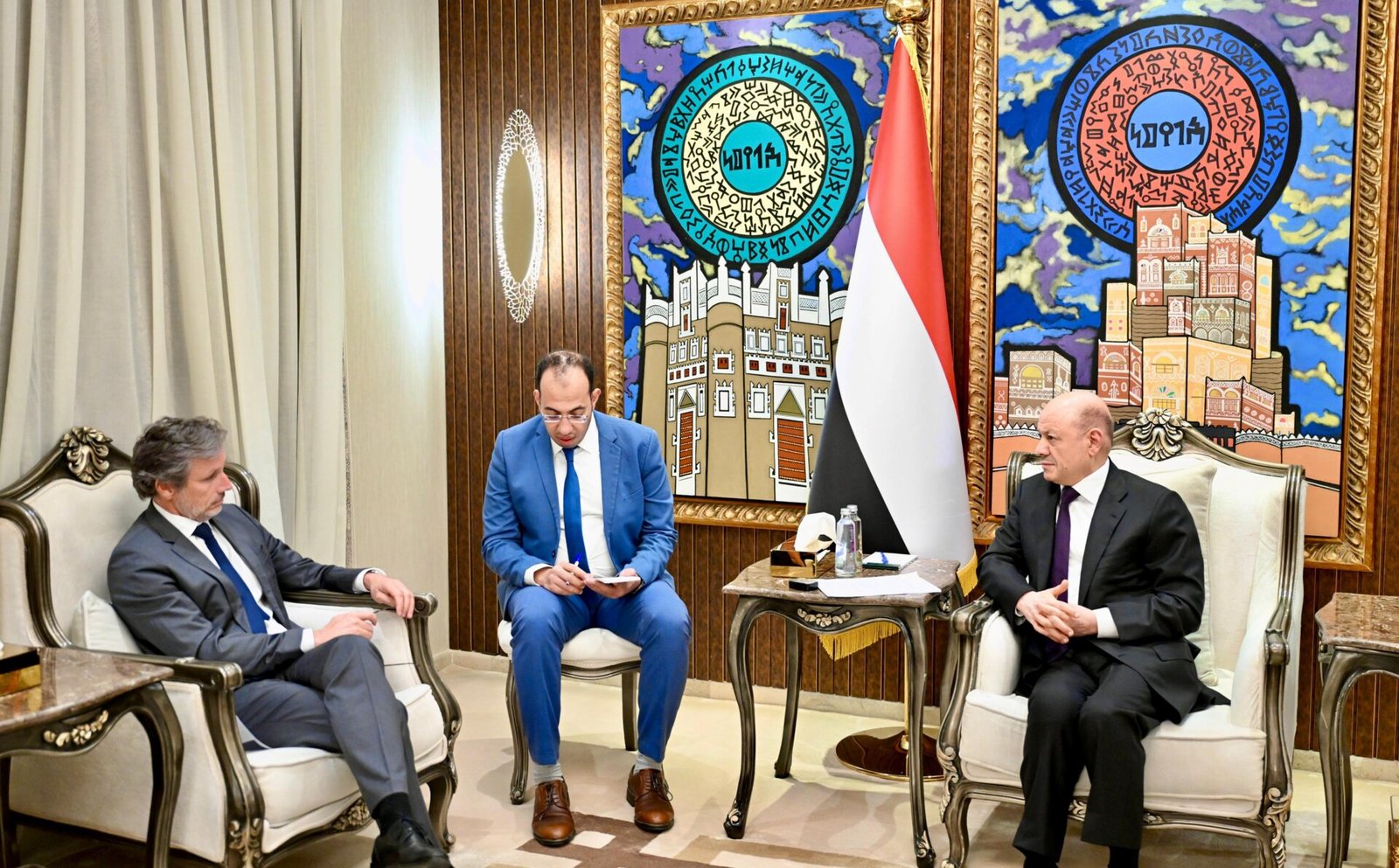
RIYADH, Saudi Arabia — Yemen’s president called on Monday for a firmer international approach to Iranian intervention in the region, during talks in Riyadh with a senior German defence official.
Rashad al-Alimi, chairman of the Presidential Leadership Council, met Nils Bolter, secretary-general of the German Ministry of Defence, the state news agency Saba reported.
Al-Alimi said that approach should combine simultaneous pressure on Tehran and what he called its terrorist networks with steps to cut off their funding and weapons, according to Saba.
He paired that with strengthening the capacity of national states and their legitimate institutions to protect their sovereignty, the agency said.
Shifts in the international position toward the Iranian government offer an opportunity to rebuild a more sustainable equation for regional security, al-Alimi said.
The Yemeni case is among the clearest examples of the danger of armed groups growing outside state authority, he said, turning gradually from an internal threat into a cross-border one that reaches ports, shipping lanes and international trade.
Al-Alimi said recent Houthi attacks on cities, ports and civilian installations, including strikes on al-Mokha and Marib, were an attempt to revive a policy of blackmail and to test the state’s resolve after years of relative calm.
The armed forces had shown preparedness and would keep striking Houthi command centres and assembly points across several fronts, he said.
He asked the international community to do more to track networks that smuggle weapons, components and military-use technology, and to tighten measures against those who finance and arm the groups he called terrorist.
Al-Alimi also called for support to protect the Red Sea, the Bab al-Mandab Strait and Yemen’s ports.
The security of shipping routes cannot be sustained by an international naval presence alone, he said, but requires a Yemeni state able to extend its authority over its coasts and territorial waters.
Yemenis cannot accept a model in which official state institutions exist alongside an armed group that keeps its weapons and decides on its own when to fight and when to make peace, he said.
Al-Alimi praised relations between Yemen and Germany and said he hoped to deepen the partnership in institutional, security and defence capacity-building, and in protecting maritime routes.
Foreign Minister Afrah al-Zouba, presidency office director Yahya al-Shaibi and Germany’s ambassador to Yemen, Thomas Schneider, attended the talks, Saba said.
The account of the meeting rests on Saba, the news agency of the internationally recognised government. No independent confirmation of the talks or of al-Alimi’s remarks has been published.
Al-Zouba took office in July as Yemen’s first female foreign minister, Al Jazeera reported at the time.
The talks followed several weeks of intensified fighting. France’s deputy permanent representative to the United Nations, Jay Dharmadhikari, told the Security Council on Aug. 13 that Yemen was experiencing “the most serious escalation of tensions since the 2022 truce,” and said the Houthis bore full responsibility for it.
Dharmadhikari said the escalation began on July 3, when an Iranian aircraft landed in Sanaa without authorisation from the internationally recognised authorities.
He said Tehran was failing to comply with the arms embargo set out in Security Council resolution 2216, and called on it to end transfers of military equipment to the Houthis. Iran has consistently denied arming the group.
A Houthi strike on the cargo vessel Tihamah on Aug. 11 killed several crew members who were Pakistani and Indonesian nationals, Dharmadhikari said.
France condemned the attacks and said it would continue its part in the European Union naval operation EUNAVFOR Aspides, which escorts commercial shipping in the Red Sea under Security Council resolution 2722.
Al Jazeera reported on Aug. 16 that Houthi forces had launched fresh attacks on al-Makha and Marib, the two places al-Alimi named.
The Houthi movement, which has held Sanaa since 2014, rejects the legitimacy of the Riyadh-based government and gives a different account of the fighting.
Al Jazeera reported that Houthi attacks on Aug. 9 killed seven people in Yemen and that a fire broke out at an Aramco facility in Jizan, southern Saudi Arabia, in an attack the group claimed.
Saudi Arabia, Yemen and 12 other regional states announced a Multinational Maritime Defence Alliance on July 30, according to Security Council Report, intended to protect navigation through Bab al-Mandab, the Red Sea and the Gulf of Aden.
At the same Council session, Dharmadhikari demanded the release of United Nations personnel, aid agency staff and diplomatic employees held by the Houthis, saying the detentions breached resolution 2730 and international humanitarian law.
He said there was no military solution and that only an inclusive political process under UN auspices, involving women and all parts of Yemeni society, could end the conflict. The UN special envoy, Hans Grundberg, and the UN aid chief, Tom Fletcher, briefed the Council that day.
The UN humanitarian plan for Yemen published in March estimates that more than 22 million people need assistance and that 18.3 million are acutely food insecure. It puts the number of children under five who are acutely malnourished at more than 2.2 million, of whom 516,157 are severely malnourished, and the number of internally displaced people at 5.2 million.
The plan seeks 2.16 billion dollars to reach 12 million people this year.
Yemen’s internationally recognised government has operated from Aden and Riyadh since the Houthis took the capital.
Saba did not report any specific commitments from the German side.
About the Author