Yemen’s foreign minister thanks Australia for listing the Houthis as a terrorist group
 Yemen Herald News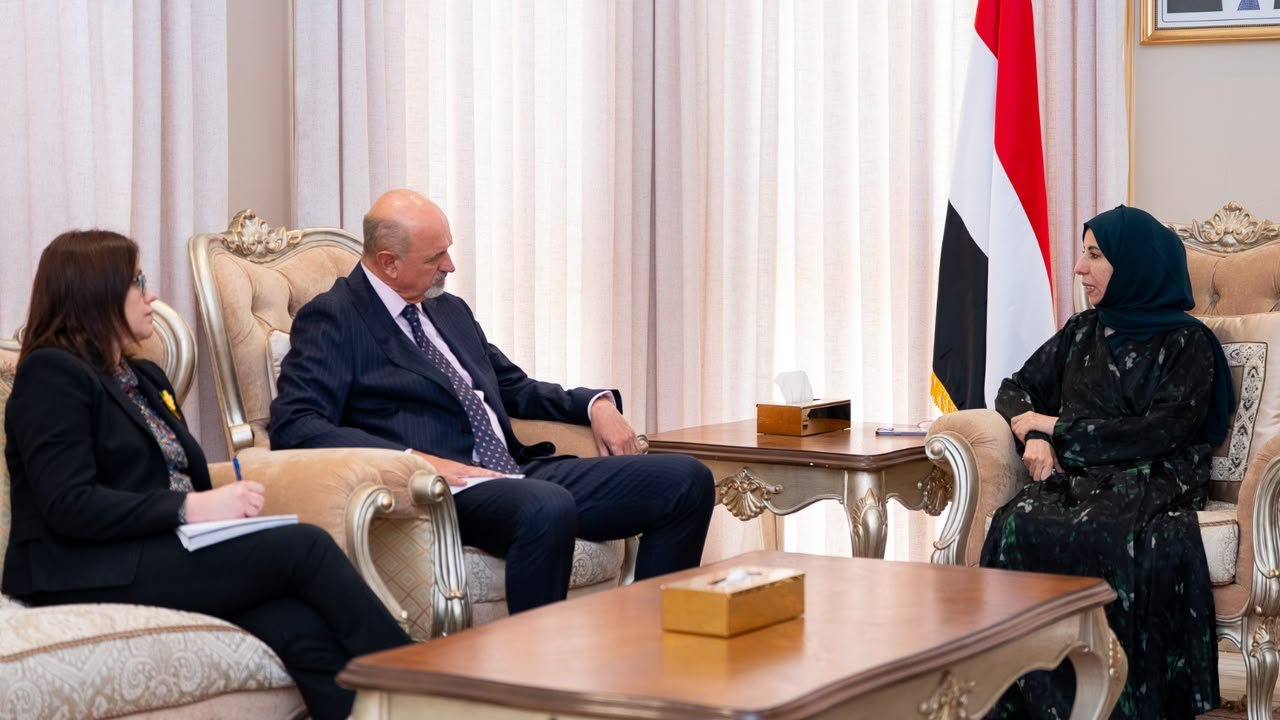
RIYADH, Saudi Arabia — Yemen’s foreign minister thanked Australia on Monday for listing the Houthis as a terrorist organisation, the state news agency Saba reported.
Dr. Afrah al-Zouba held talks with Miles Armitage, Australia’s non-resident ambassador to Yemen, the agency said.
They discussed bilateral relations and ways to widen Yemeni-Australian cooperation, according to Saba.
The account rests on Saba, which is run by Yemen’s internationally recognised government. Neither the Australian embassy nor the Department of Foreign Affairs and Trade has published a readout, and no independent outlet has reported the meeting.
The talks also covered humanitarian and development cooperation and a number of regional and international issues, the agency said.
Al-Zouba described developments in Yemen amid what she called continued escalation by the Houthi militia, according to Saba.
She said the group’s threats in the Red Sea and at Bab al-Mandab had begun to affect regional security and international interests, the agency reported.
Fighting on land has also picked up. Al Jazeera reported that missile and drone strikes on the Red Sea port of al-Makha killed at least seven people on Aug. 10, a day after earlier strikes there killed at least 11.
Marib’s government media office said six ballistic missiles and four drones hit residential districts of the city on Aug. 15, wounding four people, according to the broadcaster.
She said the government was grateful for Australia’s stance toward the government and state institutions, according to Saba.
Al-Zouba said continued international work was needed to protect the security of navigation and trade in the Red Sea and at Bab al-Mandab, the agency said.
Armitage said his country’s position on the listing rested on Australian principles regarding terrorist groups, according to Saba.
“It is very important to cooperate on issues of mutual interest, namely the protection of freedom for navigation and international trade movement,” the agency quoted him as saying.
Australia added Ansar Allah, the Houthis’ formal name, to its list of terrorist organisations under the Criminal Code. The listing took effect on May 24, 2024.
Then-Attorney-General Mark Dreyfus announced the decision, citing the group’s violent activity in the Gulf of Aden and surrounding waters.
He said the listing followed advice from Australian security agencies that Ansar Allah was involved in preparing, planning and carrying out terrorist attacks.
The group became the 30th organisation then listed under the code, and the listing made support for it a criminal offence in Australia.
The Parliamentary Joint Committee on Intelligence and Security reviewed the listing and supported it.
Armitage is Australia’s ambassador to Saudi Arabia and is accredited to Bahrain, Oman and Yemen as well.
He is a senior career officer of the Department of Foreign Affairs and Trade and has served as Australia’s ambassador to Jordan and to Timor-Leste, and as ambassador for counter-terrorism, according to the department.
He has also been posted to the Philippines, to Pakistan and to Australia’s permanent mission to the United Nations in New York.
Al-Zouba took office on July 23 and is the first woman to hold the foreign ministry or any of Yemen’s most senior cabinet posts.
She spent more than 25 years working mainly in development and peacebuilding before moving into government, and was appointed minister of planning and international cooperation in February.
The shipping threat both sides referred to is documented.
The Houthis have targeted more than 100 merchant vessels since November 2023 and sunk two of them.
Semafor reported that an attack on a Red Sea cargo ship killed six people this month, the first deadly strike in the Bab el-Mandeb strait in about a year.
The group paused its campaign after the Gaza ceasefire in October 2025 and declared a renewed ban on Israeli-linked shipping in June, as fighting between Iran and Israel resumed.
Traffic through the strait remains well below pre-crisis levels. The Suez and Red Sea route carries about 12 percent of global trade, and ships routed around southern Africa add 10 to 14 days to a voyage.
The U.S. Maritime Administration maintains a standing advisory covering the Red Sea, the Bab el-Mandeb strait, the Gulf of Aden, the Arabian Sea and the Somali Basin.
The European Union’s naval mission in the corridor, Aspides, began operations in February 2024 and escorts merchant ships through the area.
On the humanitarian side, the United Nations response plan published in March records more than 22 million people in need across Yemen and 18.3 million who are acutely food insecure.
More than 2.2 million children under five are acutely malnourished, of whom 516,157 are severely malnourished, according to the plan.
It counts 5.2 million internally displaced people and seeks 2.16 billion dollars to reach 12 million of them.
Australia provided 10 million Australian dollars in humanitarian aid to Yemen in 2024-25, according to the Department of Foreign Affairs and Trade. That brought its total since 2017 to 73.5 million.
The money went through United Nations agencies, among them the World Food Programme and the U.N. Children’s Fund, and paid for food, water, sanitation, health care and protection work, the department said.
Saba’s report did not give a figure for Australian aid to Yemen or say whether new funding was discussed.
About the Author