US Strikes Military Sites on Iran’s Kharg Island but Spares Oil Terminals
 Yemen Herald News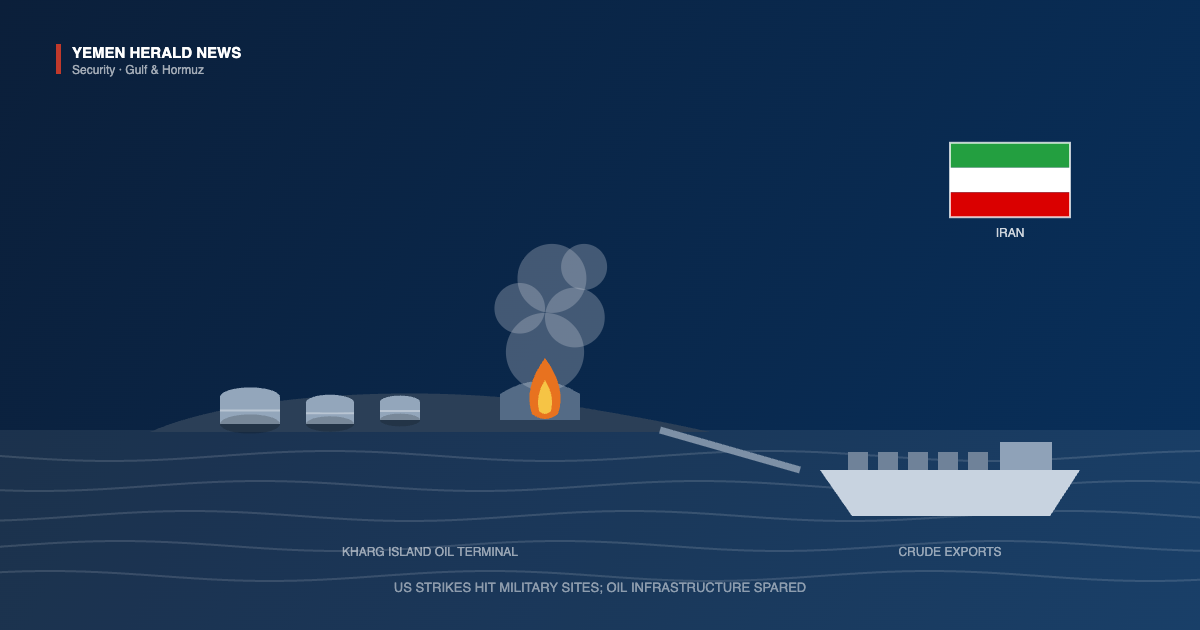
United States aircraft struck military installations on Iran’s Kharg Island in mid-March 2026, hitting the country’s most important oil export terminal while deliberately leaving its petroleum infrastructure intact, in one of the sharpest escalations of the war that began at the end of February.
US Central Command said the raid on 13 March 2026 hit more than 90 Iranian military targets on the island. President Donald Trump confirmed the strikes and said the decision to spare the oil facilities had been deliberate, writing that he had chosen not to destroy the island’s oil infrastructure but would reconsider if Iran or anyone else interfered with the free and safe passage of ships through the Strait of Hormuz. Iranian state media reported at the time that the export terminals had not been damaged, while warning of consequences for any attack on the country’s energy installations.
Kharg Island lies roughly 32 kilometres off Iran’s Gulf coast and handles the overwhelming majority of the country’s crude exports, with estimates at the time putting the figure as high as 90 per cent. That concentration is what made the strike so consequential: damage to the loading jetties would have cut Iran’s principal source of foreign revenue almost overnight, and Tehran responded by threatening to target oil facilities belonging to US-aligned states in the Gulf if its own were hit.
The strikes came a fortnight into a conflict that opened on 28 February 2026, when joint US and Israeli operations against Iran triggered a war that spread rapidly across the region. Among those killed in the opening phase was Iran’s supreme leader, Ayatollah Ali Khamenei. On 8 March the Assembly of Experts named his son, Mojtaba Khamenei, then 56, as his successor, a decision reported at the time as having been taken under pressure from the Islamic Revolutionary Guard Corps. The new supreme leader’s first public message, issued in writing rather than in person, called for continued military resistance and described the Strait of Hormuz as a lever of pressure that Iran should retain.
US Defence Secretary Pete Hegseth said Washington was seeking information on the new supreme leader and other senior Iranian figures. Little was publicly known about Mojtaba Khamenei’s whereabouts or health, and his absence from public view became a recurring theme in coverage of the war.
Iran’s response ran along several fronts. The Revolutionary Guard said it had fired missiles and drones at Israel, and Hezbollah began launching projectiles from Lebanon on 2 March, opening a northern front that would draw hundreds of casualties and displace hundreds of thousands of people over the following weeks. Iranian officials framed parts of the campaign in terms of support for the Palestinian cause.
The war did not stay within Iran and Israel. Gulf states that host American bases or are seen as aligned with Washington came under fire, and their air defences were repeatedly activated. Saudi Arabia intercepted a number of drones and Qatar shot down an incoming missile, incidents that prompted heightened security alerts, evacuations in some districts and a general tightening of civil aviation restrictions across the region. For Yemen, which sits at the southern end of the same maritime corridor, the spillover carried an obvious risk to shipping through the Red Sea and the Bab al-Mandab strait.
Casualty figures rose steeply through March. Tallies compiled by news organisations tracking the conflict put the Iranian death toll at roughly 1,045 by 4 March and at more than 2,300 by 15 March, with tens of thousands wounded. At least 118 people were reported killed in Iraq, most of them members of the Popular Mobilisation Forces, while Lebanese deaths passed 700 within the first fortnight. All of these numbers were provisional and contested, and independent verification inside Iran was extremely limited.
The economic consequences reached well beyond the battlefield. Formula One confirmed on 14 March 2026 that the Bahrain and Saudi Arabian Grands Prix scheduled for April would not take place, along with the associated Formula 2, Formula 3 and F1 Academy rounds, citing the situation in the Middle East. The cancellations cut the 2026 championship to 22 races and left a five-week gap between the Japanese Grand Prix on 29 March and the Miami Grand Prix on 3 May. The United States had by then issued travel advisories covering much of the region, including both host countries.
Yemen depends on seaborne imports for the great majority of its food and fuel, and its ports sit at the southern end of the same maritime corridor. Disruption in the Gulf and the Red Sea pushes up freight and war-risk insurance on precisely the routes that carry those cargoes, which is why a war fought largely in and around Iran registers quickly in Yemeni markets and in the cost of humanitarian operations there.
Behind the sporting disruption lay a far larger concern about energy. The Strait of Hormuz carries close to a fifth of global oil consumption according to US Energy Information Administration estimates, and sustained interference with tanker traffic there would be felt in fuel prices worldwide. Insurance costs for vessels transiting the Gulf climbed sharply during this period.
At the point this report was written, no ceasefire was in prospect and both sides were signalling that the campaign would continue. Whether Iran’s oil terminals would ultimately be struck remained the single largest variable hanging over the region’s economy.
About the Author