UAE Civil Aviation Authority Says Air Traffic Is Returning to Normal in Stages
 Yemen Herald News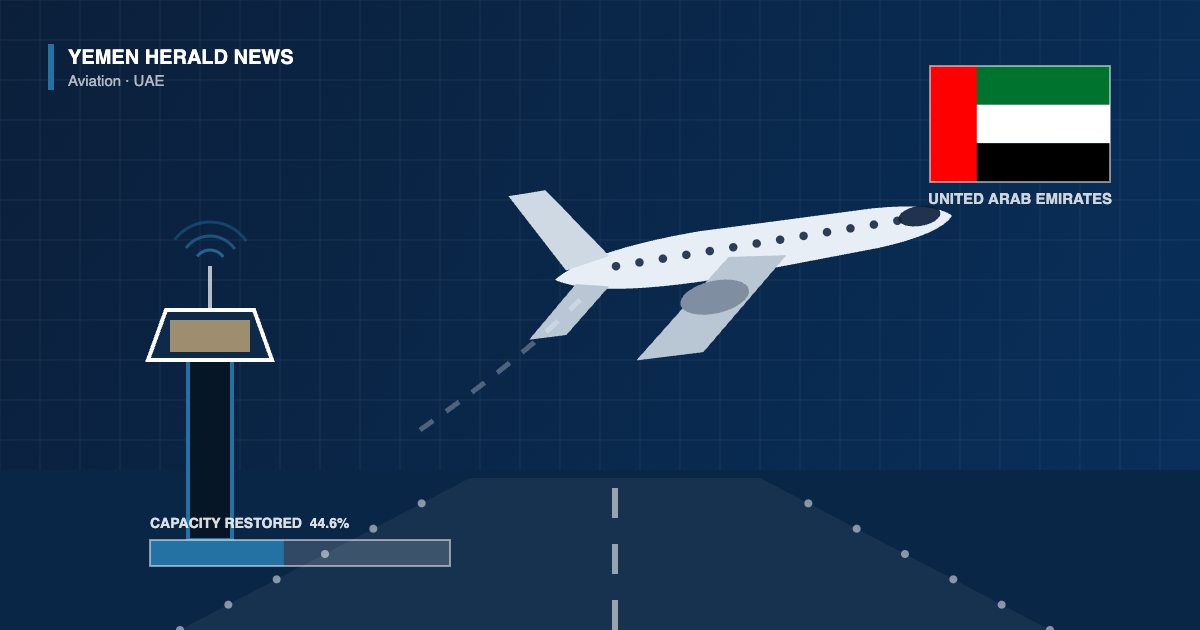
The United Arab Emirates’ General Civil Aviation Authority said in mid-March 2026 that air traffic across the country was returning in stages to its normal operating levels, after a period in which regional tensions forced temporary restrictions on the use of Emirati airspace. The authority framed the recovery as the result of a planned sequence of operational and regulatory steps rather than an abrupt reopening, and said the measures had been designed to protect passengers while keeping the country connected.
In the statement, issued on Friday 13 March, the GCAA said more than 1.4 million passengers had passed through UAE airports between 1 and 12 March. Over the same twelve days, controllers handled 7,839 aircraft movements in Emirati airspace. The authority presented both figures as evidence that traffic was rebuilding steadily, and that the arrangements introduced during the disruption had held without cutting off the movement of travellers altogether.
Abdulla bin Touq Al Marri, Minister of Economy and Tourism and chairman of the GCAA board, said the country had kept flights moving while treating safety as non-negotiable. “The safety of passengers, pilots, crews and all aviation staff remains the absolute priority in all decisions related to airspace,” he said. He added that the UAE had managed traffic in a balanced way, operating a limited number of flights along approved contingency routes while the restrictions were in force.
Those contingency routes were central to how the Emirates avoided a prolonged shutdown. Rather than closing its airspace outright for an extended period, the authority narrowed the corridors available to commercial traffic and moved aircraft around areas judged to carry risk. The approach kept a reduced schedule running, preserved connections through the country’s main hubs and gave airlines a framework they could plan against, even where it meant longer flight times and fewer frequencies on some routes.
By the time of the announcement, national carriers had restored roughly 44.6 per cent of the capacity they had been operating before the tensions began. That figure indicated that slightly less than half the normal programme was back in the air, and the GCAA presented it as a milestone in a phased recovery rather than a return to full service. Rebuilding capacity on that scale is rarely instant, because aircraft, crews and airport slots all have to be repositioned in sequence.
Saeed Mohammed Al Suwaidi, the authority’s director general, said the country’s air transport system was continuing to function efficiently under a structured plan that balanced operational requirements against safety and security standards. The GCAA also urged travellers to check directly with their airlines and confirm the status of individual flights before setting out for the airport, noting that schedules were still being adjusted as capacity was added back to the network.
The disruption mattered well beyond the departure halls. Dubai International ranks among the busiest airports in the world for international passengers, and the UAE’s carriers — Emirates, Etihad Airways, flydubai and Air Arabia among them — depend heavily on connecting traffic that routes through Emirati airspace between Europe, Asia and Africa. Restrictions in that corridor ripple outward quickly, affecting schedules and crew rotations far from the Gulf itself.
Aviation is also tightly bound to the wider Emirati economy. Tourism, trade, logistics and the free-zone businesses clustered around the main airports all depend on predictable air links, which is part of why the authority stressed continuity of operations alongside safety. A longer closure would have carried costs across several sectors at once, rather than falling on the airlines alone, and would have been felt in hotel bookings and freight forwarding as much as in ticket sales.
Several days later, in the second half of March, the GCAA announced that air navigation had returned to normal across UAE airspace after the situation stabilised and the temporary precautionary measures were lifted. That statement completed the sequence the authority had described from the outset: restrictions imposed, contingency routing applied, capacity rebuilt in stages, and finally a full resumption of ordinary operations across the country.
For the region more broadly, the episode illustrated how quickly civil aviation absorbs the consequences of security incidents. The airspace over the Gulf carries a dense volume of commercial traffic, and precautionary closures in one jurisdiction push aircraft into neighbouring corridors, tightening available capacity across a wide area. Several Gulf states adjusted their own airspace arrangements over the same period, compounding the effect on regional schedules.
For Yemen, where civil aviation has been fragmented by years of conflict and where the airports at Sanaa and Aden have operated under severe constraints, the Emirati experience is a reminder of how much regional connectivity depends on the Gulf’s large hubs. Yemeni travellers and cargo routinely transit Emirati airports, so interruptions there are felt along the routes that carry people and goods in and out of the country.
The GCAA did not publish a detailed accounting of what the disruption cost, and the figures it released described movements and passenger numbers rather than revenue. What the authority did set out was a sequence it presented as deliberate and managed — a period of restriction, a controlled partial service, and a staged recovery — ending with the restoration of normal air navigation across the country’s airspace before the end of the month.
About the Author