Yemen’s Presidential Leadership Council raises readiness and approves preemptive measures against the Houthis
 Yemen Herald News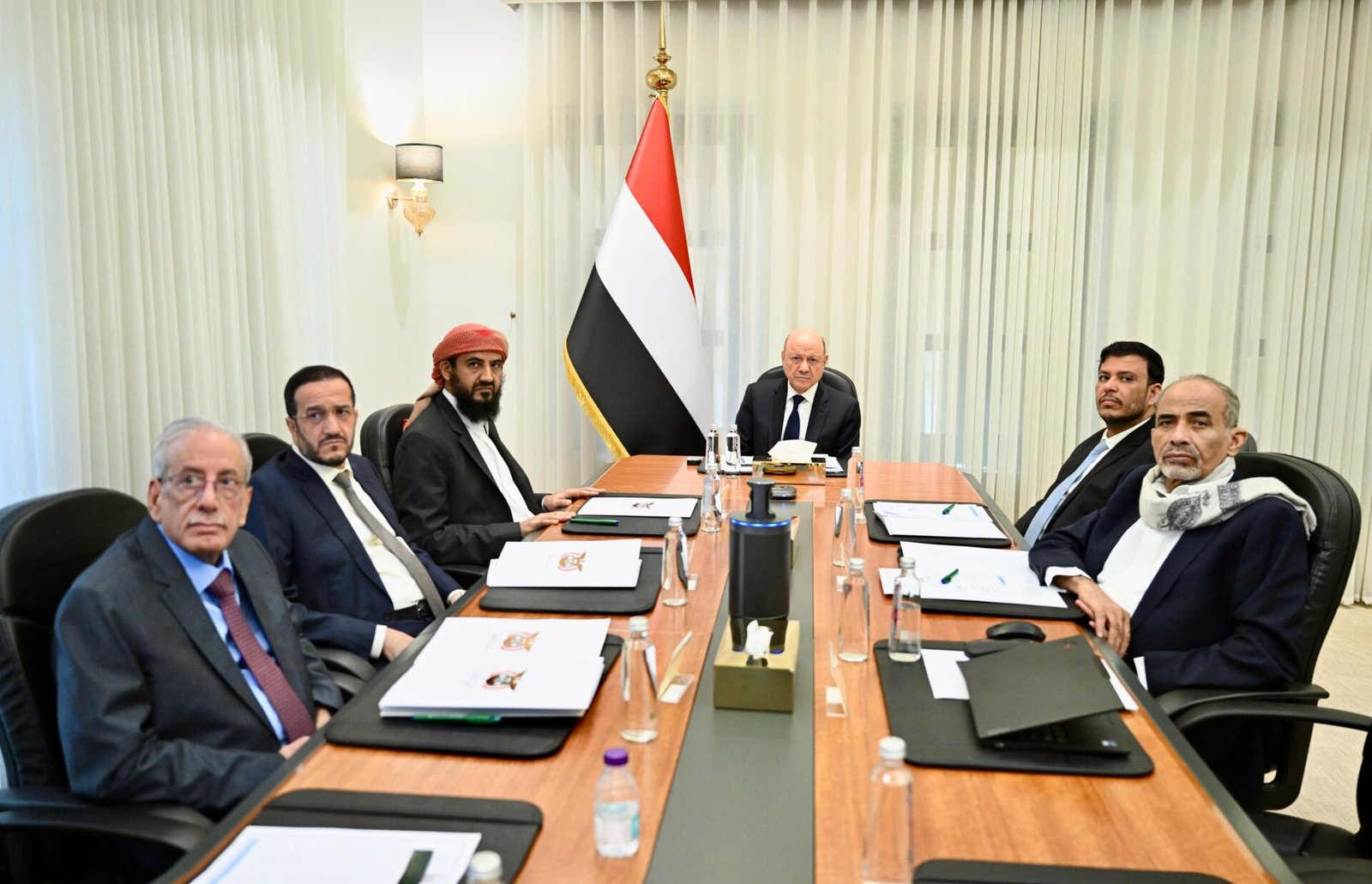
ADEN, Yemen — Yemen’s Presidential Leadership Council has ordered the country’s military, security and intelligence services to their highest readiness level, the council said.
The order came at a council meeting on Aug. 26 chaired by Rashad al-Alimi, the council’s chairman. All members attended, along with Prime Minister Shaya Zindani.
The account of the meeting rests on the council’s own statement, carried by the state news agency Saba. No independent confirmation of the council’s deliberations has been published, and Yemen Herald could not verify the decisions described.
The council said government forces were now prepared to take the initiative rather than absorb attacks.
It warned that any new escalation by the Houthi movement would carry a direct cost for the group’s leadership, capabilities and funding sources.
The measures the council approved include preemptive action against what it called threats, command and control centres, and military capabilities being used or prepared for use against government forces, civilians and vital facilities. The council described those measures as legitimate and necessary.
The meeting was given over to military, security and economic developments, and to what the council called the state’s strategic options.
Several fronts have seen increased military movement in recent weeks, the council said, along with attacks on civilian areas and installations.
The council said the state was continuing its efforts to restore its institutions, impose its authority across Yemeni territory and end what it describes as the Houthi coup. The Houthi administration in Sanaa rejects that characterisation and presents itself as the country’s legitimate authority.
Council members were briefed on developments on the ground, according to the statement.
They also discussed economic and security measures intended to improve living conditions and to address what the council listed as terrorism, smuggling and organised crime.
The council praised the performance of the armed and security forces over recent weeks and said they had foiled Houthi attacks. It gave no figures.
Recent government operations had sent a message that targeting cities, civilians and national installations without cost was no longer possible, the council said.
Asharq Al-Awsat reported on Aug. 30, citing military sources and monitoring centres, that the Houthis carried out more than 75 attacks over the preceding six weeks using ballistic missiles and explosive-laden drones. The newspaper said government forces and allied formations carried out more than 500 combat, defensive and offensive operations over the same period.
Those attacks included missile barrages against the port of Mokha and the city of Al Khawkhah, and strikes on military camps in Marib and Al Abr, the newspaper said. Commercial vessels were also targeted.
Yemen Herald could not independently verify either tally. Both rest on accounts from one side of the conflict.
The government operations covered fronts in Hodeidah, Marib, Taiz, Al Dhale and Al Bayda, according to the newspaper.
Informed Yemeni sources told Asharq Al-Awsat that two drone aviation brigades have been formed within the armed forces, moving the aircraft from reconnaissance work to combat use.
Drones have been used against Houthi barracks, supply vehicles and trenches on fronts in Marib, Al Jawf, Al Bayda, the west coast and Al Dhale, and in parts of Hajjah governorate, the same report said.
Government forces have also downed Houthi reconnaissance drones that were preparing maritime attacks with explosive-laden boats, according to the newspaper.
Government forces remain divided among several commands. Regular units answer to Lieutenant General Sagheer bin Aziz. Forces on the west coast and at Mokha are commanded by Tareq Saleh, a council member.
The Emergency Forces and the Nation’s Shield formations report to al-Alimi. Units on the Taiz fronts operate under the Fourth Military Region, headquartered in Aden.
The Giants Brigades and other southern formations deployed in Lahj, Al Dhale and Shabwa are commanded by Abdul Rahman al-Mahrami, who also sits on the council.
Shelling of the port of Mokha halted the port’s activity and damaged its infrastructure, Asharq Al-Awsat reported, with preliminary estimates putting the losses in the billions of Yemeni riyals.
Al-Alimi has repeatedly described the government’s approach as calibrated escalation, striking sources of threat with missiles, artillery and drones while stopping short of large ground operations to take territory.
Asharq Al-Awsat assessed that a full-scale ground war remains less likely than continued calibrated escalation, and that the government appears unwilling to be drawn into a wider confrontation.
Asharq Al-Awsat wrote that recent statements by Tareq Saleh pointed to Hodeidah as a possible focus of a wider confrontation if pressure on shipping is sustained.
The escalation of recent weeks has produced new waves of displacement in Marib and along the west coast, the newspaper said.
The Presidential Leadership Council was formed in April 2022, when President Abd Rabbu Mansour Hadi transferred his powers to it. Al-Alimi has chaired it since.
The Houthis took control of Sanaa in September 2014. A United Nations-brokered truce took effect in April 2022 and lapsed that October, and was followed by what Asharq Al-Awsat has described as a fragile de-escalation.
The United Nations published its 2026 Yemen Humanitarian Needs and Response Plan on March 18. The plan seeks 2.16 billion dollars to reach 12 million people.
It puts more than 22 million people in need of assistance and 18.3 million as acutely food insecure.
Funding has lagged well behind that target. The United Nations funding update issued on May 6 recorded about 12.7 percent of the appeal as received.
About the Author