Saudi Arabia and France back Yemen’s Presidential Leadership Council and condemn Houthi attacks on ships
 Yemen Herald News
PARIS, France — Saudi Arabia and France reaffirmed support for Yemen’s Presidential Leadership Council and condemned Houthi attacks on shipping in a joint statement issued here on Aug. 24.
The statement followed talks between Saudi Crown Prince and Prime Minister Mohammed bin Salman and French President Emmanuel Macron during a two-day official visit to France.
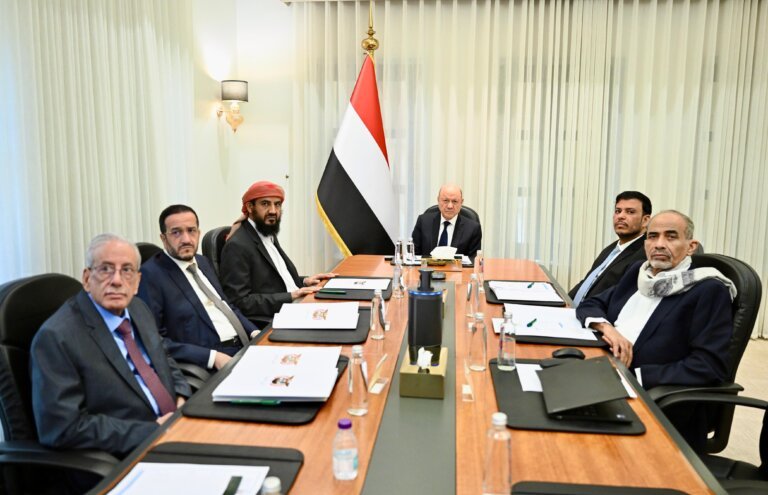
On Yemen, the two governments said they supported the Presidential Leadership Council and United Nations efforts to reach what they described as an inclusive and comprehensive solution to the conflict.
They condemned Houthi attacks on civilian infrastructure and on what the statement called vital facilities inside Saudi Arabia, along with attacks on commercial vessels.
Both sides said they were determined to preserve freedom of maritime navigation.
The statement did not cite specific incidents, dates or locations for the attacks it condemned.
The two governments said Houthi provocations were deepening the humanitarian suffering of the Yemeni people, according to the text carried by the Saudi Press Agency.
France expressed what the statement called its solidarity and full support for Saudi Arabia, and rejected attacks on Saudi territory and installations.
The Houthi movement, which controls Sanaa and much of northern Yemen, disputes the way Riyadh and the internationally recognised government characterise its operations. It has said its attacks on shipping are tied to the war in Gaza.
Yemen Herald found no public Houthi response to the Paris statement.
The statement said stability in the Middle East must rest on the sovereignty of states, respect for international law and the pursuit of political and diplomatic solutions.
It also addressed the Strait of Hormuz. Riyadh and Paris condemned attacks on ships there and called for navigation through the strait to be restored to the conditions that prevailed before Feb. 28, 2026.
They called for freedom of navigation, regular shipping traffic and the absence of direct or indirect tolls or restrictions on passage, in accordance with international law.
On energy, the two sides cited market stability, security of supply and the protection of maritime routes. They set out plans to deepen cooperation in oil, petrochemicals, renewable energy, energy storage, clean hydrogen and peaceful nuclear power.
The Presidential Leadership Council was formed in April 2022, when President Abd Rabbu Mansour Hadi transferred his powers to it. It is chaired by Rashad al-Alimi and is based in Aden.
Saudi Arabia has led a military coalition in Yemen since March 2015 in support of the internationally recognised government.
Houthi attacks on commercial shipping in the Red Sea and the Bab al-Mandab strait began in November 2023.
The United Nations special envoy for Yemen, Hans Grundberg, told the Security Council on Aug. 13 that the country faced a greater risk of renewed large-scale conflict than at any point since the truce agreed in April 2022.
Grundberg linked that assessment to fighting in Marib and Hadramawt and to renewed attacks on commercial shipping in the Red Sea and the Gulf of Aden.
Humanitarian needs remain severe. The United Nations Office for the Coordination of Humanitarian Affairs said in its March 2026 humanitarian needs and response plan that more than 22 million people require assistance.
The plan put the number of acutely food insecure people at 18.3 million. It recorded more than 2.2 million children under five as acutely malnourished, including 516,157 severe cases.
It also counted 5.2 million internally displaced people, and appealed for 2.16 billion dollars to reach 12 million of those in need.
Yemen was one of several files covered in Paris.
On Iran, the two sides called for a negotiated solution to prevent further escalation and urged Tehran to resume full cooperation with the International Atomic Energy Agency.
On the Palestinian territories, they welcomed the announcement of an agreement on the disarmament of Hamas and called for its implementation. They also called for conditions allowing a sustainable ceasefire and for safe and unhindered humanitarian access to civilians in Gaza.
They rejected attempts to undermine the Palestinian right to an independent state within the 1967 borders, and called for an end to Israeli settlement policy and settler violence.
On Lebanon, the two governments backed full implementation of United Nations Security Council Resolution 1701 and the disarmament of all non-state armed groups. They commended President Joseph Aoun and Prime Minister Nawaf Salam, and called for Israel to withdraw from Lebanese territory.
On Sudan, they called for intensified efforts to end the crisis and for a halt to foreign interference. On Syria, they backed the country’s unity, stability and economic recovery, and welcomed the creation of a Saudi-Syrian-French business council.
The visit marked a century of political relations between Saudi Arabia and France and included the first meeting of the French-Saudi Strategic Partnership Council.
The two leaders adopted a declaration on defence cooperation covering armaments and training.
Bilateral trade reached about 11.8 billion dollars in 2025, the statement said.
More than 22 agreements and memorandums of understanding were announced at a French-Saudi investment roundtable, covering defence, healthcare, artificial intelligence, emerging technologies and entertainment.
The statement welcomed a plan by Qiddiya Investment Company to develop a mixed-use site at Cergy-Pontoise, in the Ile-de-France region, with investment of around 6 billion euros over the project’s development lifecycle.
Cooperation is also to deepen in artificial intelligence, quantum computing and emerging technologies.
The two countries agreed to extend their partnership on AlUla until 2035.
France confirmed it would take part in Riyadh Expo 2030.
About the Author