Foreign Minister Afrah al-Zouba and Kuwait’s foreign minister agree to revive cooperation agreements
 Yemen Herald News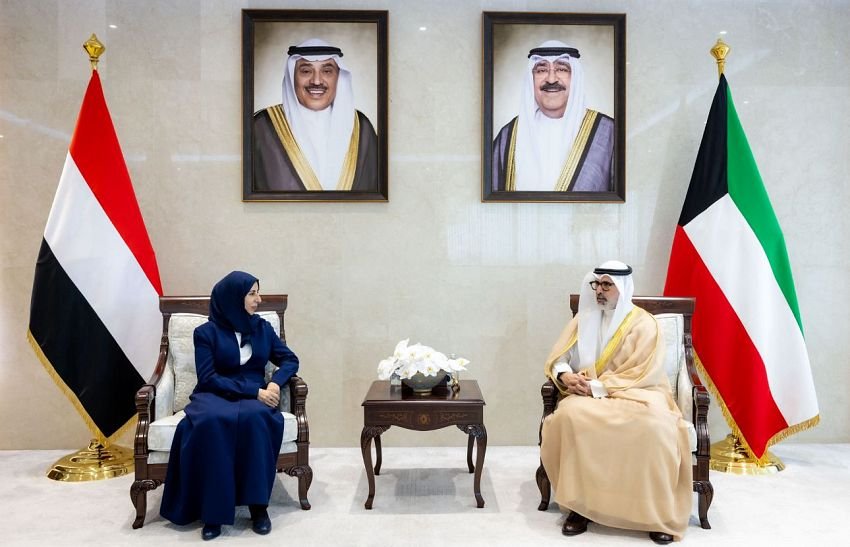
KUWAIT CITY, Kuwait — Yemen’s foreign minister and her Kuwaiti counterpart agreed on Monday to review and reactivate dormant cooperation agreements between the two states.
Afrah al-Zouba held talks with Sheikh Jarrah Jaber al-Ahmad al-Sabah on bilateral relations, the situation in Yemen and regional issues, the Yemeni state news agency Saba reported.
The two agreed to go through existing agreements, memorandums of understanding and cooperation frameworks, and to update them to widen diplomatic, economic and development ties, according to Saba.
Al-Zouba thanked Kuwait for what she described as decades of political, development and humanitarian support for Yemen.
She said Yemen stood in full solidarity with Kuwait and the other Gulf Cooperation Council states against Iranian attacks.
Sheikh Jarrah said Kuwait’s support for the Presidential Leadership Council and the Yemeni government was firm, and backed Yemen’s unity, sovereignty and territorial integrity, Saba reported.
He said Kuwait would continue development and humanitarian support and back efforts to end the suffering of the Yemeni people.
Yemen Herald could not independently confirm the account of the meeting. It rests on the Saba report alone, and Kuwait’s foreign ministry published no readout of its own.
Saba named no agreement, gave no timetable for the review and set no date for further talks.
The meeting was part of a Gulf tour by al-Zouba, her most substantial travel since taking office.
On the same visit she delivered a written message from President Rashad al-Alimi, chairman of the Presidential Leadership Council, addressed to Kuwait’s Emir, Sheikh Meshal al-Ahmad al-Jaber al-Sabah, Saba reported.
She also met the Kuwait Fund for Arab Economic Development to discuss resuming Kuwaiti development financing for Yemen, and the Kuwait Red Crescent Society on humanitarian projects, according to the agency.
Al-Zouba was appointed foreign minister on July 23, the first woman to hold the post or any of Yemen’s most senior cabinet jobs.
She had served as minister of planning and international cooperation since February. She trained as a pharmacist at Sanaa University and spent more than 25 years in development and peacebuilding work before entering government.
Sheikh Jarrah took the Kuwaiti portfolio in February, succeeding Abdullah Ali al-Yahya, who had held it since May 2024.
Kuwait has a long involvement in Yemeni diplomacy. It hosted UN-mediated peace talks between the Yemeni government and the Houthis over several months in 2016.
Those talks broke down without an agreement.
A later UN-brokered truce took effect in April 2022 and lapsed that October. Formal negotiations have not resumed.
The talks came during a sharp escalation between Iran and the United States across the Gulf.
Iran fired ballistic missiles and drones at US bases in Kuwait, Bahrain, Jordan and Erbil in northern Iraq, Gulf News and Asharq Al-Awsat reported.
Kuwait’s military said its air defences intercepted drones launched from Iran. Jordan said it brought down 10 ballistic missiles and that three others fell in remote areas without casualties.
Yemen’s foreign ministry condemned those attacks on Wednesday, calling them a violation of the four countries’ sovereignty.
Saudi Arabia’s foreign ministry separately condemned Iran’s targeting of the tanker Sidr in the Strait of Hormuz, saying crew members were killed. Yemen Herald has not independently verified that toll.
Iran rejects allegations that it arms the Houthis. The Houthis deny acting on Tehran’s behalf.
Yemen’s government moved its seat to Aden after the Houthis seized Sanaa in September 2014. Several ministries and the central bank operate from the southern port city; others work from Riyadh.
The cabinet is led by Prime Minister Shaya Zindani, who took office in February after Salem Saleh bin Braik resigned. Zindani had previously served as foreign minister.
Yemen’s humanitarian position remains among the worst tracked by the United Nations.
The UN Office for the Coordination of Humanitarian Affairs said in its March 2026 response plan that more than 22 million people need assistance and that 18.3 million are acutely food insecure.
More than 2.2 million children under five are acutely malnourished, 516,157 of them severely, the plan said. It recorded 5.2 million internally displaced people.
The plan seeks USD 2.16 billion to reach 12 million people this year.
Gulf states have been the largest single bloc of donors to Yemen through the war, alongside the United States and European governments.
Al-Zouba has made regional outreach an early priority, holding contacts with counterparts in Egypt, Sudan and Djibouti in her first weeks in office.
Saba did not say where in Kuwait the meeting was held, or who else attended.
The Kuwait Fund for Arab Economic Development has financed roads, power and water projects in Yemen since the 1960s. Much of that lending was suspended as the war spread.
Kuwait is a member of the Gulf Cooperation Council, which brokered the 2011 transition deal that removed Ali Abdullah Saleh from the presidency after three decades in power.
The council also hosted the 2022 consultations in Riyadh at which Abd Rabbu Mansour Hadi transferred his powers to the Presidential Leadership Council.
That council has governed the internationally recognised side of the conflict since April 2022. It is chaired by al-Alimi and has eight members.
Saba said the council held a joint session with the government on Wednesday to review what the agency called comprehensive deterrent measures. It gave no detail.
The Houthis control Sanaa and much of Yemen’s densely populated north-west, including the Red Sea port of Hodeidah.
About the Author