Yemen’s ambassador to Germany raises Houthi escalation and Red Sea security with Berlin official
 Yemen Herald News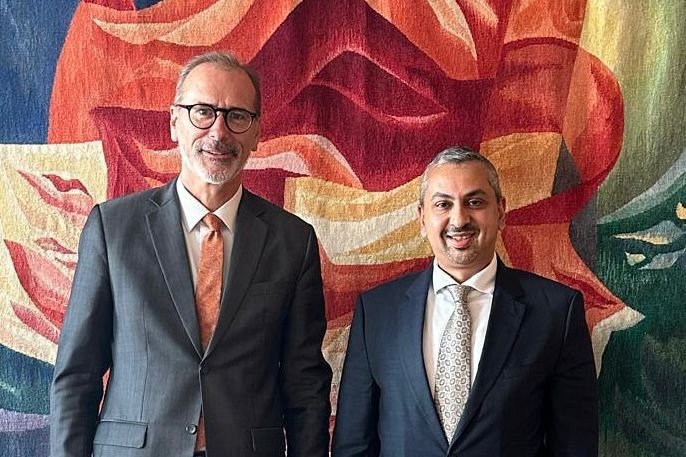
BERLIN, Germany — Yemen’s ambassador to Germany raised Houthi attacks on Red Sea shipping with a senior German foreign ministry official on Monday.
Louay al-Eryani met Clemens Hach, director of the Middle East and North Africa department at the German Federal Foreign Office, the Yemeni state news agency Saba reported.
The two discussed developments inside Yemen and what Saba described as the recent Houthi escalation and the movement’s threats to maritime security in the Red Sea.
Al-Eryani said the Yemeni government treated peace as its primary option while defending Yemen’s sovereignty, national interests and the lives of its citizens, according to Saba.
He thanked Germany for its support for the government and people of Yemen and for its backing of peace efforts.
Hach said Germany supported the Yemeni government and people and wanted to strengthen relations between the two countries, Saba reported.
Yemen Herald could not independently confirm the account of the meeting. It rests on the Saba report alone, and the German Federal Foreign Office published no readout of its own.
Saba named no specific German commitment and reported no new initiative arising from the talks.
The Houthis reject the description of their Red Sea campaign as terrorism and say it is a response to the war in Gaza.
The movement has attacked commercial shipping in the Red Sea and the Gulf of Aden since late 2023, targeting more than 100 vessels between November 2023 and January 2024.
Many operators moved to the longer route around southern Africa. Suez Canal revenue fell to about USD 4 billion in 2024 from a record USD 10.3 billion the previous year, according to the Suez Canal Authority.
Bab al-Mandab, the 18-mile strait between Yemen and Djibouti, is the southern gate to the Suez route.
Germany was one of Yemen’s largest bilateral donors last year, according to the Federal Foreign Office. It provided 50 million euros in development cooperation and more than 25 million euros in humanitarian assistance in 2025.
The ministry says only a very limited number of German humanitarian projects run in areas controlled by the Houthis, both to protect staff and to avoid strengthening the movement.
Berlin supports the United Nations-led effort and the Office of the Special Envoy for Yemen to settle the conflict between the internationally recognised government and the Houthis, the ministry says.
Germany has no mission operating inside Yemen. Its embassy accredited to Sanaa works from Riyadh, and its consular service for the country is suspended.
The head of that mission, Ambassador Thomas Friedrich Schneider, met Yemen’s planning minister, Mohammed al-Faqmi, in Riyadh on Tuesday for talks on development assistance, Saba reported.
Yemen’s own embassy in Berlin has continued to operate through the war. Al-Eryani was sworn in as ambassador to Germany before taking up the post.
Relations between the two countries have traditionally been friendly, the Federal Foreign Office says, and Germany is well regarded in Yemen because of decades of development and humanitarian work.
The Houthis seized Sanaa in September 2014 and the government moved its seat to Aden. Several ministries and the central bank operate from the southern port city; others work from Riyadh.
A UN-brokered truce took effect in April 2022 and lapsed that October. Formal negotiations have not resumed.
The Presidential Leadership Council, chaired by Rashad al-Alimi, has governed the internationally recognised side of the conflict since April 2022. Prime Minister Shaya Zindani has led the cabinet since February.
Afrah al-Zouba was appointed foreign minister on July 23, the first woman to hold the post.
Saba said the council held a joint session with the government on Wednesday to review what the agency called comprehensive deterrent measures. It gave no detail.
Yemen’s humanitarian position remains among the worst tracked by the United Nations.
The UN Office for the Coordination of Humanitarian Affairs said in its March 2026 response plan that more than 22 million people need assistance and that 18.3 million are acutely food insecure.
More than 2.2 million children under five are acutely malnourished, 516,157 of them severely, the plan said. It recorded 5.2 million internally displaced people.
The plan seeks USD 2.16 billion to reach 12 million people this year.
The talks came during a sharp escalation between Iran and the United States across the Gulf.
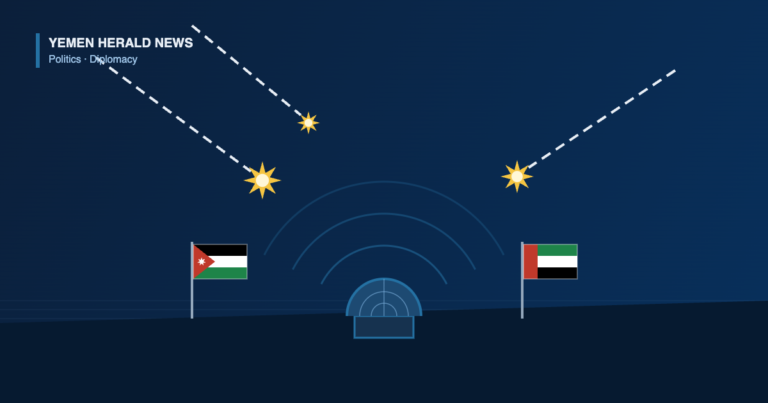
Iran fired ballistic missiles and drones at US bases in Kuwait, Bahrain, Jordan and Erbil in northern Iraq, Gulf News and Asharq Al-Awsat reported. Jordan said it intercepted 10 ballistic missiles and that three others fell in remote areas without casualties.
Yemen’s foreign ministry condemned those attacks on Wednesday, calling them a violation of the four countries’ sovereignty.
Saudi Arabia’s foreign ministry separately condemned Iran’s targeting of the tanker Sidr in the Strait of Hormuz, saying crew members were killed. Yemen Herald has not independently verified that toll.
Iran rejects allegations that it arms the Houthis. The Houthis deny acting on Tehran’s behalf.
The United States redesignated the Houthi movement a foreign terrorist organisation in 2025. The European Union has not applied the same designation.
Germany contributes to European naval efforts in the region. The EU launched Operation Aspides in the Red Sea and Gulf of Aden in February 2024 to escort merchant vessels.
The Houthis control Sanaa and much of Yemen’s densely populated north-west, including the Red Sea port of Hodeidah.
About the Author