Bahrain Joins 20-Nation Pledge to Help Secure Navigation Through the Strait of Hormuz
 Yemen Herald News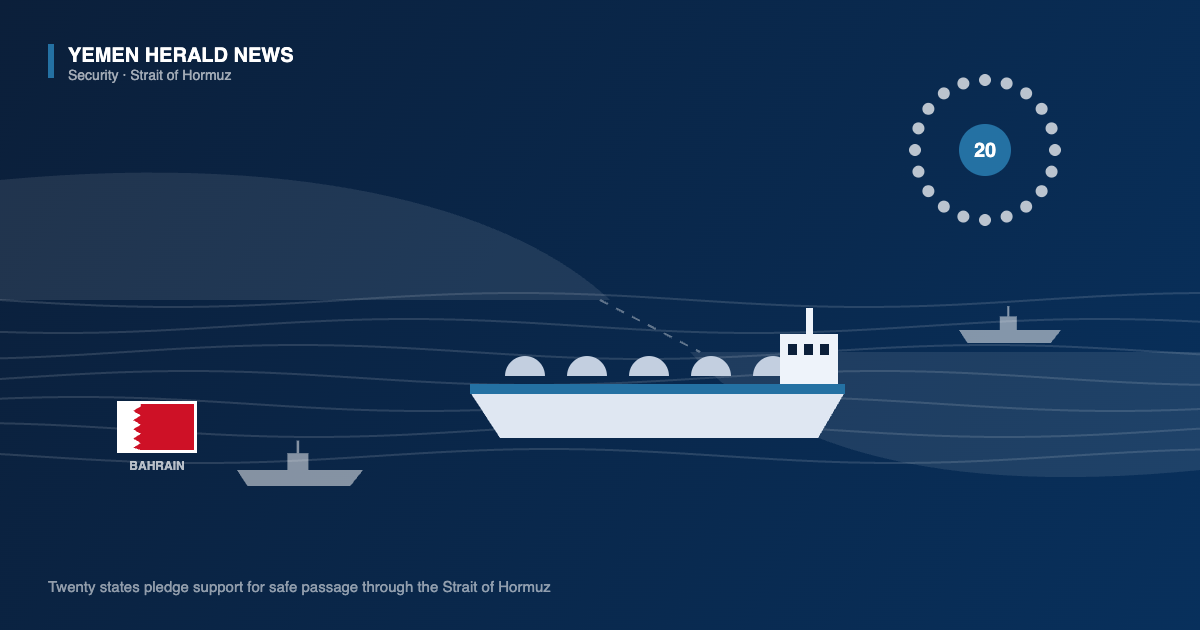
Bahrain was among twenty countries that signed a joint statement in March 2026 declaring their readiness to help secure navigation through the Strait of Hormuz, the passage through which a large share of the world’s seaborne oil and liquefied natural gas moves. The statement was issued on 19 March and published by participating governments over the following day.
The signatories were the United Kingdom, France, Germany, Italy, the Netherlands, Japan, Canada, the Republic of Korea, New Zealand, Denmark, Latvia, Slovenia, Estonia, Norway, Sweden, Finland, Czechia, Romania, Lithuania and Bahrain. Bahrain was the only Gulf state among them at the time of issue, which gave its participation particular weight: it is the sole signatory whose territory sits on the waterway in question. Additional countries subsequently associated themselves with the position, and reporting later put the number at twenty-two.
The statement set out three specific objections. It condemned attacks by Iran on unarmed commercial vessels in the Gulf; it condemned attacks on civilian infrastructure, including oil and gas installations; and it objected to what the signatories described as the de facto closure of the Strait of Hormuz by Iranian forces. The third point is the most consequential, because a strait that is closed in practice does not require a formal declaration to disrupt global trade.
On the operational side, the signatories said they were ready to contribute to appropriate efforts to ensure safe passage, and welcomed the commitment of states already engaged in preparatory planning. The language was deliberately unspecific. Contributions to maritime security operations can range from warships providing escort to surveillance aircraft, minesweeping capability, intelligence sharing or funding, and governments generally avoid committing to a particular form before national decision-making processes have run.
The composition of the group is notable. It is dominated by European states and by Asian and Pacific economies that import most of their energy, rather than by producers. Japan and South Korea draw a substantial share of their crude and liquefied natural gas from the Gulf, and several smaller European signatories have large merchant fleets registered under their flags. The list reads less like a security alliance than like a coalition of the exposed.
Freedom of navigation through international straits is governed by the United Nations Convention on the Law of the Sea, which provides a right of transit passage that coastal states may not suspend. Iran signed the convention but has not ratified it, and has disputed elements of the transit passage regime. That disagreement predates the current conflict by decades.
The statement also addressed the energy consequences directly. It welcomed the decision by the International Energy Agency to authorise a coordinated release of strategic petroleum reserves. IEA member countries had agreed on 11 March to make 400 million barrels available from emergency stocks, an unprecedented volume intended to blunt the effect of the supply disruption on importing economies. The signatories added that they would take further steps to stabilise energy markets, including working with producing countries to increase output.
Strategic reserve releases are a blunt instrument with a limited horizon. They can cover a shortfall for weeks or months and dampen speculative price movement, but they add no production capacity and the stocks must later be rebuilt. Their main value lies in signalling that consuming governments will not let a chokepoint closure translate directly into a price shock.
The Strait of Hormuz is roughly 33 kilometres across at its narrowest point, with the shipping lanes narrower still, and it links the Gulf to the Gulf of Oman and the Arabian Sea. No comparable alternative route exists for the bulk of Gulf crude and gas exports. Pipelines through Saudi Arabia and the United Arab Emirates can bypass a portion of the flow, but their combined capacity falls well short of what normally transits the strait. That geography is what makes the waterway a standing point of leverage.
Bahrain’s position within the group reflects both exposure and alignment. The kingdom hosts the United States Navy’s Fifth Fleet at Naval Support Activity Bahrain, has been struck repeatedly by Iranian missiles and drones since the campaign against Gulf states began on 28 February 2026, and depends on the strait for its own trade. Its defence force reported destroying dozens of missiles and more than a hundred drones aimed at Bahraini territory during that period. South Korea separately announced that it would join international efforts on safe navigation.
For Yemen, the Hormuz statement forms one half of a picture whose other half lies much closer to home. The Bab al-Mandab strait at the southern end of the Red Sea, bordered by Yemen, has been the site of repeated attacks on commercial shipping in recent years, and it is the route through which most of Yemen’s imported food, fuel and medicine arrives. Insurance rates, charter costs and vessel routing decisions made in response to conditions in the Gulf feed through into what Yemeni importers pay.
The parallel carries a political point as well. The international response to disruption of the Strait of Hormuz was rapid, coordinated and backed by an emergency release of oil reserves, while the response to disruption of the Red Sea corridor has been slower and less unified. Yemeni officials and shipping bodies have noted that difference.
No detail of the preparatory planning referred to in the statement was made public at the time, and no timetable for any deployment was announced.
About the Author