Executive Unit says 57 families fled Houthi shelling in southern Hodeidah
 Yemen Herald News
HAYS, Yemen — Fifty-seven families fled villages in three southern Hodeidah districts this week after repeated shelling, the Yemeni government body that manages displacement camps said.
The Executive Unit for IDP Camps Management put the number of people at about 400. It reported the movement on Thursday.
The families left villages in the districts of Hays, al-Jarrahi and Jabal Ras, the unit said. All three lie in the south of Hodeidah governorate, on the Red Sea coastal plain.
They moved to Uways, al-Qash, Mahwa al-Abd, al-Ha’it, Mahal al-Rabi, al-Nazali and al-Haribah, according to the unit.
The unit attributed the artillery fire to Houthi forces. It said panic spread through the villages as the shelling continued.
The Houthis have not published an account of the strikes. The account of this displacement rests on the Executive Unit’s statement, and Yemen Herald found no independent organisation that has published its own count of the 57 families.
The families abandoned homes, livestock and their main sources of income, the unit said. Livestock is the principal household asset across the farming villages of the coastal plain.
Those who reached the new sites face shortages of food, drinking water and shelter, the unit said.
It asked aid organisations for emergency shelter, food, cash transfers and sanitation services.
The unit also asked that children, women, older people and people with disabilities be given priority, and that medical and psychological support be arranged.
It said the new arrivals should be folded into existing aid programmes rather than handled as a separate caseload.
The Executive Unit is the government’s camp management authority. It registers displaced households, coordinates with aid agencies and reports movements in the areas the government administers.
Its figures do not extend to Houthi-held territory, where displacement is recorded through other channels.
A larger movement through the same districts was reported in late August. The unit said then that 158 families had left their homes in Hodeidah governorate.
Of those, 124 reached Hays from al-Jarrahi, Jabal Ras and Maqbanah, and 34 reached Khokha, according to the August account.
Maqbanah lies in neighbouring Taiz governorate, across the boundary from the Hodeidah districts. Khokha sits on the coast to the north of Mokha.
The unit did not give a figure for how many people the 158 families comprised.
Some of those families were sheltering in open ground without services, the unit said at the time.
Jamal Mashra’i, who directs the unit in Hodeidah, said relief was being coordinated with the Human Access association and the King Salman Humanitarian Aid and Relief Centre.
Shelter and emergency supplies reached part of the displaced population through the International Rescue Committee and the International Organization for Migration, Mashra’i said.
Many families had still not received food rations, he said.
The movement matches a pattern the International Organization for Migration has tracked through the year.
The agency’s Displacement Tracking Matrix logged 2,631 displaced families, or 15,786 people, between Jan. 1 and Aug. 29.
Of those, 967 families moved during August alone. That is more than a third of the total the matrix recorded across the first eight months.
The agency named Taiz, Hodeidah and Marib as the governorates where military activity intensified during that month.
Conflict drove 95 percent of the movements the matrix recorded, the agency said. Economic pressure accounted for 4 percent.
The matrix collects household-level data daily, which lets the agency report new displacement by number, location and need rather than in periodic estimates.
IOM reported separately that about 227 displaced families left three shelter sites in western Taiz on Aug. 25 and Aug. 26 as fighting closed in. Those households had already been displaced at least once.
Hays lies on Yemen’s west coast, south of Hodeidah city, along the road that links Mokha to the port.
The district has sat close to the front line since 2018, when fighting reached the coastal plain and government-aligned forces advanced north from Mokha.
The Stockholm Agreement, signed that December, set out a ceasefire and a redeployment of forces in Hodeidah city and its three ports.
The agreement did not cover the governorate’s southern districts. Shelling and ground fighting continued there.
A United Nations-brokered truce took effect in April 2022 and formally lapsed that October. Front lines have largely held since, with intermittent artillery exchanges along the west coast and around Taiz.
The United Nations put the number of people in Yemen needing humanitarian assistance at more than 22 million in its humanitarian needs and response plan for 2026, published in March.
The plan recorded 18.3 million people as acutely food insecure and counted more than 2.2 million children under five as acutely malnourished, 516,157 of them severely.
It put the displaced population at 5.2 million.
Aid agencies sought $2.16 billion under the plan to reach 12 million people during the year.
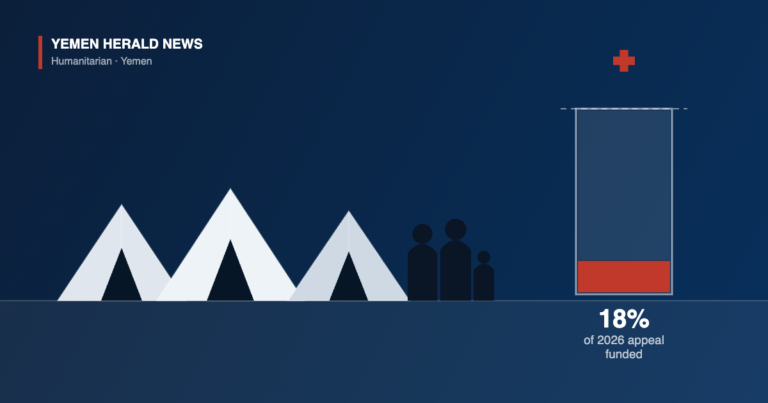
By May 9 the appeal had received about $280 million, or 12.9 percent of the requirement, the U.N. Office for the Coordination of Humanitarian Affairs said.
The office described the response as critically underfunded at that point and said agencies were being forced into prioritisation decisions.
The Executive Unit did not say how many of the 57 families had been displaced before.
About the Author