Yemen’s ambassador in Geneva raises Houthi escalation with Swiss foreign ministry official
 Yemen Herald News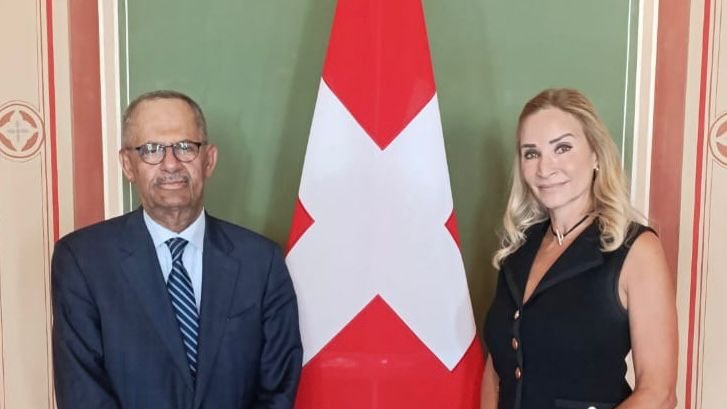
GENEVA, Switzerland — Yemen’s ambassador to Switzerland met a senior Swiss foreign ministry official this week to discuss Houthi escalation and Red Sea shipping.
Ali Mujawar, who is also Yemen’s permanent representative to the United Nations in Geneva, held the talks with Ambassador Monika Schmutz Kirgöz, head of the Middle East and North Africa Division at the Swiss Federal Department of Foreign Affairs, according to Saba, Yemen’s state news agency.
The account of the meeting rests on Saba alone. No Swiss readout or independent report of the talks has been published, and Yemen Herald could not confirm the exchange separately.
Mujawar said the Houthi movement acts as an Iranian proxy.
He said the group was trying to reproduce in the Bab al-Mandab Strait the tensions that have affected the Strait of Hormuz, threatening energy security and global supply chains, Saba reported.
The Houthis have rejected such descriptions in the past. The movement has said its maritime operations are its own decision and has denied that Iran directs them.
Mujawar said United Nations reporting had documented operational and intelligence cooperation between the Houthis, al-Qaeda and Somalia’s al-Shabaab.
He said the group had also moved drone technology, naval mines and explosive devices across the Red Sea.
The ambassador pointed to recent missile and drone attacks he attributed to the Houthis.
He said the attacks had left the humanitarian port at Mokha inoperable, targeted oil tankers in the Red Sea and struck civilian sites in Marib, Hadramout, Hodeidah and Shabwa.
Mokha’s port on Yemen’s Red Sea coast stopped operating after strikes reported earlier this week. About 1,500 workers lost their jobs, according to accounts from the port.
Mujawar asked for what he called firm international action.
He said states should enforce Security Council resolutions on Yemen, curb Iranian arms smuggling networks and press for the release of detained United Nations and humanitarian staff, Saba reported.
He also asked for support for the Yemeni state and its Coast Guard in protecting ports and international navigation.
Schmutz Kirgöz reaffirmed Swiss support for peace and humanitarian efforts in Yemen, and said coordination with the internationally recognised government would continue, according to the agency.
The Swiss Federal Department of Foreign Affairs did not publish its own account of the meeting.
Schmutz Kirgöz joined the Swiss diplomatic service in 1996. She previously served as head of mission in Rome and took up the Middle East and North Africa portfolio in Bern in early 2025.
Mujawar has represented Yemen in Bern and Geneva since December 2012.
Detentions of aid staff have been a recurring subject in Yemeni diplomatic contacts. Human Rights Watch said this week that Houthi authorities were holding 73 United Nations employees.
The rights group put the number of Yemenis needing humanitarian assistance at 22.3 million.
The United Nations humanitarian plan issued in March 2026 gives a similar figure. It lists more than 22 million people in need and 18.3 million who are acutely food insecure.
The plan records 5.2 million internally displaced people.
It counts more than 2.2 million children under five who are acutely malnourished, of whom 516,157 are severely malnourished.
The appeal seeks 2.16 billion dollars to reach 12 million people.
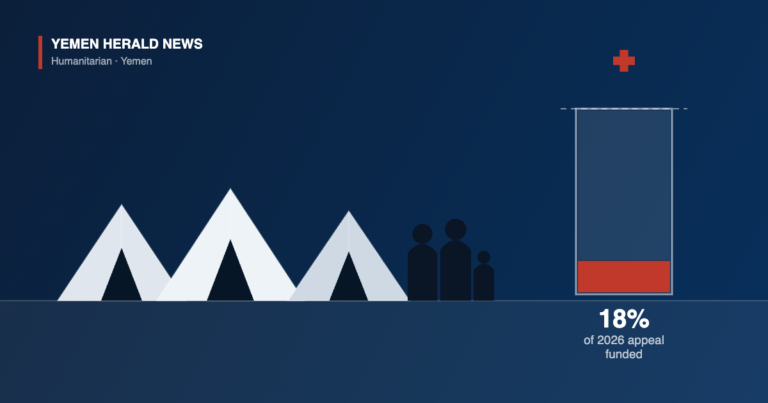
Funding has lagged. The European Union announced three million euros for the United Nations Population Fund this week, at a point when the Yemen appeal stood at 18 per cent funded.
Bab al-Mandab separates Yemen from the Horn of Africa and links the Red Sea to the Gulf of Aden.
Traffic through the strait dropped after Houthi attacks on merchant shipping began, and carriers rerouted vessels around southern Africa.
The Geneva meeting followed a series of similar Yemeni approaches to European capitals.
Yemen’s ambassador to Prague asked the Czech Republic and the European Union this week to designate the Houthis.
Yemen’s ambassador to Germany raised Houthi escalation and Red Sea security with a Berlin official earlier in the week.
The government also asked Arab states this week for a joint strategy to protect trade routes.
A subcommittee of the United States House of Representatives heard testimony this week on countering Houthi attacks and Red Sea shipping security.
Claims about Houthi support for al-Shabaab have circulated beyond Yemeni official channels. Researchers said this week that the movement had supplied the Somali group with drones, weapons and training.
Al-Shabaab has not commented on those accounts.
Yemen’s Presidential Leadership Council ordered a higher state of readiness in late August.
Saudi Arabia and France issued a joint statement on 31 August backing the council and condemning Houthi attacks.
Yemen’s foreign ministry condemned Iranian missile attacks on Kuwait, Bahrain, Jordan and Iraq this week.
Mujawar’s Geneva post covers both the bilateral relationship with Bern and Yemen’s representation at the United Nations offices in the city.
Yemen took part in a Human Rights Council preparatory meeting in Geneva at the start of the month, where the Arab Group discussed an Item 10 resolution.
Switzerland is not a member of the European Union.
Geneva hosts the Office of the High Commissioner for Human Rights and the International Organization for Migration, both of which work on Yemen.
The migration agency reported this week that 227 families had left three displacement sites in western Taiz.
About the Author