Foreign Minister Afrah al-Zouba and South Africa’s envoy discuss political consultations mechanism
 Yemen Herald News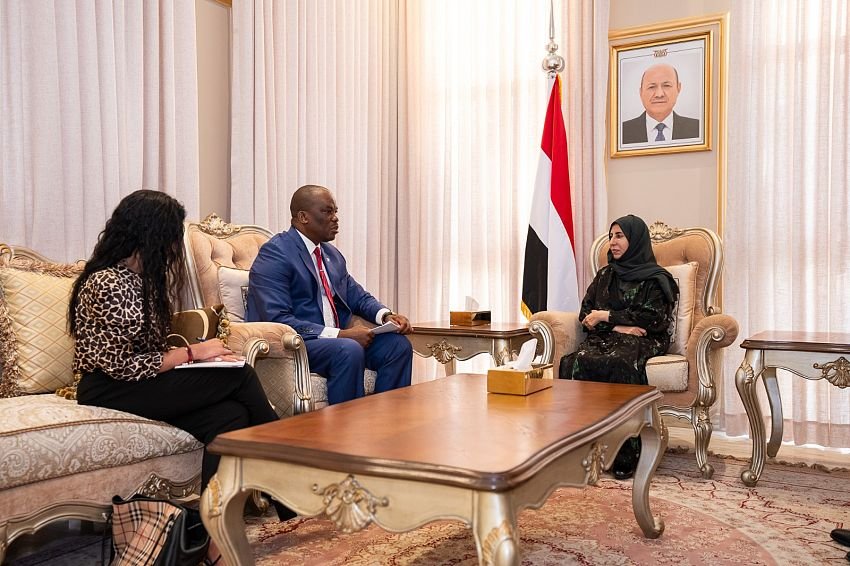
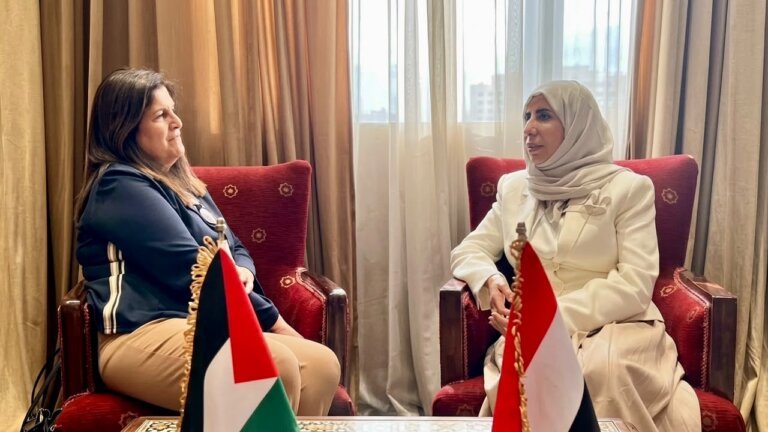
RIYADH, Saudi Arabia — Yemen’s foreign minister and South Africa’s non-resident ambassador discussed arrangements for signing a political consultations mechanism between the two countries on Sunday, the state news agency Saba reported.
Afrah al-Zouba met Mogobo David Magabe, the non-resident ambassador of South Africa to Yemen, the agency said.
Magabe conveyed greetings from Ronald Lamola, South Africa’s minister of international relations and cooperation, and renewed an invitation for al-Zouba to visit the country, according to Saba.
The two sides discussed completing arrangements for a document that would organise the mechanism for political consultations, the agency reported.
Saba said the mechanism is intended to allow regular consultation and coordination, to widen cooperation at the United Nations and in international forums, and to expand political and economic ties.
Al-Zouba thanked South Africa for its positions in support of Yemen and pointed to what she called deep historical relations between the two countries.
She praised South Africa’s stance on the Palestinian question and its international efforts to defend Palestinian rights. Those positions are greatly valued by the Yemeni leadership, government and people, she said.
Magabe reaffirmed South Africa’s support for Yemen’s sovereignty, unity, territorial integrity, security and stability, and said his country wanted to develop bilateral relations, Saba reported.
The account of the meeting rests on Saba, which is run by the internationally recognised government. South Africa’s department of international relations has not published a readout, and Yemen Herald found no independent confirmation of what was said.
Lamola has led South Africa’s foreign ministry since 2024. He also chairs the Council of Ministers of the Southern African Development Community, which South Africa took over for 2026 and 2027.
South Africa filed a case against Israel at the International Court of Justice in December 2023, alleging violations of the Genocide Convention over the conduct of the war in Gaza. Israel rejects the allegations.
Yemen has never recognised Israel and backs a Palestinian state on the 1967 lines with East Jerusalem as its capital.
Saba reported on Sunday that Yemen’s foreign ministry condemned statements by two Israeli cabinet ministers calling for Palestinians to be moved out of Gaza.
Pretoria has kept a non-aligned posture on the Yemen war and has not joined the Saudi-led coalition or the naval operations in the Red Sea.
Both countries sit in the Group of 77 and take part in the Non-Aligned Movement. Yemen’s ambassador to the movement, Asmahan al-Tawqi, delivered a national statement to its meeting at the start of September, Saba reported.
Yemen has sought seats and support in UN bodies through such groupings. It took part in a preparatory meeting of the Arab Group ahead of the Human Rights Council session this month.
The government has also pressed European states to designate the Houthi movement, and its ambassador to Prague raised the question with the Czech Republic on 4 September, the agency reported.
Political consultation mechanisms are standard bilateral instruments. They commit two foreign ministries to meet at agreed intervals and to coordinate positions in multilateral bodies.
Yemen has signed comparable arrangements with several states as it works to hold together diplomatic support for the internationally recognised government.
Al-Zouba held a series of meetings with foreign envoys over the same period. Saba reported that she also met Spain’s non-resident ambassador, Javier Carbajosa, on Sunday, and discussed developments in Yemen with the secretary-general of the Arab League on Monday.
On 2 September the agency reported that she met Kuwait’s foreign minister and discussed resuming financing from the Kuwait Fund for Arab Economic Development.
South Africa does not maintain a resident embassy in Yemen. Several states accredit ambassadors to the country on a non-resident basis, a practice that followed the closure of most missions in Sanaa in 2015.
The Presidential Leadership Council was formed in April 2022, when Abd Rabbu Mansour Hadi transferred his powers to the eight-member body. Rashad al-Alimi chairs it. The council is seated in Aden, and parts of the government work from Riyadh.
The meeting fell during the heaviest fighting in Yemen since the United Nations brokered a truce in April 2022.
Houthi forces launched simultaneous ground assaults in southern Hodeidah and in three districts west of Taiz on Thursday, according to Al Jazeera and Arab News, which described the attack as the largest since that truce. The National reported that government forces counted 14 ballistic missiles fired at rural areas of the two governorates.
Hans Grundberg, the UN special envoy for Yemen, called the escalation extremely alarming and warned that it risked widening the conflict, his office said. He urged the parties to halt hostilities and to use the Military Coordination Committee.
The UN Office for the Coordination of Humanitarian Affairs said nearly 1,800 families fled in less than 48 hours and that several displacement camps in Maqbanah and Jabal Habashi emptied under shelling. It said emergency stocks were severely depleted.
The United Nations humanitarian plan for 2026 counts more than 22 million people in Yemen needing assistance, of whom 18.3 million are acutely food insecure. It records more than 2.2 million children under five as acutely malnourished, including 516,157 severe cases.
The plan counts 5.2 million people displaced inside the country and seeks 2.16 billion dollars to reach 12 million of them.
Saba did not say when the consultations document would be signed.
About the Author