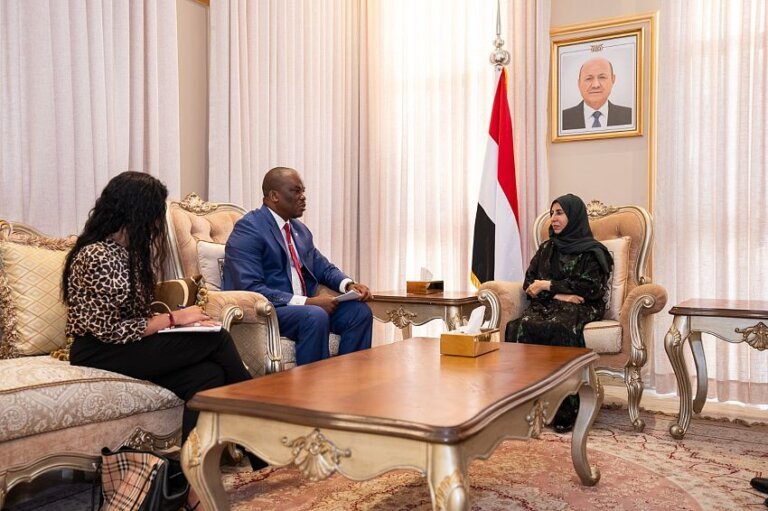
Foreign Minister Afrah al-Zouba meets Palestinian counterpart on Arab League sidelines in Cairo
 Yemen Herald News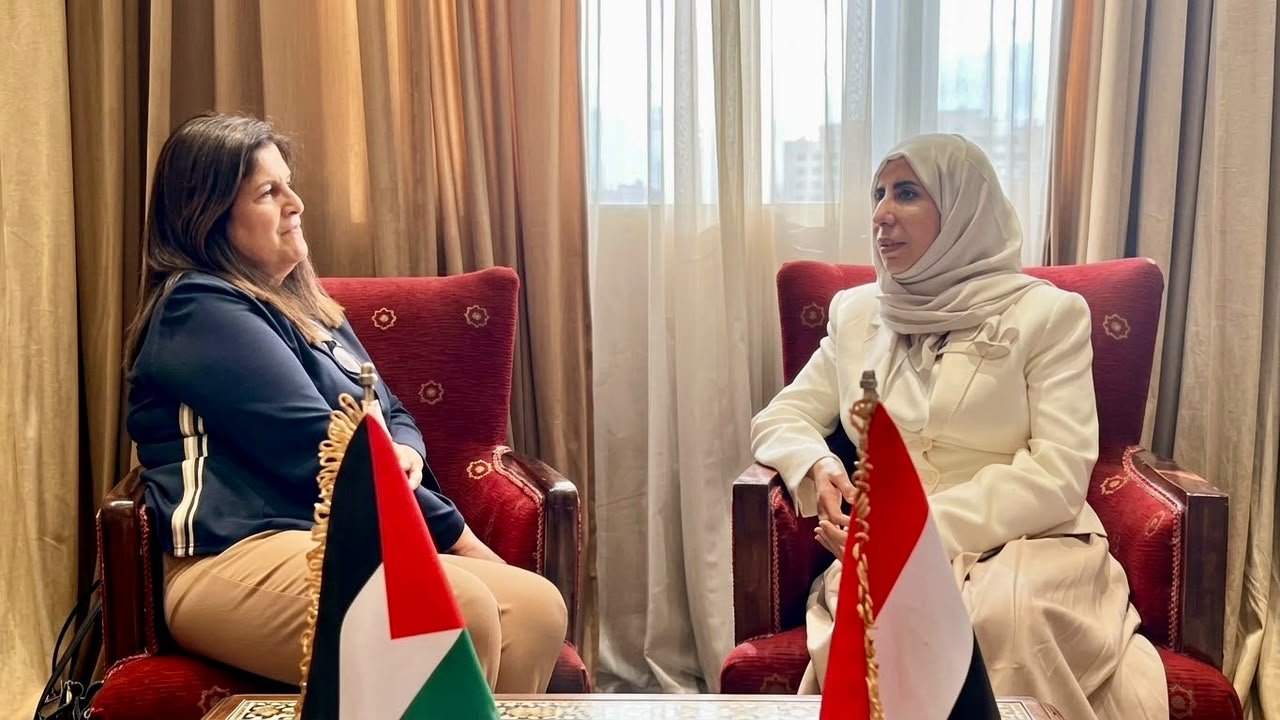
CAIRO, Egypt — Yemen’s foreign minister told her Palestinian counterpart that Yemen’s backing for Palestinian statehood rests on justice, not passing politics, the state news agency Saba reported.
Afrah al-Zouba met the Palestinian minister of foreign affairs and expatriates, Varsen Aghabekian Shahin, on Monday on the sidelines of the 166th ordinary session of the Arab League Council at ministerial level.
“The Palestinian issue for Yemenis is not a momentary political attitude or a slogan influenced by events, but a matter of legitimate rights and justice deeply rooted in their consciousness and national conscience,” al-Zouba said, according to Saba.
She said Yemen’s position on the Palestinian cause had held through changing stages and circumstances.
The two ministers discussed bilateral relations and coordination between the two governments, Saba said. They also reviewed developments in the Palestinian territories, including the situation in Gaza, the West Bank and al-Quds, the Arabic name for Jerusalem.
Saba said the talks covered what it described as continuing Israeli violations against Palestinians. Israel rejects that characterisation and says its operations in Gaza target armed groups.
The account of the meeting rests on Saba, which is run by Yemen’s internationally recognised government. No independent report of the bilateral talks has been published, and Yemen Herald could not confirm their contents separately.
The session opened at the Arab League General Secretariat headquarters in Cairo under Tunisia’s chairmanship.
The Palestinian cause led the agenda, alongside regional security. The council also took up settlement expansion in the occupied territories, which it opposed.
Egypt’s foreign minister, Badr Abdelatty, told the session that Cairo was ready to work with the League and its member states on a framework setting out areas of cooperation, coordination mechanisms and procedures for responding to crises.
Arab foreign ministers also discussed what several delegations described as Iranian escalation and attacks on Arab states.
Syria’s foreign minister, Asaad al-Shaibani, told the council that Syria was returning to its Arab role and entering a phase of rebuilding, the Syrian state agency SANA said. SANA reported that he discussed bilateral ties with his Yemeni counterpart in Cairo during the session.
Al-Zouba held several other bilateral meetings there. Saba said she met Egypt’s foreign minister to discuss relations and security in the Red Sea and Bab al-Mandab, and separately met Iraq’s deputy prime minister.
It was her first participation in the council since taking office.
Aghabekian Shahin was appointed to the Palestinian foreign ministry by presidential decree in June 2025.
She was appointed foreign minister on 23 July, becoming the first woman to hold the post in Yemen’s history.
Britain’s ambassador to Yemen, Abda Sharif, said after the appointment that al-Zouba would bring extensive expertise, professionalism and dedication to the role.
She had been minister of planning and international cooperation since February.
Al-Zouba trained as a pharmacist at Sanaa University. She later took a master’s degree in community health and health economics in Malaysia and an MBA at the University of Science and Technology in Yemen.
She spent more than 25 years working in development and peacebuilding before entering government.
She served as first deputy secretary-general of the National Dialogue Conference, the transitional body set up after the removal of former president Ali Abdullah Saleh to draft a new constitution.
Yemen’s foreign ministry has issued a series of statements on the Palestinian territories in recent days. Saba reported on Sunday that the ministry condemned statements by two Israeli cabinet ministers who called for Palestinians to be removed from Gaza.
The same Arab League session produced a separate outcome for Yemen. Saba said permanent delegates adopted a draft resolution backing Yemen’s sovereignty over its territory and airspace.
Yemen’s government has raised Red Sea shipping security repeatedly in its diplomacy this month. Saba reported that al-Zouba discussed the issue on Sunday in Riyadh with Spain’s non-resident ambassador, and that Yemen’s ambassador in Havana raised what the government calls a Houthi threat to Red Sea navigation with a Cuban official.
The Houthi movement, which controls Sanaa and much of northern Yemen, says its maritime operations are tied to the war in Gaza. It denies targeting shipping unconnected to Israel.
Yemen’s own war has run since 2015. The UN Office for the Coordination of Humanitarian Affairs said in its March 2026 plan that more than 22 million people in Yemen need assistance and 18.3 million are acutely food insecure.
OCHA put the number of internally displaced people at 5.2 million and said more than 2.2 million children under five are acutely malnourished, 516,157 of them severely.
The agency appealed for 2.16 billion dollars to reach 12 million people this year.
Funding has lagged. Saba reported this month that the appeal stood at 18 per cent funded when the European Union gave 3 million euros to the UN Population Fund.
The Famine Early Warning Systems Network has projected emergency levels of hunger in three Yemeni governorates in the months ahead.
Fighting on the western fronts has displaced thousands of families in recent days. OCHA said nearly 1,800 families fled in less than 48 hours as several displacement camps in Maqbanah and Jabal Habashi emptied under shelling.
The Arab League Council meets in ordinary session twice a year, in March and September.
About the Author