
Al-Zouba and Abdelatty agree to accelerate Yemen-Egypt joint business council
 Yemen Herald News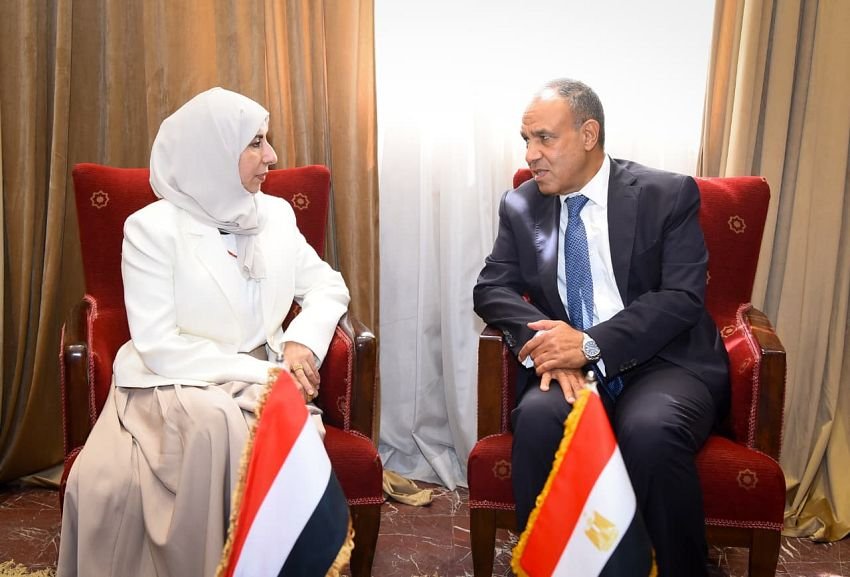
CAIRO, Egypt — Yemen’s foreign minister and her Egyptian counterpart agreed to speed up the creation of a joint business council, the state news agency Saba reported.
Afrah al-Zouba met Badr Abdelatty on the sidelines of the 166th ordinary session of the Arab League Council at ministerial level in Cairo, Saba said.
The council opened its 166th regular session in the Egyptian capital at the level of permanent delegates on Saturday, under Tunisia’s chairmanship. Palestine and developments in several Arab states were on the agenda.
The proposed business council would cover trade and investment between the two countries, according to Saba. The agency did not say when it would be established, who would sit on it, or where it would be based.
The account of the bilateral meeting rests on Saba, which is run by Yemen’s internationally recognised government. No independent confirmation of the meeting or of the business council agreement has been published, and Yemen Herald could not verify either separately.
The two ministers also discussed Houthi operations in the Red Sea, Saba said. The agency reported that they treated those operations as a threat to shipping and to the economies of countries bordering the waterway, Egypt among them.
Egyptian revenue from the Suez Canal depends on traffic passing through Bab al-Mandab, at the southern end of the Red Sea.
Suez Canal revenue reached a record 10.25 billion dollars in 2023. It fell to about 4 billion dollars in 2024, after attacks on shipping in the Red Sea pushed carriers onto the longer route around southern Africa.
Traffic through the canal dropped by roughly 38 percent in 2024. Revenue has since recovered part of that ground, and the canal took 1.26 billion dollars in the second quarter of 2026, 13 percent more than a year earlier.
The waterway is still running at about half the number of transits it handled before the attacks began.
The Houthi movement says its attacks on shipping are tied to the war in Gaza. The Yemeni government and its partners describe them as attacks on commercial vessels.
Abdelatty told the ministerial session that Egypt was ready to work with the Arab League and its member states on a framework setting out areas of cooperation, coordination mechanisms and procedures for responding to crises, Daily News Egypt reported.
He condemned attacks by Iran on Arab countries and expressed Egypt’s solidarity with the Gulf states, Jordan and Iraq, according to the same report. He called for de-escalation and a return to diplomacy.
At the same session, the council’s permanent delegates adopted a resolution supporting Yemen’s sovereignty over its airspace, Saba reported.
Al-Zouba was appointed foreign minister on 23 July by republican decree. She is the first woman to hold the post, or any of Yemen’s most senior cabinet jobs.
She had served as minister of planning and international cooperation since February.
She succeeded Shaya al-Zindani in a cabinet reshuffle. Some critics questioned whether she carried the diplomatic experience the post required, Al Jazeera reported.
The appointment came as the government worked to establish itself in the south and east, the areas outside Houthi control, according to the same report.
From 2021 she was executive director of the Executive Bureau for Accelerating Aid Absorption and Supporting Policy Reforms, the body responsible for absorbing foreign aid to Yemen.
Al-Zouba is from al-Bayda, in central Yemen. She trained as a pharmacist at Sanaa University, then took a master’s degree in community health and health economics in Malaysia and an MBA at the University of Science and Technology.
Her early career was with SOUL for Development, a Yemeni non-governmental organisation working in rural areas on poverty, health and education. She later worked on United States Agency for International Development programmes covering governance, conflict mitigation and opportunities for women and young people.
In 2019 she advised the then prime minister, Maeen Abdulmalik, on humanitarian relief and development.
Between 2013 and 2015 she was first deputy secretary-general of the National Dialogue Conference, the transitional body set up after the 2011 uprising to agree a new political system. She helped oversee its technical work and contributed to drafting its final document.
She later sat on the Constitution Drafting Committee, which was to turn those agreements into a proposed constitution. The process collapsed when the Houthi movement rejected its outcomes and took control of Sanaa in September 2014.
Between 2016 and 2017 the United Nations invited her, with a small number of other Yemeni women, to consultations connected to peace talks held in Kuwait.
Egypt has kept diplomatic relations with Yemen’s internationally recognised government throughout the war, and Cairo has hosted Yemeni officials for talks at intervals since 2015.
Abdelatty congratulated al-Zouba after her appointment and restated Egypt’s support for Yemen, Egypt Independent reported.
She has since held calls with counterparts in Egypt, Sudan and Djibouti on Red Sea security, Yemen Monitor reported.
Yemen’s government is working to bring anti-Houthi forces under a single chain of command. Fighting on the western fronts has intensified in recent weeks, after roughly four years of relative calm.
Saba did not say whether the two ministers set a date for the business council’s first meeting.
About the Author




