
Prime Minister Shaya Zindani and UNDP’s Noura Hamladji discuss reform and recovery in Aden
 Yemen Herald News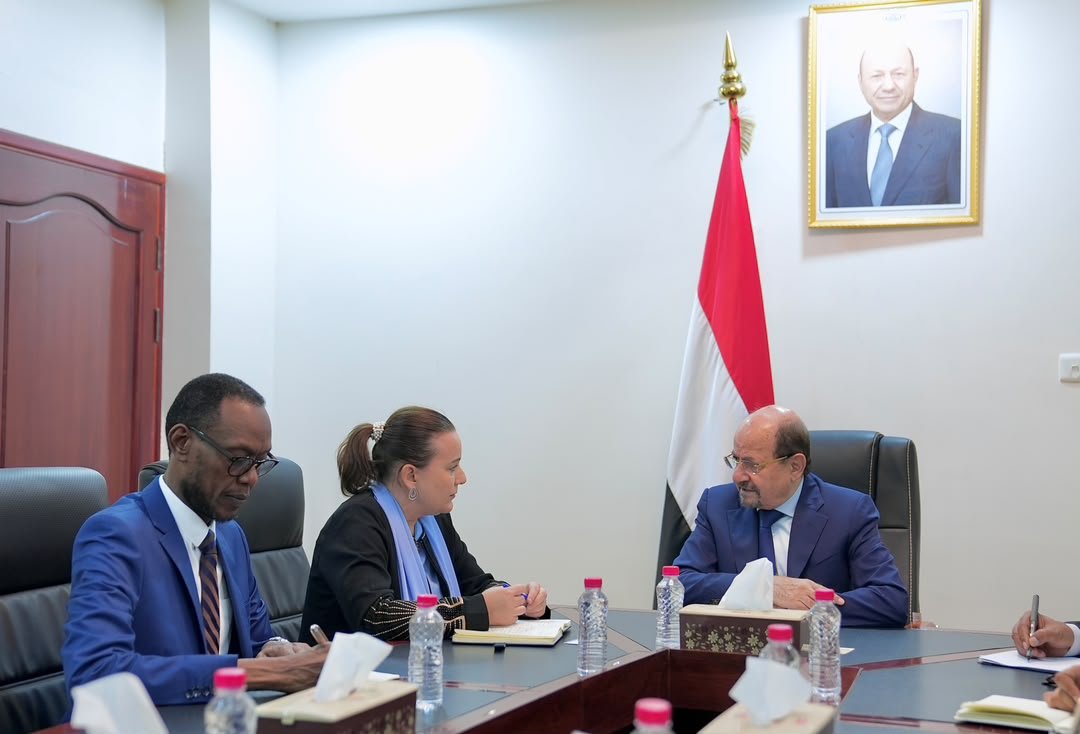
ADEN, Yemen — Prime Minister Shaya Zindani met the new UN Development Programme resident representative in Yemen, Noura Hamladji, on Monday, the state news agency Saba reported.
The two discussed cooperation priorities and the agency’s role in economic recovery, institutional reform and sustainable development, Saba said.
Zindani welcomed Hamladji and wished her success in the post, according to the agency.
He said the government wanted to take its partnership with the UNDP beyond responding to the effects of the crisis, toward supporting Yemenis and state institutions in overcoming its consequences, Saba reported.
The prime minister briefed Hamladji on what he described as escalation by the Houthi movement, including attacks on civilians, residential areas and displacement camps that he said had produced new waves of displacement. Saba, which is run by Yemen’s internationally recognised government, called the movement a terrorist militia. The Houthis reject that description and have not commented on the meeting.
Protecting civilians and displaced people remains a government priority, Zindani said, and the government is working with international partners on urgent humanitarian needs.
He described progress on an institutional, economic, financial and administrative reform programme, calling it a prerequisite for restoring the efficiency of state institutions and improving public services, Saba said. He tied the programme to transparency, accountability, governance and the management of resources.
Supporting state institutions and building their capacity should sit at the core of international partnership priorities, the prime minister said.
He said the government was looking for a larger UNDP role in institutional reform, capacity building, digital transformation and the efficiency of government bodies, in a way that turned international assistance and expertise into national capacity.
Zindani also said UNDP projects and those of other development partners should align with national priorities and give more weight to work with lasting economic and social effects.
Hamladji said the UNDP would continue and strengthen its partnership with the government and support its priorities in recovery, development, capacity building and governance, according to Saba. She said the programme was ready to expand areas of cooperation.
The account of the meeting rests on Saba. No independent confirmation of what was said has been published, and Yemen Herald could not verify the exchange.
Hamladji took up the Yemen post this year. The UNDP says she has more than 23 years in development, humanitarian work, peacebuilding and stabilisation, and most recently served as deputy executive secretary of the UN Framework Convention on Climate Change.
She was previously UNDP deputy regional director for Africa, and held senior roles in Libya, Timor-Leste, Iraq, Djibouti and Azerbaijan, according to the agency. She holds a doctorate in political science from the European University Institute in Florence and a master’s degree from Sorbonne University in Paris.
Saba reported earlier that Hamladji presented her credentials to the vice foreign minister, who discussed cooperation with her at that meeting.
Zindani has led the government since February. Presidential Leadership Council chairman Rashad al-Alimi appointed him prime minister by decree in January, after accepting the resignation of Salem Saleh bin Braik. Zindani took office on 6 February.
He had served as foreign minister before the appointment. Afrah al-Zouba took over the foreign ministry later in the year, the first woman to hold the post.
The meeting followed a period of displacement in south-western Yemen. The UN said last week that 1,790 families were displaced in two days as fighting spread in Taiz governorate. The Executive Unit for Internally Displaced Persons put the figure at 2,183 families across Taiz and Hodeidah by early September.
The International Organization for Migration recorded 274 families displaced across five governorates in a separate count.
The UN Office for the Coordination of Humanitarian Affairs said in its March plan that more than 22 million people in Yemen need assistance and 18.3 million are acutely food insecure. More than 2.2 million children under five are acutely malnourished, 516,157 of them severely.
The office put the number of internally displaced people at 5.2 million. It sought 2.16 billion dollars to reach 12 million people this year.
The UNDP’s economic recovery and development programme in Yemen works to restore income sources and rehabilitate infrastructure and productive assets, according to the agency. It supplies solar power for health, water and education facilities, and for livelihood schemes.
More than 164 public service facilities, among them schools, health centres and local administration offices, received solar equipment from 2023 onward under a joint programme funded by the European Union and Sweden, the UNDP says. The agency puts the number of people served at 199,745.
That programme has also trained women as certified solar technicians able to install and maintain the systems, according to the UNDP.
Working with the World Bank’s Emergency Crisis Response Project, the agency supported five microfinance institutions and more than 5,000 microfinance clients.
The Presidential Leadership Council was formed in April 2022, when President Abd Rabbu Mansour Hadi transferred his powers to the eight-member body that al-Alimi chairs.
A UN-brokered truce took effect that same month and formally lapsed in October 2022. Front lines have shifted repeatedly since.
Aden has served as the seat of the internationally recognised government since 2015, when the Houthis took the capital, Sanaa.
About the Author




