Foreign Minister Afrah al-Zouba and Arab League chief Nabil Fahmy discuss Yemen and Red Sea security
 Yemen Herald News
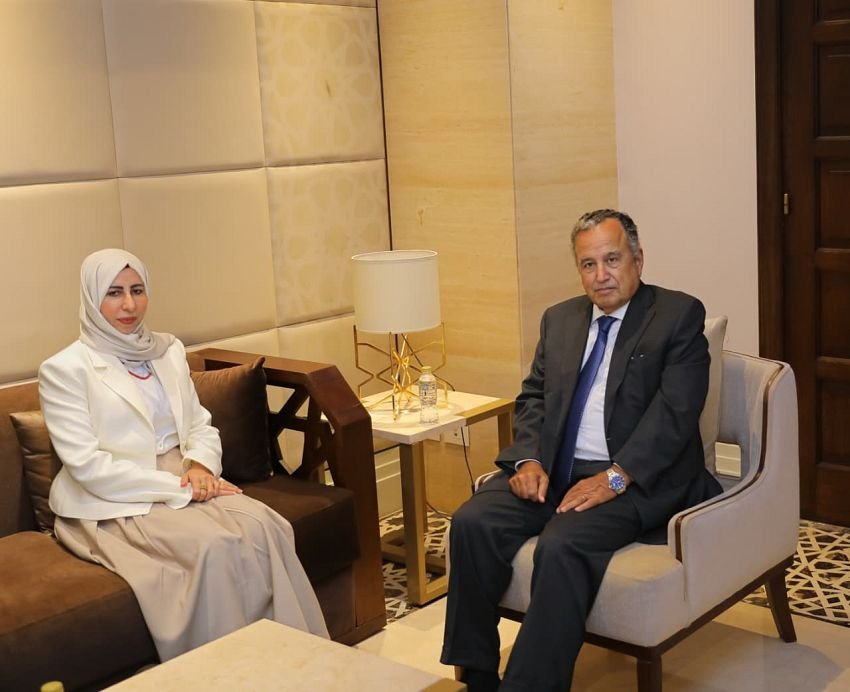
CAIRO, Egypt — Yemen’s foreign minister, Afrah al-Zouba, met Arab League Secretary-General Nabil Fahmy in Cairo on Monday, the state news agency Saba reported.
The two discussed developments in Yemen and the region, and ways to strengthen coordination within joint Arab action, Saba said.
Al-Zouba said Yemen wanted closer cooperation with the League’s General Secretariat in a way that would strengthen the organisation’s role, according to the agency.
She briefed Fahmy on what she described as continued escalation by the Houthi movement, including attacks on civilian targets and vital facilities, violations against civilians, and threats to maritime security in the Red Sea and the Bab al-Mandab Strait, Saba reported.
Saba, which is run by Yemen’s internationally recognised government, called the movement a terrorist militia. The Houthis reject that description and have not commented on the meeting.
The foreign minister said the consequences of that escalation reached beyond Yemen’s borders and touched Arab national security, the safety of shipping routes and regional and international economic interests, according to the agency.
She said the Yemeni government had both the right and the responsibility to extend state sovereignty over the country’s territory, territorial waters and airspace.
Al-Zouba called for Arab support to let the government meet those responsibilities and to prevent Yemen being used as a platform to threaten neighbouring countries in service of a regional agenda, Saba said.
She also pressed for the Yemeni file to sit among the priorities of joint Arab action, and for Yemen to resume an active role within its Arab sphere.
Fahmy reaffirmed the League’s support for the Yemeni government and state institutions, and for Yemen’s unity, sovereignty and territorial integrity, according to Saba.
He said efforts to reform and develop the framework of joint Arab action should continue, and called for closer coordination on security in the Red Sea and the Bab al-Mandab Strait, citing their bearing on Arab national security and on international navigation and trade.
The account of the meeting rests on Saba. No independent confirmation of what either official said has been published, and Yemen Herald could not verify the exchange.
The meeting took place on the sidelines of the 166th ordinary session of the Arab League Council at ministerial level. The council opened that session in Cairo at the level of permanent delegates on Saturday, under Tunisia’s chairmanship.
Arab foreign ministers convened in Cairo the same day for the session, which took up the Palestinian issue, Iranian actions and Iran’s obligations under international law, the occupied Syrian Golan Heights, support for Lebanon, and developments in Syria, Sudan, Libya, Yemen, Somalia and the Comoros.
Algeria sent its foreign minister, Ahmed Attaf, on instructions from President Abdelmadjid Tebboune, the Algerian state news agency reported.
Syria’s foreign minister held separate talks with al-Zouba in Cairo on bilateral relations, according to the Syrian state news agency SANA. That report is one of the few independent accounts placing her at the session.
The Arab League groups 22 member states and is headquartered in Cairo. Its council holds regular sessions twice a year.
Fahmy took office as secretary-general on 1 July for a five-year term. Arab foreign ministers approved his candidacy by consensus at a meeting on 29 March.
He succeeded Ahmed Aboul Gheit, whose second term ended on 30 June. Fahmy served as Egypt’s foreign minister and is the son of Ismail Fahmy, who held the same post.
Al-Zouba took over Yemen’s foreign ministry this year, the first woman to hold the office. She succeeded Shaya Zindani, who moved to the prime minister’s post in February.
The Bab al-Mandab Strait links the Red Sea to the Gulf of Aden and carries a large share of traffic bound for the Suez Canal. Shipping through the corridor fell sharply after attacks on vessels began in late 2023.
Fighting inside Yemen has continued since a UN-brokered truce took effect in April 2022 and lapsed that October.
The UN said last week that 1,790 families were displaced in two days as fighting spread in Taiz governorate. The Executive Unit for Internally Displaced Persons put the figure at 2,183 families across Taiz and Hodeidah by early September.
The International Organization for Migration recorded 274 families displaced across five governorates in a separate count.
The UN Office for the Coordination of Humanitarian Affairs said in its March plan that more than 22 million people in Yemen need assistance and 18.3 million are acutely food insecure.
More than 2.2 million children under five are acutely malnourished, 516,157 of them severely, the office said. It put the number of internally displaced people at 5.2 million and sought 2.16 billion dollars to reach 12 million people this year.
The Presidential Leadership Council was formed in April 2022, when President Abd Rabbu Mansour Hadi transferred his powers to the eight-member body chaired by Rashad al-Alimi.
The Bab al-Mandab Strait narrows to about 30 kilometres between Yemen and Djibouti at its tightest point.
Aboul Gheit, an Egyptian diplomat, led the League from 2016 and served two five-year terms.
Yemen has been represented at Arab League meetings by the internationally recognised government throughout the conflict.
Aden has served as the seat of the internationally recognised government since 2015, when the Houthis took the capital, Sanaa.
About the Author