
AFP tally puts toll from southwest Yemen fighting above 300 as families flee
 Yemen Herald News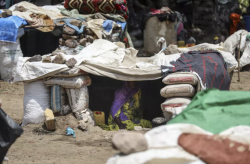
TAIZ, Yemen — The toll from days of fighting between Yemeni government forces and Houthi fighters in the country’s southwest passed 300 on Sunday, Agence France-Presse reported.
The agency said more than 300 combatants and some civilians had been killed since the Houthi assault began on Thursday, Sept. 3.
It compiled the tally from military and medical sources on both sides of the front.
Two military officials with the government told the agency that 84 of their troops were killed between midday Saturday and early Sunday, mostly in missile attacks.
Four Houthi military sources said 57 of their fighters were killed over the same hours.
Neither figure has been confirmed by a body independent of the warring parties, and Yemen Herald could not verify them.
The agency had put the toll above 140 earlier in the offensive, citing military sources.
At least four civilians were killed and nine wounded when a missile struck the road linking Taiz and Aden on Saturday, according to local and medical sources.
The offensive was aimed at cutting off the government-held port city of Mokha and advancing toward areas bordering the Bab al-Mandab Strait, at the southern entrance to the Red Sea, according to the agency.
A government military official said Houthi forces succeeded on Saturday evening in “cutting off the road linking Taiz to Mokha”.
Another official, based in Aden, said the fighting subsided in the early hours of Sunday.
Government forces “were able to establish positions for themselves north of Hays after advancing in the area”, the official said.
Hays is a frontline district less than 30 kilometres inland from the Red Sea coast.
The same official said Houthi forces had advanced west of Taiz and south of Hays as they pushed toward Bab al-Mandab.
On Monday the Yemeni Armed Forces spokesperson reported advances on fronts in al-Jawf and al-Bayda, in the north and centre of the country.
Government troops entered and took control of the al-Labanat military camp and were moving toward al-Hazm, according to that account.
The air force was carrying out strikes in both governorates, the spokesperson said, and called on Houthi fighters to withdraw from the advancing fronts with their light weapons.
The Houthis have not confirmed the government’s account of those advances. Each side routinely disputes the other’s battlefield claims.
Hundreds of families have left their homes since the assault began.
The UN Office for the Coordination of Humanitarian Affairs said on Friday that an estimated 1,790 households had been displaced after “intense shelling and clashes” in the districts of Maqbanah and Jabal Habashi, in Taiz governorate.
Families fleeing those districts took refuge at the al-Bareen camp for the internally displaced on Saturday.
Agence France-Presse journalists saw displaced people setting up shelters at another camp in the area on Sunday, carrying mattresses, livestock and other belongings.
“The shooting came at us from above and from below,” said Rawdhah Hasan, a woman displaced from Maqbanah. “They surrounded us from every direction, we fled with our children without even putting on our shoes.”
Nimah Saif, displaced from Jabal Habashi, said: “Some people were injured and others were killed. We saw them lying on the ground, but we could not help anyone.”
“Now we are stranded here, hungry, with nothing to eat,” she added.
A spokesman for UN Secretary-General Antonio Guterres said he was “deeply concerned by the ongoing military clashes”, warning of “devastating political economic and security ramifications for Yemen and its people”.
A ceasefire agreed in 2022 collapsed in July, after the Houthis received an Iranian aircraft at Sanaa airport and a series of attacks followed.
Farea al-Muslimi, a researcher at the London-based institute Chatham House, said the Houthis were seeking to exploit a weak front line at Mokha and “cut a lot of ties between Taiz and Bab al-Mandab and Mokha”.
“If they have a chance to fully take over Bab al-Mandab, they won’t hesitate for a second,” he said.
Adam Baron, a fellow at the United States-based institute New America, said the offensive had “shattered much of what was left of Yemen’s tenuous ceasefire”.
“Things increasingly appear to be on a path to escalation with few potential off-ramps,” he added.
Bab al-Mandab has taken on added weight as a transit route since Iran closed the Strait of Hormuz to commercial shipping. The strait connects Asia to Europe by way of the Suez Canal.
A Yemeni government body that manages displacement camps said 2,183 families had been displaced in Taiz and Hodeidah by Sept. 5, among them 1,643 families in Taiz alone.
The International Organization for Migration said 227 families had fled three displacement sites in western Taiz earlier in the month.
The United Nations humanitarian plan for Yemen published in March put more than 22 million people in need of assistance, with 18.3 million acutely food insecure and 5.2 million displaced inside the country.
More than 2.2 million children under five are acutely malnourished, 516,157 of them severely, according to the plan, which sought 2.16 billion dollars to reach 12 million people.
Houthi strikes closed the port of Mokha earlier this month, and about 1,500 workers there lost their jobs.
Mokha lies on the Red Sea coast south of Hodeidah and has been held by government forces.
Government forces and allied units have held the town since driving Houthi fighters out of it.
Neither side has published a breakdown of civilian deaths within the toll.
About the Author




