Yemen joins first OIC Muslim diaspora forum in Ankara as deputy foreign minister leads delegation
 Yemen Herald News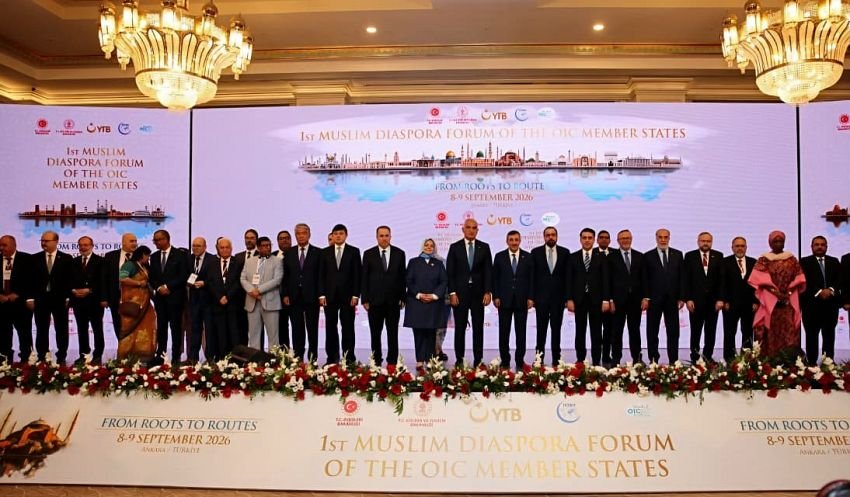
ANKARA, Turkey — Yemen took part in the first Forum of Organization of Islamic Cooperation Member States on Diaspora Muslims, which opened in Ankara on Tuesday.
Osan al-Awad, deputy minister of foreign affairs for financial and administrative affairs, headed the Yemeni delegation, the state news agency Saba reported.
Mohammed Tareq, Yemen’s ambassador to Türkiye, and adviser Waleed Ahmed also attended, according to the agency.
The account of Yemen’s delegation rests on Saba, the government’s own news agency. No independent confirmation of its composition has been published.
The forum runs from 8 to 9 September under the banner “From Roots to Routes”.
Türkiye’s Presidency for Turks Abroad and Related Communities, known as YTB, organised the meeting with the Turkish foreign ministry and the Statistical, Economic and Social Research and Training Centre for Islamic Countries.
That centre, SESRIC, is the OIC’s statistics and training body. It is based in Ankara.
Cevdet Yılmaz, Türkiye’s vice president, opened the forum.
Mehmet Nuri Ersoy, the Turkish culture and tourism minister, Abdulhadi Turus, the YTB president, and Zehra Zümrüt Selçuk, the SESRIC director general, also spoke at the opening, Turkish media reported.
Yılmaz spoke about the size of the young population in OIC states, the contribution of diaspora communities and the situation in Gaza, according to those reports.
Delegations from OIC member states attended, along with international institutions and organisations working on diaspora affairs, Saba said.
Participants were expected to adopt a declaration on Muslim diaspora communities covering the protection of diaspora rights and measures against Islamophobia, Turkish media reported.
The forum is discussing cooperation between member states on diaspora affairs and the exchange of experience, expertise and policy, Saba said.
Yemen’s participation was intended to draw on international practice presented at the forum and to build cooperation with Turkish and international bodies working on diaspora affairs, the agency said.
Saba said the aim was to serve Yemenis abroad, strengthen their ties to the country and support their contribution to development.
The OIC has 57 member states. It was founded in 1969 and has its headquarters in Jeddah.
Türkiye holds the chair of the OIC Council of Foreign Ministers for 2025 and 2026. The council’s 51st session is to be held in Istanbul.
OIC member countries have about 60 million people living in diaspora communities in Europe and North America alone, according to figures set out by the organisers.
The organisers set three objectives for the meeting: wider sharing of good practice between member states, joint work on problems common to diaspora communities, and the building of long-term cooperation networks.
SESRIC was established in 1978 and collects statistics and runs training programmes for OIC members. YTB was created in 2010 to work with Turkish citizens abroad and with related communities.
The Ankara meeting is one of a series of OIC events Türkiye is hosting during its term in the chair.
Money sent home by Yemenis working abroad is one of the country’s largest sources of foreign currency.
Formal remittance flows to Yemen are estimated at 4 billion to 6 billion dollars a year, close to 20 percent of gross domestic product, according to research published by the International Growth Centre.
Total inflows may reach about 10 billion dollars a year once informal transfers are counted, the same research says.
Saudi Arabia accounts for about 61 percent of recorded remittance inflows to Yemen. Gulf Cooperation Council states together account for about 90 percent.
Saudi census figures for 2022 put the number of Yemenis in the kingdom at 1,803,469.
The Saudi Arabia to Yemen corridor is also among the cheaper remittance routes in the region, at an average cost of about 2.55 percent of the sum sent, according to the same body of research.
Banking restrictions and the split between the rival central banks in Aden and Sanaa have complicated formal transfers during the war.
Researchers have noted that Saudi labour policy is therefore a leading determinant of how much money reaches Yemeni households in any given year.
Yemeni migration to East Africa, South and Southeast Asia, Britain and the United States predates the current war by generations. Communities in Cardiff, Detroit and Djibouti date to the nineteenth and twentieth centuries.
The war has added to those numbers. The UN humanitarian needs and response plan published in March 2026 puts the number of people displaced inside Yemen at 5.2 million.
The same plan says more than 22 million people need humanitarian assistance and that 18.3 million are acutely food insecure. It seeks 2.16 billion dollars to reach 12 million people.
More than 2.2 million children under five are acutely malnourished, according to the plan, 516,157 of them severely.
Yemen’s internationally recognised government is based in Aden. It has kept its embassy in Ankara running through the conflict.
Yemen’s diplomatic activity has picked up in recent weeks. The Arab League’s permanent delegates adopted a resolution backing the Presidential Leadership Council this month, and the Arab Ministerial Council approved the creation of a fund for Yemen’s development needs plan.
Yemen has taken part in other OIC bodies during the war, including the organisation’s conference of information ministers.
Saba did not say whether Yemen signed the forum’s closing declaration.
About the Author