Ambassador Aws al-Awd briefs Spanish foreign ministry official on Houthi escalation and Red Sea security
 Yemen Herald News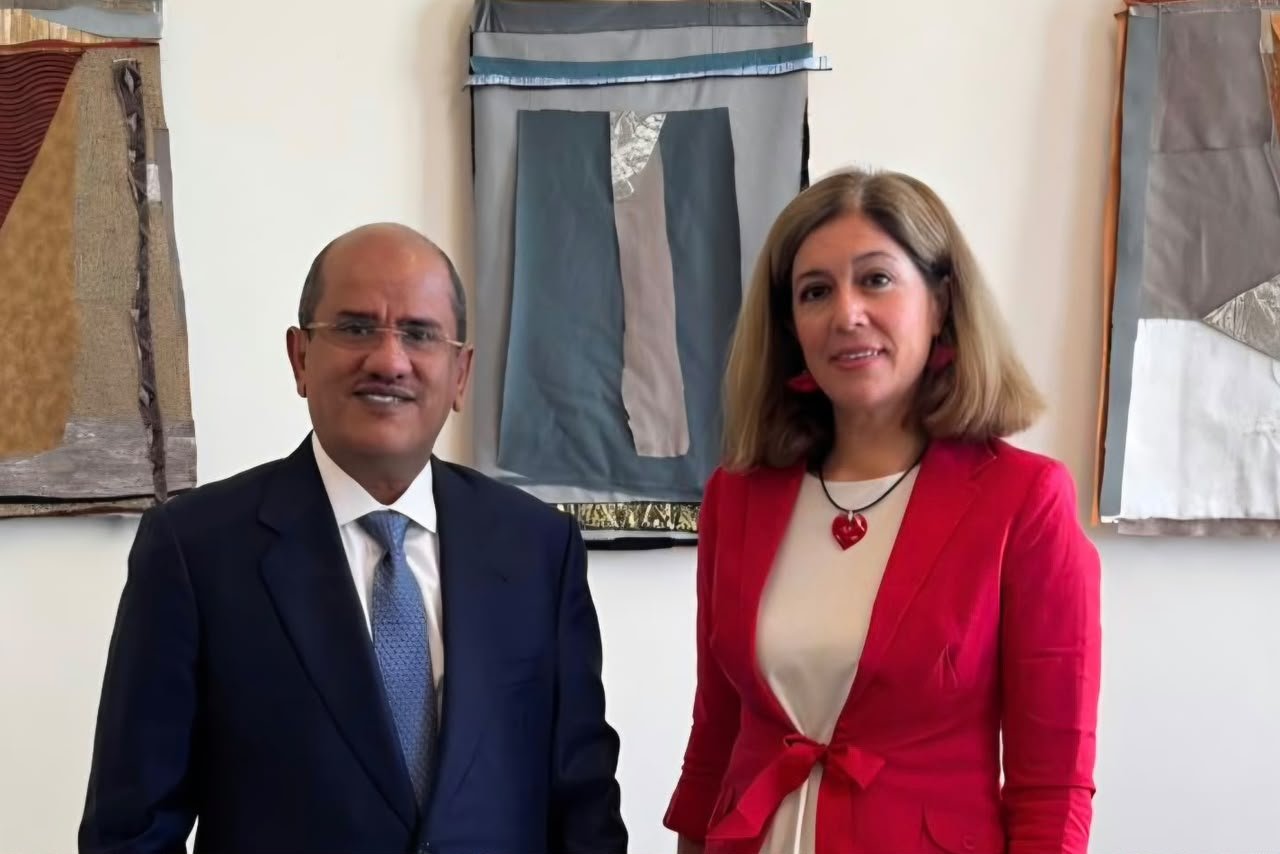
MADRID, Spain — Yemen’s ambassador to Spain briefed a senior Spanish foreign ministry official on the Houthi military escalation and its effect on Red Sea shipping, the state news agency Saba said.
Ambassador Aws al-Awd met Maria Luisa Benítez-Donoso on Tuesday, according to the agency.
She directs the Office of the Secretary of State for Foreign and Global Affairs at Spain’s Ministry of Foreign Affairs, European Union and Cooperation.
The two discussed developments in Yemen and the region and ways to increase Spanish support, Saba said.
Al-Awd told the Spanish official that the Yemeni government was exercising its constitutional and legal right to protect citizens and defend state institutions, according to the agency.
Saba described the Houthi movement as a terrorist militia. The Houthis reject that characterisation and describe their campaign as a defence of Yemen against foreign-backed forces.
The two also discussed the effect of the escalation on security in the Red Sea and the Bab al-Mandab strait, and on freedom of navigation, the agency said.
Al-Awd said Spain had an important role within the European Union in supporting Yemen, according to Saba.
The meeting also covered bilateral relations and consultation between the two governments.
The account of the meeting rests on Saba, the news agency of the internationally recognised government. Yemen Herald found no Spanish account of the talks and no independent confirmation of what was said.
The meeting came during the heaviest fighting in Yemen since a UN-brokered truce halted large-scale combat in 2022.
Yemen’s internationally recognised government said on Monday it was launching counteroffensives against Houthi-held positions across several provinces.
The Houthis began an offensive in Taiz governorate on 3 September, seeking to cut the road linking Taiz city to the coast at al-Mokha.
Rashad al-Alimi, who chairs the Presidential Leadership Council, said on Monday that government forces had gained ground in al-Jawf, al-Bayda, Taiz and Hodeidah.
“Our armed forces will continue to carry out their constitutional duty until state institutions are restored and their authority extends over the entire territory of Yemen,” al-Alimi said in a statement.
Deputy Defence Minister Samir al-Sabri said on state television that the government had resolved to retake Sanaa, which the Houthis have held since 2014.
Majid al-Nuzaili, a spokesman for government-aligned forces, said the aim of the offensive was to restore Sanaa as a capital for all Yemenis.
The Houthis said they repelled a government advance towards al-Labanat in al-Jawf and inflicted casualties on government-aligned forces.
Al Jazeera said it could not independently verify the battlefield claims made by either side.
The Houthis said on Tuesday they had attacked Saudi energy sites operated by Aramco in the south of the kingdom, using drones and ballistic missiles.
Yahya Saree, the group’s military spokesman, said the attacks were retaliation for Saudi strikes on Houthi-controlled areas.
Turki al-Malki, spokesman for the Saudi-led coalition, said the attacks hit Abha, Khamis Mushait, Jazan and Najran and injured at least 73 people, among them women and children. The figure is the coalition’s and has not been independently confirmed.
Saudi Arabia said it would respond firmly.
Fighting resumed in July after an Iranian aircraft attempted to land in Sanaa without Saudi authorisation, followed by strikes on Sanaa airport and Houthi retaliation.
The Houthis said on Monday that Saudi aircraft and cruise missiles had struck al-Jawf, al-Bayda, Marib and Taiz provinces.
They accused Saudi Arabia of an air strike on a prison in al-Hazm, the capital of al-Jawf, saying seven people were killed and seven wounded. Riyadh did not immediately comment on the claim.
The group also said it had shot down Saudi reconnaissance drones over al-Jawf and al-Bayda.
Southern Saudi Arabia holds significant oil infrastructure, including the Jazan refinery, which can process 400,000 barrels of crude a day.
The Houthis declared a blockade on Saudi shipping in July.
About 4.1 million barrels of crude oil and petroleum products passed through Bab al-Mandab each day on average in 2024, roughly 5 per cent of the global total.
Saudi seaborne crude exports through the strait between March and mid-July were eight times higher than in the same period of 2025, after Iran restricted traffic through the Strait of Hormuz.
Spain contributes naval vessels to EUNAVFOR Aspides, the European Union operation set up to protect merchant shipping in the Red Sea. Greece and Italy are the other two contributors of vessels.
The EU Council extended the operation’s mandate to 28 February 2027 and allocated close to 15 million euros for common costs over the year from March 2026.
Aspides has accompanied more than 1,570 vessels since it began operating.
The World Health Organization said on Monday that at least 728 people had been killed or wounded in Yemen since 23 August, most of them in Taiz and along the western coast.
It estimated that about 21,000 people, or roughly 3,000 families, had been displaced from Taiz since Thursday.
Ahmed Nagi, a senior analyst at the International Crisis Group, said the Houthi push towards the western coast had a maritime dimension as well as a territorial one.
“The move towards the western coast is not only about gaining territory on the ground. It also has a maritime dimension,” Nagi told Al Jazeera.
Saba did not say how long the Madrid meeting lasted or whether other officials attended.
About the Author