Al-Subaihi visits Jabal Habashi and al-Kadha fronts in Taiz and urges higher readiness
 Yemen Herald News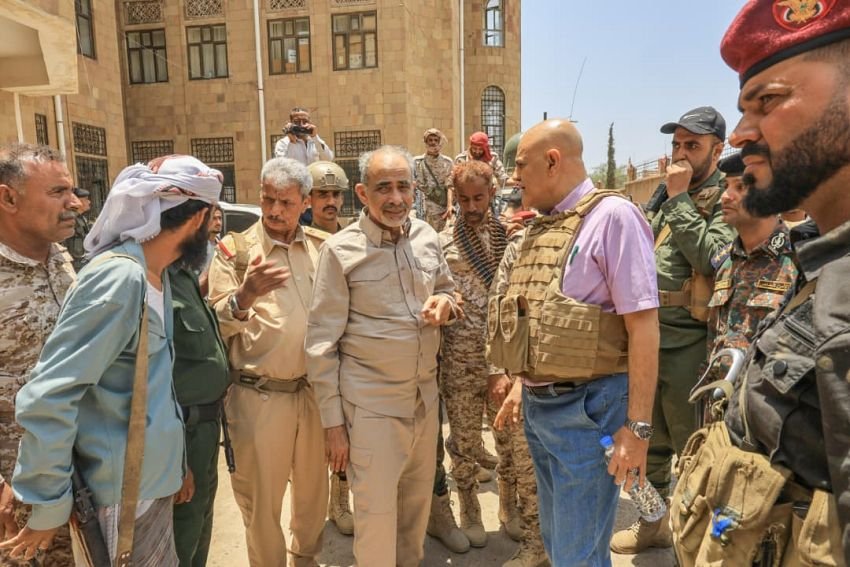
TAIZ, Yemen — Presidential Leadership Council member Mahmoud al-Subaihi inspected front lines at Jabal Habashi and al-Kadha in Taiz on Wednesday and pressed commanders to raise readiness.
Al-Subaihi met officers, non-commissioned officers and soldiers stationed on the fronts, the state news agency Saba said.
He conveyed the greetings of President Rashad Mohammed al-Alimi, the supreme commander of the armed forces, and of other council members.
“We are by your side and support you in this decisive national battle,” al-Subaihi told the troops, according to Yemen Monitor, an independent Yemeni outlet that reported the visit separately.
He called for the fronts to be reinforced with personnel and logistical support, Saba said.
Al-Subaihi also pressed for closer military and operational coordination between units, and for planners to allow for every possible scenario.
The visit took in the cities of Taiz and al-Turbah, Yemen Monitor reported.
Taiz Governor Nabil Shamsan accompanied him, along with Maj. Gen. Yousuf al-Sharaji of the Supreme Military Committee, Taiz Axis commander Maj. Gen. Khalid Fadel and Tur al-Baha Axis commander Maj. Gen. Abu Bakr al-Jubouli.
The delegation reviewed the readiness and the needs of the forces, the outlet said.
It also inspected the conditions of residents and displaced people in both cities.
Al-Sharaji briefed al-Subaihi on field developments and on coordination between the National Resistance and the Taiz Axis, according to Yemen Monitor.
Shamsan said the Houthi movement’s focus on Taiz was, in his assessment, part of an effort to control international navigation at Bab al-Mandab, which he described as an Iranian agenda.
The Houthis reject that characterisation and cast their operations as a response to attacks on Yemen. They did not comment on al-Subaihi’s visit.
Shamsan said the governorate was ready for what he called general mobilisation and could send thousands of fighters to the fronts. Yemen Herald could not independently verify that figure.
Jabal Habashi is one of the districts from which the International Organization for Migration recorded displacement this month.
Fighting along Yemen’s west coast and in parts of Taiz and Al-Hodeidah escalated on 3 September.
IOM said on 7 September that about 18,500 people had been displaced in the two governorates since then.
The agency said displacement had been reported from Maqbanah, Al Ma’afer and Jabal Habashi, including the areas of Al-Hajab, Al-Rajehi, Hajjat Gabeh and Al Kadaha.
“Many of these are people who have already been displaced once, twice, even four times before,” said Abdusattor Esoev, IOM’s chief of mission in Yemen.
Esoev said some families might be unable to leave front-line areas safely because of continuing hostilities and insecurity along access routes.
IOM said 663 households had been reached with household items across Taiz and Hodeidah, and that emergency stocks of food, shelter and household items were severely depleted.
It said road access problems and disrupted telecommunications in the affected districts were slowing efforts to register newly displaced families.
The escalation has drawn in Saudi Arabia. Houthi missile and drone attacks on southern Saudi Arabia on 8 September wounded 73 people and forced operations to halt at several energy sites, the Saudi-led coalition said.
The attacks struck areas around Abha, Khamis Mushait, Jazan and Najran, according to Saudi authorities, who described them as a dangerous escalation.
The Houthis said the attacks answered Saudi strikes on Yemen. The two accounts have not been reconciled.
Hans Grundberg, the UN special envoy for Yemen, has urged the warring parties to halt hostilities and exercise restraint, warning that the escalation could widen into a full-scale war.
The UN Security Council said on 7 August that Houthi attacks on Saudi Arabia and on commercial vessels threatened regional security, navigational rights and efforts to secure peace in Yemen.
Taiz has been a front line since 2015, when the Houthi movement advanced on the city and a Saudi-led coalition entered the war.
The government has administered the country from Aden since that year, while the Houthis hold Sanaa and much of the north.
International news organisations covering the current fighting have described it as ending a truce that had largely held since 2022.
The account of al-Subaihi’s visit rests on Saba and on Yemen Monitor, which carried separate reports of it.
Yemen Monitor said the delegation heard an account of service conditions in the governorate from Shamsan alongside the military briefing.
Al-Subaihi reaffirmed the political and military leadership’s support for the stationed forces and for strengthening their personnel and logistical capabilities, Yemen Monitor said.
He praised what the outlet described as the high morale of the fighters.
Al-Sharaji’s briefing covered progress the government says its forces have made on several fronts.
IOM said civilians were reported to be among those killed and injured as the clashes intensified.
The casualty figure given by the coalition was carried by international news organisations including CNN and The National.
IOM said host communities across south Taiz and the west coast, including Al Mokha, Hays, Mawza and Al Ma’afer, were under pressure from the influx of newly displaced families.
The agency said local capacities were overstretched and that authorities had appealed to humanitarian partners and UN agencies for more support.
It said renewed fighting had also caused secondary displacement among families who had been living in displacement sites in Hays.
About the Author