Foreign Minister Sergey Lavrov calls Houthi attacks on Saudi Arabia unacceptable in Moscow talks
 Yemen Herald News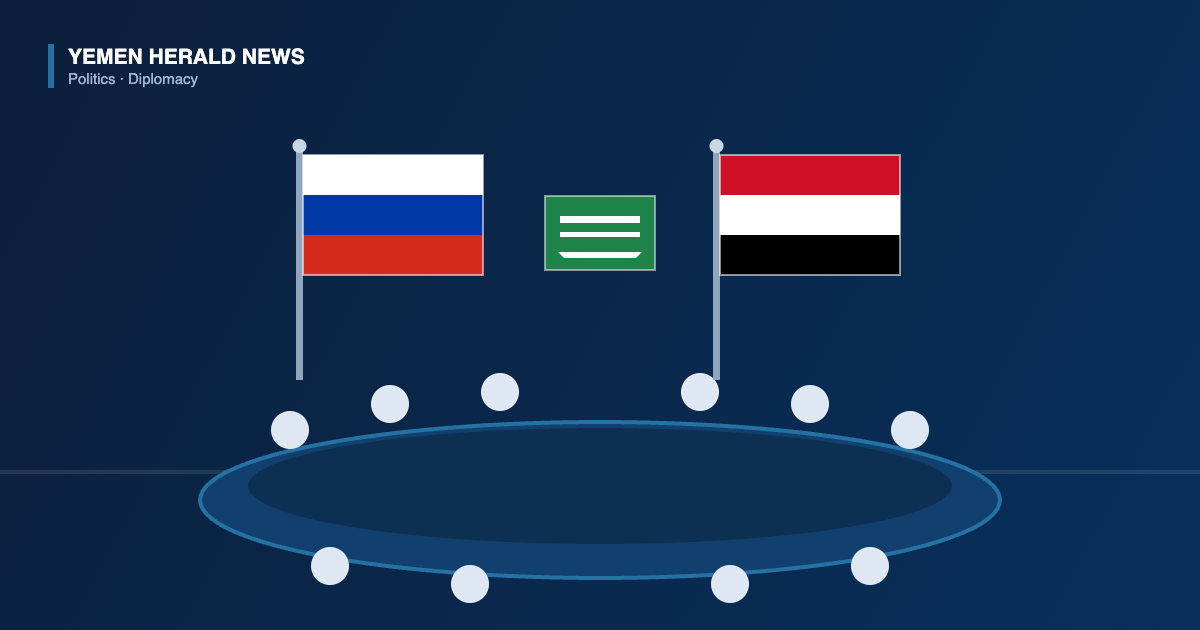
MOSCOW, Russia — Russian Foreign Minister Sergey Lavrov said Houthi attacks on Saudi Arabia are unacceptable, speaking on Tuesday after talks in Moscow with his Saudi counterpart, Prince Faisal bin Farhan.
Lavrov said the strikes on civilian infrastructure inside the kingdom were counterproductive and were damaging the global economy.
He warned of repercussions for regional security, Yemen Monitor reported from the joint news conference.
Lavrov said security and freedom of navigation in the Bab al-Mandab strait had to be ensured.
Regional tensions were affecting trade movements and supply chains, he said.
Prince Faisal said the kingdom “strongly condemns” the Houthi attacks.
“The Houthis choose to prioritise their narrow interests over the interests of Yemen and resort to violence,” he said.
He said diplomacy remained available. “The road to diplomacy is not closed,” Prince Faisal said.
“Saudi Arabia will always support diplomatic solutions, but the kingdom will never hesitate to defend itself and its interests,” he added.
He said the kingdom would use “every tool” to carry out its duties.
The Russian foreign ministry said the ministers met on 8 September during a working visit by Prince Faisal.
The talks covered bilateral relations as well as developments in the region and the world, the ministry said.
Lavrov set out Russia’s assessment of the geopolitical situation, including Ukraine, according to the ministry.
“Russia is genuinely interested in contributing to efforts to ease tensions, as well as to addressing other regional issues of mutual interest,” Lavrov said in opening remarks published by the ministry.
This year marks the centenary of diplomatic relations between Russia and Saudi Arabia.
The ministry said the ministers also reviewed trade, investment, cultural and humanitarian ties.
Prince Faisal said Saudi-Russian cooperation had supported stability in global energy markets, Arab News reported.
The meeting followed Houthi strikes on southern Saudi Arabia earlier the same day.
Major-General Turki al-Malki, spokesman for the Saudi-led coalition, said the attacks hit Abha, Khamis Mushait, Jizan and Najran and injured at least 73 people, among them women and children.
Saudi Arabia’s energy ministry said the strikes started fires at oil installations and utility sites in the kingdom’s southern provinces.
The Jizan refinery, one of the largest in the kingdom, can process 400,000 barrels of crude a day.
Yemen Herald could not independently verify the casualty figure.
The Houthi military spokesman, Yahya Saree, said the group had targeted energy infrastructure operated by Saudi Aramco using drones and ballistic missiles.
Saree described the operation as “a broad operation”.
Saree said the attacks were retaliation for Saudi strikes on Houthi-controlled areas of Yemen.
The Houthis said Saudi aircraft and cruise missiles hit al-Jawf, al-Bayda, Marib and Taiz on Monday. Riyadh did not immediately comment on that account.
Yemen’s internationally recognised government announced counteroffensives against Houthi-held positions in several provinces on Monday.
Rashad al-Alimi, chairman of the Presidential Leadership Council, said on Monday that government forces had advanced in al-Jawf, al-Bayda, Taiz and Hodeidah. The Houthis dispute the government’s battlefield accounts, and independent confirmation is not available.
The United Nations condemned the cross-border attacks on Tuesday.
“We condemn the Houthi cross-border attacks against multiple sites in southern Saudi Arabia, which affected civilian and energy infrastructure, and express deep concern over reports of civilian casualties,” UN spokesperson Stephane Dujarric told reporters.
Dujarric said the United Nations was also concerned about intensifying clashes inside Yemen, and called on all parties to exercise restraint.
Hans Grundberg, the UN special envoy for Yemen, was engaging directly with the parties, Dujarric said.
Qatar’s foreign ministry described the attacks as a “reprehensible act of aggression”. Bahrain’s foreign ministry called them a violation of international law.
The United Arab Emirates condemned the attacks and the continued targeting of commercial vessels in the Red Sea.
Pakistan’s prime minister, Shehbaz Sharif, called the attack “cowardly”.
The World Health Organization said on Monday that at least 728 people had been killed or wounded in Yemen since 23 August, most of them in Taiz and along the western coast.
The UN Office for the Coordination of Humanitarian Affairs said the 2.2 billion dollar humanitarian appeal for Yemen was about 20 per cent funded, with 438 million dollars received.
The Houthis declared a blockade on Saudi shipping in July.
Fighting resumed in July after an Iranian aircraft tried to land in Sanaa without Saudi authorisation, followed by strikes on Sanaa airport and Houthi retaliation.
About 4.1 million barrels of crude oil and petroleum products passed through Bab al-Mandab each day on average in 2024, about 5 per cent of the global total.
Iran’s restrictions on the Strait of Hormuz have pushed Saudi Arabia to rely more heavily on its Red Sea export route.
Saudi seaborne crude exports through the strait between March and mid-July were eight times higher than in the same period of 2025.
Yemen’s war has run since the Houthi movement took the capital, Sanaa, in September 2014.
A Saudi-led coalition intervened in March 2015 in support of the internationally recognised government, which is seated in Aden.
A United Nations-brokered truce halted large-scale fighting in 2022.
The current hostilities are the most serious since that truce.
Russia abstained in April 2015 when the Security Council adopted Resolution 2216, which imposed an arms embargo on Houthi leaders.
About the Author