Planning Minister Mohammed al-Faqmi discusses new UN development framework with Laurent Bukera
 Yemen Herald News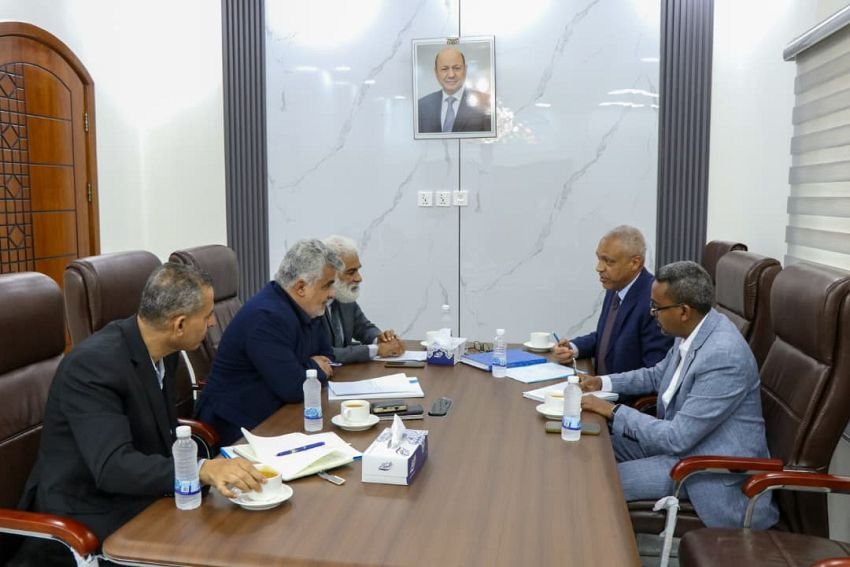
ADEN, Yemen — Planning Minister Mohammed al-Faqmi discussed a new UN development cooperation framework with the acting UN resident and humanitarian coordinator, Laurent Bukera, on Wednesday.
Deputy Minister of Planning and International Cooperation Nizar Basuhaib and Assistant Undersecretary Mansour Zaid attended, the state news agency Saba said.
The two sides reviewed aligning the framework with the government’s stated priorities and with the National Development Plan for 2027 to 2029, according to Saba.
Saba said the alignment was intended to unify effort and avoid duplication between frameworks and programmes.
It was also meant to strengthen the government’s role in leading and coordinating development work, the agency said.
Al-Faqmi and Bukera discussed mobilising development resources and financing, Saba reported.
They went over mechanisms for monitoring and evaluation, and arrangements for sharing data.
Both sides said the ministry should receive regular reports on activities, funding and beneficiaries, according to the agency.
Saba said that was meant to strengthen mutual accountability and the effectiveness of aid interventions.
The meeting turned to urgent relief for people driven from their homes by clashes in Taiz, Hudaydah and Al Bayda governorates.
It also covered the government’s role in designing, implementing and monitoring the Humanitarian Response Plan, and in closing its funding gap, Saba said.
The two men discussed unconditional cash transfer programmes. They pressed for support to resume for beneficiary families whose payments have been suspended, according to the agency.
The meeting emphasised moving the offices of UN organisations and agencies to Aden, and setting a timetable for the move.
Saba said the relocation was intended to ease those agencies’ operations and give them direct access to government authorities.
Both sides affirmed the importance of continued dialogue and joint coordination, the agency said.
The account of the meeting rests on Saba, the news agency of the internationally recognised government, and on the ministry’s own read-out. Yemen Herald found no independent confirmation of what was discussed.
The United Nations in Yemen lists Bukera as its resident and humanitarian coordinator. Saba described him as acting in the post.
The talks came as fighting on Yemen’s west coast pushed thousands of families from their homes.
The International Organization for Migration said on 7 September that about 18,500 people had been displaced in Taiz and Al-Hodeidah governorates since hostilities escalated on 3 September.
“Families are arriving with nothing: no shelter, no food, no way to know if it’s safe to go back,” said Abdusattor Esoev, IOM’s chief of mission in Yemen.
Esoev said many of those arriving had been displaced before, some as many as four times.
IOM said reports indicated displacement from Maqbanah, Al Ma’afer and Jabal Habashi, and secondary displacement among families already living in sites in Hays.
Host communities across south Taiz and the west coast, including Al Mokha, Hays, Mawza and Al Ma’afer, were under pressure from the influx, the agency said.
Local authorities have appealed to humanitarian partners and UN agencies for additional support, IOM said.
The agency said 663 households had been reached with household items across Taiz and Hodeidah, and that further supplies were on the way.
Emergency stocks of food, shelter and household items were severely depleted after recent flood and west coast responses, it said.
IOM said displaced families needed cash, emergency shelter, household items and food, and that access to safe drinking water and hygiene support remained a problem.
It said road access problems and disrupted telecommunications in the affected districts were slowing efforts to register and verify newly displaced families.
The agency called on all parties to protect civilians and allow safe passage for families trying to flee.
The UN humanitarian needs and response plan for Yemen, issued in March, put the number of people needing assistance at more than 22 million.
It recorded 18.3 million people as acutely food insecure and more than 2.2 million children under five as acutely malnourished, including 516,157 severe cases.
The plan counted 5.2 million internally displaced people and sought $2.16 billion to reach 12 million of those in need.
Yemen’s government has operated from Aden since 2015, while the Houthi movement administers Sanaa and much of the north. The two sides give competing accounts of the fighting on the west coast.
IOM said renewed hostilities along the western coast and in parts of Taiz and Al-Hodeidah had forced thousands from their homes, with civilians reportedly among those killed and injured.
The agency said the count was rising by the hour as families continued to reach host communities and displacement sites.
It said affected people urgently needed emergency healthcare and referral routes for the injured.
IOM urged donors to replenish emergency stocks, saying the scale of need was outpacing available resources.
It said migrants using the Eastern Route had limited access to assistance, information, safe shelter and essential services, which could increase their exposure to protection risks.
International news organisations covering the escalation have described it as ending a truce that had largely held since 2022.
IOM said it was also concerned about migrants using the Eastern Route who could become stranded in the affected areas.
The agency said it was working alongside Yemen’s Executive Units for Internally Displaced People to track, verify and consolidate displacement figures.
About the Author