
Yemen’s ambassador to the EU briefs EEAS official Hélène Le Gal on Houthi coastal advance
 Yemen Herald News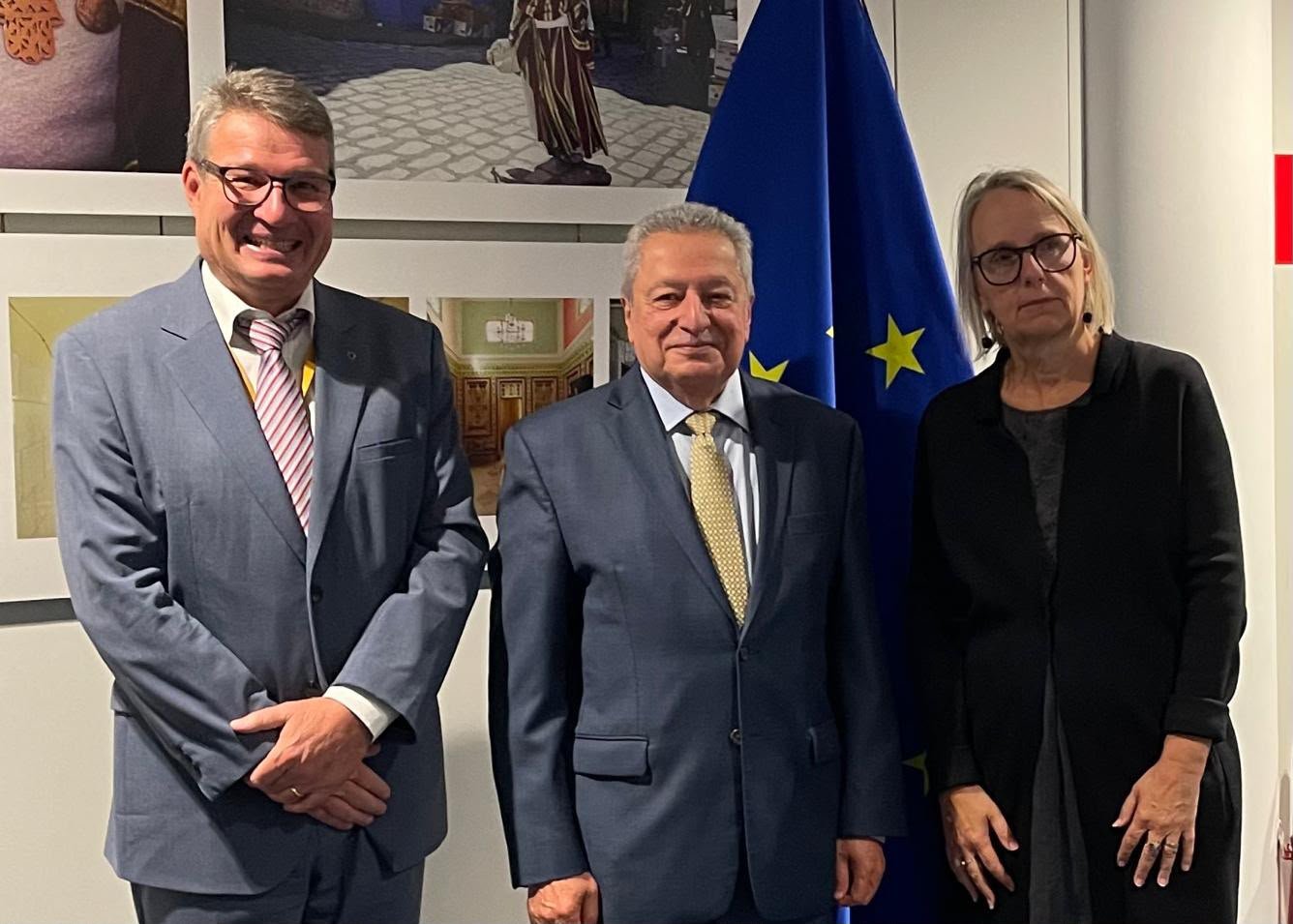
BRUSSELS, Belgium — Yemen’s ambassador to the European Union briefed a senior EU diplomat on the Houthi advance along Yemen’s Red Sea coast, the state news agency Saba reported Saturday.
Ambassador Mohammed Taha Mustafa met Hélène Le Gal, managing director for the Middle East and North Africa at the European External Action Service, the agency said.
The two discussed the latest developments in Yemen and what Saba described as the Houthi movement’s military escalation along the western coast.
Mustafa warned that the escalation threatened Yemen, regional security and international navigation, according to the agency. He said it served Iran-backed plans to destabilise maritime security and disrupt global supply chains.
Le Gal reaffirmed European Union support for the internationally recognised Yemeni government, Saba said. She condemned Houthi attacks on civilians and on freedom of navigation and called for them to stop immediately.
The account of the meeting rests on Saba, which is run by the Yemeni government. No independent confirmation of the talks has been published, and Yemen Herald could not verify the agency’s account of what was said.
Le Gal is a French career diplomat. She took up the European External Action Service post in October 2022.
The meeting followed a week in which Houthi forces completed a sweep of Yemen’s Red Sea coastline.
Houthi fighters took the port city of Mokha on Thursday, then pushed south to Dhubab, at the southern end of the coast, Yemeni officials told The National.
The officials said the group also took Perim island, known in Arabic as Mayyun, and Zuqar island.
Together those positions give the Houthis command of Bab al-Mandab, the strait at the southern entrance to the Red Sea.
A Houthi military spokesman said the group had seized 5,400 square kilometres. The Yemeni government disputes Houthi accounts of the offensive.
Perim covers about 13 square kilometres. It sits in the strait between the Yemeni mainland and Djibouti and splits the channel in two.
Zuqar covers about 130 square kilometres. It lies about 32 kilometres off Yemen’s west coast and some 90 kilometres south-west of Hodeidah.
Government forces had used Zuqar to watch shipping traffic and to interdict weapons smuggling in the Red Sea.
Bab al-Mandab links the Red Sea to the Gulf of Aden. To the north, the Red Sea runs to the Suez Canal.
Doctors Without Borders said Friday that many residents had left Mokha. The medical charity said health workers had abandoned most hospitals in the area and that several facilities had stopped working.
Tareq Saleh, vice chairman of Yemen’s Presidential Leadership Council, said government forces had taken deaths and injuries over several days of fighting. He named the National Resistance, the Giants Brigades and the Nation’s Shield forces among the units involved.
The European Union has commented on the escalation before. Its spokesperson issued a statement on Sept. 8 on Houthi attacks against Saudi Arabia.
Saudi cities came under fire that week. Maj. Gen. Turki al-Maliki, spokesman for the Saudi-led coalition, said the Houthis struck Khamis Mushait, Abha and Jizan with ballistic missiles and drones on Wednesday.
U.S. Secretary of State Marco Rubio said on Sept. 8 that the Houthis are “agents and proxies of the Iranians.” Esmaeil Baghaei, spokesman for Iran’s foreign ministry, rejected the accusation and said the group acts on its own.
Hans Grundberg, the UN special envoy for Yemen, warned this month of grave consequences for civilians and urged the parties to hold back from further escalation.
Rajeh Badi, Yemen’s ambassador to Qatar, told Al Jazeera on Sept. 9 that his government had not broken any truce since 2021. He called the Houthis the aggressors.
The Houthis reject that account. They say their operations answer Saudi and Yemeni government attacks.
Five Yemeni military sources said Iran’s Islamic Revolutionary Guard Corps directed the coastal campaign, according to reporting by Reuters and The National. They cited intercepted communications and accounts of captured Houthi prisoners.
Those sources named Abdolreza Shahlaei, a Revolutionary Guard commander, as the officer directing the push. A third Iranian source told The National that the move on Mokha was a Houthi decision rather than an Iranian one.
Amr al-Bidh, an exiled figure in Yemen’s Southern Movement, attributed the collapse to a security vacuum. “The deterrence on the west coast was not there any more,” he said.
Edmund Fitton-Brown, a former British ambassador to Yemen, linked the two chokepoints. “It should have been obvious that Bab Al Mandab and the Strait of Hormuz are linked to each other,” he told The National.
The fighting has reached a population already dependent on aid. The United Nations humanitarian plan for Yemen this year counts more than 22 million people who need assistance.
It puts 18.3 million people at acute levels of food insecurity. It records more than 2.2 million children under five as acutely malnourished, including 516,157 severe cases.
The plan counts 5.2 million people displaced inside the country. It seeks 2.16 billion dollars to reach 12 million of them.
The International Organization for Migration has said at least 46,000 people fled the fighting in south-western Yemen.
The European Union has kept a naval mission in the corridor since February 2024. Operation Aspides escorts merchant vessels through the Red Sea and the Gulf of Aden.
Yemen’s mission to the European Union is based in Brussels.
About the Author




