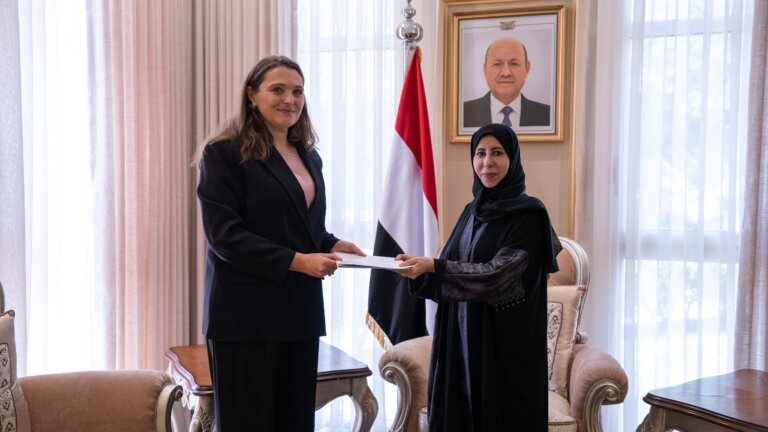
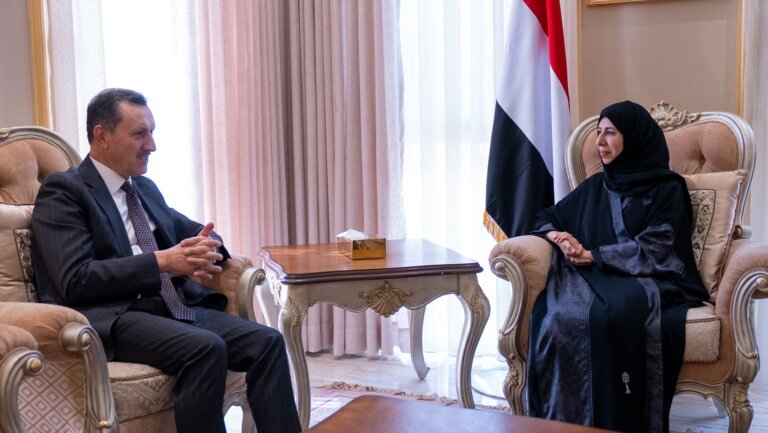
Education Minister Adel al-Abbadi signs school feeding partnership with WFP
 Yemen Herald News
ADEN, Yemen — Yemen’s education minister and the World Food Programme’s representative in the country signed a school feeding partnership agreement in Aden on Thursday.
Minister of Education Adel al-Abbadi signed the accord with the agency’s representative in Yemen, whom the state news agency Saba named as al-Khader Dolo.
The agreement covers school feeding programmes, work on a national school feeding strategy and joint financing mechanisms, Saba reported.
It also provides for expanding a locally sourced school feeding model and for building the ministry’s technical and institutional capacity to run the programmes, according to the agency.
Al-Abbadi said the World Food Programme was the ministry’s main partner in delivering school meals in Yemen, Saba reported.
He said school feeding is a social protection programme that supports children’s continued education and improves their academic performance.
The minister said the ministry would deepen coordination with the agency to keep the programmes running and extend them to more children.
The account of the signing rests on Saba, the news agency of Yemen’s internationally recognised government. No independent confirmation of the agreement or its terms has been published, and Saba gave no value or timeframe for the partnership.
The World Food Programme has run an emergency school feeding operation in Yemen since 2012. The programme, known as Tamriya, distributes fortified biscuits or date bars to pupils during the school day.
The agency has put the ration at 100 grams per pupil per day.
It reported reaching 1.8 million Yemeni children with school meals in January 2023.
Across the Middle East and North Africa, school meals programmes reach 23.5 million children, the agency said in a regional report.
Its interim country strategic plan for Yemen covers 2026 to 2028.
Yemen’s school system has contracted through more than a decade of war. UNICEF’s 2026 humanitarian appeal says more than 4.5 million children remain out of school.
The UN children’s agency puts the number of children who need education assistance this year at 6.6 million.
It says 2,783 schools have been destroyed or damaged, and that one in five schools in Yemen can no longer be used as a result of the conflict.
Teachers in areas under Houthi control have gone years without regular pay, UNICEF says, and salaries in government-held areas have been paid irregularly. Hundreds of teachers have left the profession.
Al Jazeera reported this month that economic pressure is pushing Yemeni children out of classrooms and into paid work.
The appeal sets out priorities in health, nutrition, water and sanitation, child protection and education. Its funding requirement is 31 percent lower than the 2025 appeal, which UNICEF attributed to a realignment of humanitarian work, access limits in parts of the country and expected constraints.
UNICEF is seeking $7.66 billion for humanitarian work for children worldwide this year.
Hunger compounds the pressure on attendance. The UN humanitarian office said in its March 2026 response plan that more than 22 million Yemenis need assistance.
The plan put the number of acutely food insecure people at 18.3 million.
More than 2.2 million children under five are acutely malnourished, it said, including 516,157 with severe acute malnutrition.
Food aid itself has been scaled back. WFP began a targeted emergency food assistance programme in February, cutting the number of people it reaches in government-held areas from 3.4 million to 1.6 million and concentrating on the most food insecure households.
The agency said the reduction followed a shortfall in funding. It planned six distribution cycles across the year.
FEWS NET, a famine early warning service, projected that the June to September lean season would push 1.5 million Yemenis into emergency levels of food insecurity, and that the figure would rise to 1.8 million between October and December.
The World Bank approved a country partnership framework for Yemen covering the 2026 to 2030 financial years, together with four operations worth $285 million. Of that, $20 million was set aside for modernising public institutions and systems.
The plan counted 5.2 million internally displaced people and sought $2.16 billion to reach 12 million of those in need.
Education is one of nine sectors covered by the World Bank’s active grant portfolio in Yemen, which the bank puts at about $2 billion.
Displacement has risen again this month. The International Organization for Migration said on Sept. 13 that more than 82,000 people had been displaced in Yemen during September, most of them from the west coast.
The UN humanitarian office later put the figure at 125,000.
Houthi forces took the Red Sea port of Mocha on Sept. 10 and went on to seize the rest of Yemen’s Red Sea coastline, Perim Island and the Hanish Islands.
Rashad al-Alimi, chairman of the Presidential Leadership Council, has said the Houthi gains along the coast are temporary. The Houthis say their operations are defensive.
Al-Abbadi serves in the cabinet of Prime Minister Shaya al-Zindani, who took office on Feb. 6. The government is based in Aden, while the Houthis hold Sanaa and administer schools across much of the north.
Saba said the agreement was signed on Thursday. It did not say where in Aden the signing took place or who else attended.
About the Author