Legal Affairs Minister Ishraq al-Maqtari discusses government contracting with World Bank specialist
 Yemen Herald News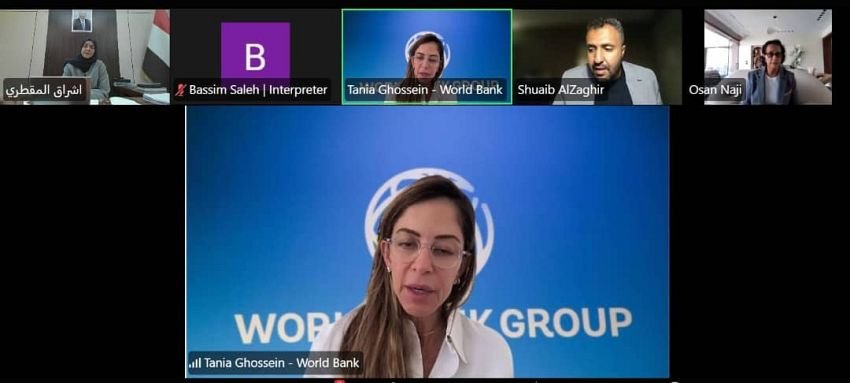
ADEN, Yemen — Yemen’s legal affairs minister discussed government contracting and the ministry’s legal capacity with a World Bank specialist in a video conference on Thursday.
Minister of Legal Affairs Ishraq al-Maqtari held the talks with Tania Ghossain, a senior private sector specialist at the bank, the state news agency Saba reported.
The two discussed developing the system of government contracts and agreements, strengthening the ministry’s legal and institutional capacities and supporting partnership between the public and private sectors, according to Saba.
The talks covered the ministry’s need for technical support in drafting and reviewing investment contracts and concession agreements, the agency reported.
They also covered preparing contract templates suited to the requirements of different sectors, and training the ministry’s legal staff to assess the obligations and risks attached to government contracts.
The account rests on Saba, the news agency of Yemen’s internationally recognised government. No independent confirmation of the meeting or its content has been published, and the agency reported no commitment of funding.
Al-Maqtari, a judge, was named minister of legal affairs in the cabinet of Prime Minister Shaya al-Zindani, who took office on Feb. 6.
The cabinet was the first in Yemen since 2015 to include women.
Before her appointment she worked in the judiciary and on human rights, including missions investigating violations at national and international level, Arab News reported.
Al-Zindani’s cabinet took office weeks after Salem Saleh bin Braik resigned as prime minister. Bin Braik’s cabinet was dissolved on Jan. 15, and the Presidential Leadership Council appointed al-Zindani to form a new one.
The change followed an offensive by the Southern Transitional Council in December that took control of much of the former South Yemen, after which bin Braik left Aden for Riyadh.
Al-Zindani had previously served as foreign minister. Afrah al-Zouba now holds that post.
Since taking office she has met the UN human rights office to discuss legislative reform, and has sought French technical assistance for the ministry, Saba reported at the time.
The World Bank has been re-engaged in Yemen since 2016. It says it has provided more than $3.9 billion in grants through its concessional arm, the International Development Association, over that period.
The bank puts its active portfolio in Yemen at about $2 billion across nine projects, covering health and nutrition, social protection, education, water and sanitation, agriculture, urban services, roads, electricity, fisheries and financial infrastructure.
In June its board approved a country partnership framework for Yemen covering the 2026 to 2030 financial years.
The framework came with four operations worth $285 million. Water management and irrigation took the largest share at $153.6 million, health, nutrition and water $94 million, and modernising public institutions and systems $20 million.
The bank framed the new programme around livelihoods and job creation in a fragile setting.
The International Finance Corporation, the bank group’s private sector arm, invested $8 million in Islamic financing in a Yemeni education and health provider last year. It has also worked on Sharia-compliant products for small and medium-sized businesses.
The $20 million operation, the Modernizing Public Institutions and Systems in Yemen Project, is intended to strengthen public financial management, improve statistical capacity and prepare the ground for a shift toward direct World Bank financing of Yemeni institutions.
The bank has described the fragmentation and weakening of core governance systems as one of the main constraints on Yemen’s longer-term recovery.
Public contracting has drawn attention elsewhere in the government this week. Saba reported on Thursday that the Higher Committee for Tenders and Auctions had stressed the importance of complying with the rules and procedures governing tenders.
The government’s finances remain under strain. The Central Bank of Yemen in Aden, headed by Governor Ahmed Ghaleb al-Mabaqi, has been estimated to hold reserves of about $225 million.
The rial traded at roughly 1,520 to 1,550 to the dollar in government-held areas at the start of August.
The Sana’a Center for Strategic Studies said the currency had appreciated by more than 44 percent since late July, after the central bank moved to curb speculation, channel import financing through formal mechanisms and require the rial for domestic transactions.
Yemen has operated two versions of its currency since January 2020, when the central bank in Sanaa banned banknotes issued by the Aden bank.
The central bank governor suspended the licence of an exchange company and ordered its premises closed, Saba reported on Thursday.
The bank also discussed challenges facing the banking sector and ways to strengthen its capacity, the agency said.
The talks with the World Bank took place as fighting intensified. Houthi forces seized the Red Sea port of Mocha on Sept. 10 and went on to take the rest of Yemen’s Red Sea coastline, Perim Island and the Hanish Islands.
The UN Security Council met on Sept. 15 at France’s request over Houthi control of the approaches to the Bab al-Mandab strait.
The International Organization for Migration said on Sept. 13 that more than 82,000 people had been displaced in Yemen during September. The UN humanitarian office later put the figure at 125,000.
Rashad al-Alimi, chairman of the Presidential Leadership Council, has said the Houthi gains along the coast are temporary. The Houthis say their operations are defensive.
Saba did not say whether further talks between the ministry and the bank had been scheduled.
About the Author