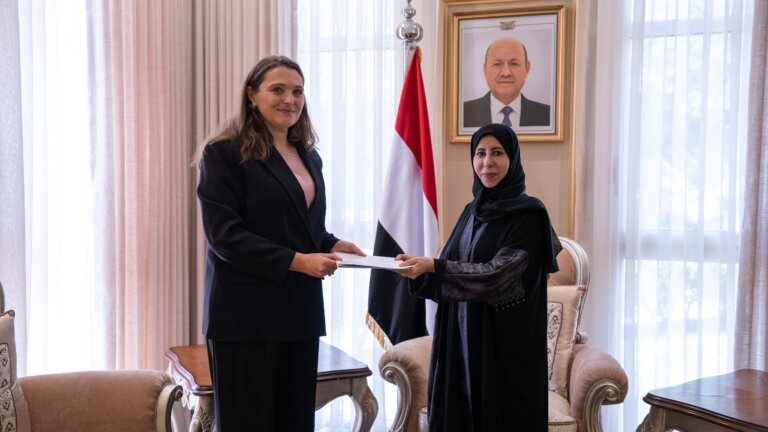
Afrah al-Zouba discusses Red Sea threats and state institutions with Türkiye’s envoy in Riyadh
 Yemen Herald News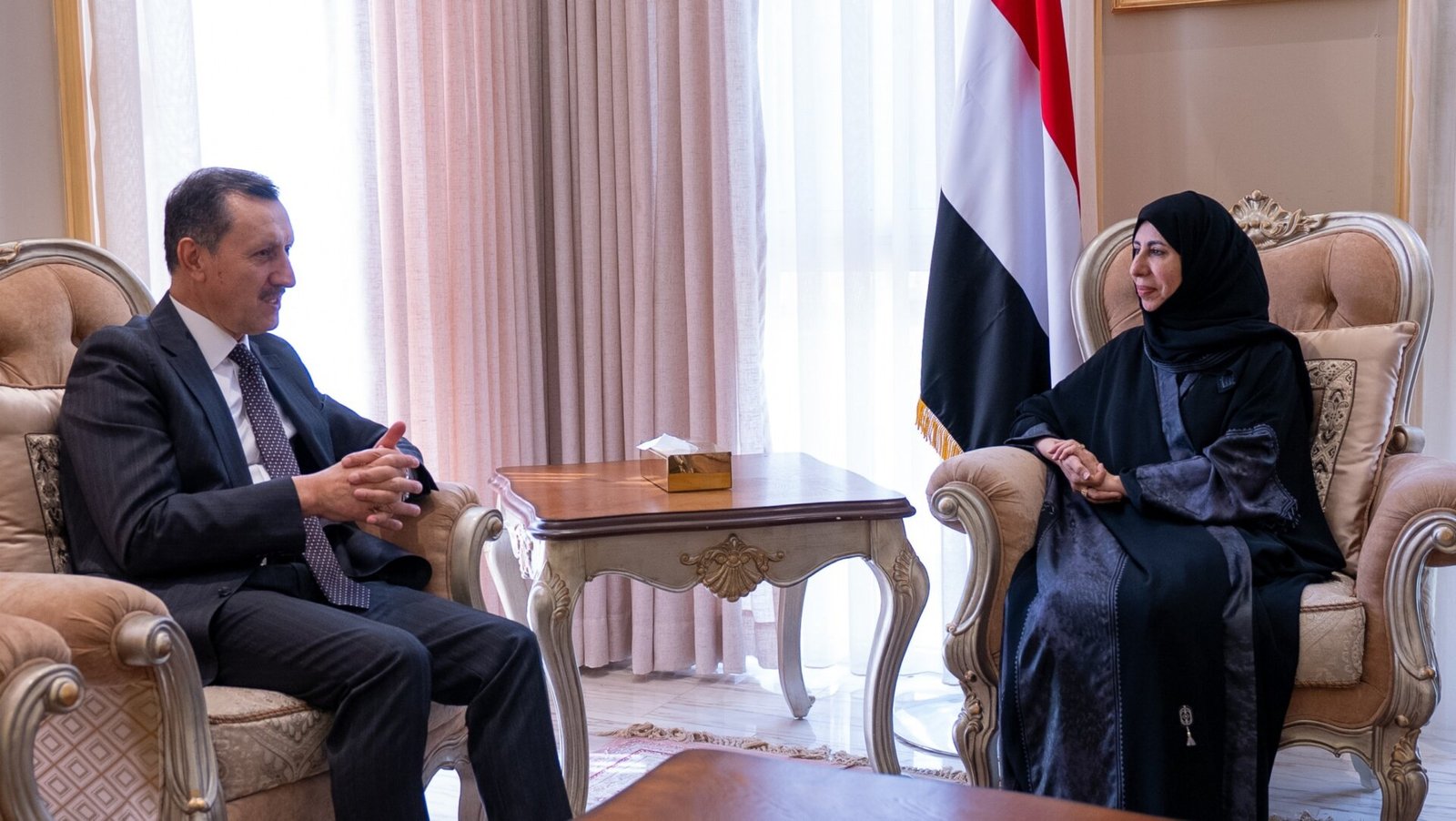
RIYADH, Saudi Arabia — Yemen’s foreign minister discussed Houthi attacks on Red Sea shipping and cooperation on rebuilding state institutions with Türkiye’s envoy in Riyadh on Wednesday, the state news agency Saba said.
Afrah al-Zouba met Emrullah Isler, whom Saba identified as Türkiye’s chargé d’affaires to Yemen.
Isler has served as Türkiye’s ambassador to Saudi Arabia since March 2024, according to the Turkish foreign ministry. The Turkish daily Daily Sabah, which also reported the meeting, described him as Ankara’s ambassador in Riyadh.
Al-Zouba said Yemen wanted to widen cooperation with Türkiye, particularly on strengthening state institutions, Saba reported.
She thanked Ankara for its support of Yemen’s government and of the Presidential Leadership Council, according to the agency.
The two discussed what Saba called Houthi escalation, including threats to shipping in the Red Sea and at Bab al-Mandab and to international trade.
Al-Zouba said missile launches were a growing threat to civil aviation and to international air traffic, the agency reported. She did not cite specific incidents in the account given.
Isler reaffirmed Ankara’s commitment to Yemen’s security, sovereignty and territorial integrity, Saba said.
Both sides spoke of restoring state authority, strengthening institutions and improving basic services, according to the report.
Daily Sabah gave broadly the same account. It quoted Isler as saying Türkiye was committed to expanding bilateral cooperation and to supporting the government’s efforts to rebuild state institutions and restore security.
The Houthi authorities in Sanaa reject the characterisation of their operations used by the government and by Saba. They describe their Red Sea campaign as action in support of Palestinians and dispute that it targets civil aviation.
The account of the meeting rests on Saba’s readout and on the Daily Sabah report. Neither the Yemeni foreign ministry nor the Turkish embassy has published its own text, and Yemen Herald could not obtain one.
Saba did not say whether the two discussed any specific programme, and it named no agreement.
Al-Zouba became foreign minister on 23 July 2026, the first woman to hold the post.
She is from al-Bayda in central Yemen. She holds a bachelor’s degree in pharmacy from Sanaa University, a master’s in community health and health economics from Malaysia and an MBA from the University of Science and Technology in Yemen.
She spent more than two decades in development and humanitarian work, including with SOUL for Development and with USAID programmes on governance and women’s empowerment.
She was first deputy secretary-general of the National Dialogue Conference between 2013 and 2015, overseeing technical operations and constitution drafting.
She took part in UN-facilitated consultations in Kuwait in 2016 and 2017. She advised Prime Minister Maeen Abdulmalik on humanitarian relief in 2019.
In 2021 she ran the Executive Bureau for Accelerating Aid Absorption. She was appointed minister of planning and international cooperation in February 2026.
Yemen’s government has operated largely from Riyadh and Aden since 2015.
Fighting escalated across several fronts from early August. The UN Special Envoy for Yemen, Hans Grundberg, told the Security Council on 10 September that the country faced the greatest risk of a return to large-scale conflict since the truce of 2022.
Grundberg said Ansar Allah, the movement also known as the Houthis, had captured the port city of Mokha, about 75 kilometres from Bab al-Mandab. He said that gave it a direct presence on the approaches to the strait.
Bab al-Mandab links the Red Sea to the Gulf of Aden. Shipping bound for the Suez Canal passes through it.
The World Health Organization said 838 people were killed and 3,643 wounded in Yemen between 6 August and 26 September, a total of 4,481. The count draws on returns collected by Yemen’s Health Emergency Operations Center.
Kaja Kallas, the European Union’s foreign policy chief, asked member states in late September to commit more warships to the Red Sea.
Shaya al-Zindani has served as prime minister since January 2026, when he replaced Salem Saleh bin Braik. He held the foreign affairs portfolio before that.
The Presidential Leadership Council, chaired by Rashad al-Alimi, has held executive authority since April 2022.
Grundberg set out three priorities in his September briefing: keeping channels of engagement open through the Military Coordination Committee, upholding international humanitarian law and preserving a pathway to a political settlement.
More than 130,000 people have fled their homes since early September, the United Nations said. More than 5.2 million were already displaced.
Türkiye maintains diplomatic accreditation to Yemen, with its mission operating from Riyadh alongside the Yemeni government.
More than 3,600 Yemenis have crossed to Djibouti since 10 September, according to the UN. Nearly half of them are children.
Taiz accounts for more than 60 percent of the recent displacement, the UN said.
Al-Zouba met Germany’s foreign minister, Johann Wadephul, in New York in late September to discuss Red Sea navigation.
She addressed a panel in New York on a Yemeni health strategy for 2026 to 2030 during the same period.
Isler taught Arabic at Gazi University in Ankara and served as Turkey’s deputy prime minister between December 2013 and August 2014. He has sat in the Grand National Assembly for Ankara province since 2011.
He has served as an Arabic interpreter for President Recep Tayyip Erdogan.
About the Author