Marib local authority signs water deal with British charity Muslim Hands
 Yemen Herald News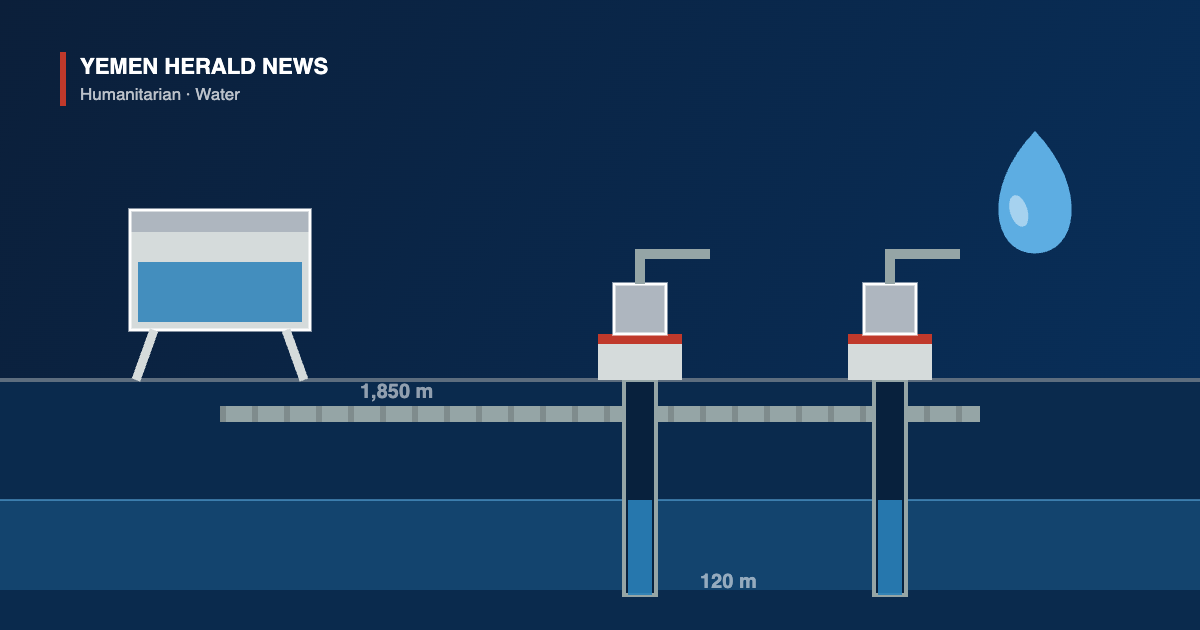
MARIB, Yemen — The local authority in Marib signed a memorandum of understanding with the British charity Muslim Hands on Thursday to drill two groundwater wells for Marib City.
The agreement covers both the financing and the construction of the work, the state news agency Saba reported.
Two news agencies operate in Yemen under the Saba name. The report came from the agency aligned with the internationally recognised government.
The wells will be sunk in the Old Marib Well Field. Each is to reach a depth of 120 metres.
Muslim Hands will pay for the drilling and carry it out.
The project also covers the supply and installation of fully integrated submersible pumping units, according to Saba. It includes the construction of well chambers and the civil, electrical and mechanical works attached to them.
A transmission pipeline forms the second half of the scheme. It is to measure 10 inches across and run 1,850 metres.
The line will connect to the existing main transmission pipe and to the strategic reservoir, Saba said. Valves, valve chambers and the necessary connections are included.
The stated aim is to raise the production capacity of the city’s water sources. The local authority also wants the supply system run more efficiently and kept working over time.
The Old Marib Well Field is one of the sources feeding the city network. Saba did not say how many wells it currently holds or what they produce. Nor did it name a contractor for the drilling.
Hussein Ahmed bin Jalal signed for the local authority. He is director general of the Water and Sanitation Corporation branch in the governorate.
Saleh al-Saqqaf, director general of the Planning Office, signed alongside him.
Saleh Qasim, who heads the Muslim Hands office in Marib, signed for the organisation.
Deputy Governor Abd-Rabu Miftah attended the signing. He said the project would strengthen the resilience of the Public Water Corporation and its capacity to deliver safe and clean water to residents, according to Saba.
Miftah said the authority planned to widen service coverage and to keep supplies and operations sustainable. He said the scheme addressed part of what he called growing needs in the water sector.
He praised the organisation’s humanitarian work in the governorate, singling out projects aimed at recovery.
Yemen Herald could not independently verify the terms of the memorandum. The account rests on Saba, Yemen’s state news agency, and no independent confirmation has been published.
Saba gave no cost for the project and no completion date.
Marib lies at the eastern edge of the government-held interior. The governorate has taken in the largest displaced population in Yemen since the war began in 2015.
Its water network was built for a fraction of the people now living there.
Local reporting this year put the share of the governorate’s population without a safe and sustainable source of drinking water at 63 per cent. That figure rests on local assessments and has not been independently audited.
A report by local authorities cited in Yemeni media this year put the number of families in the governorate facing hunger at about 234,000. Yemen Herald could not verify that count. A separate local account gave a higher figure, and the two have not been reconciled.
Muslim Hands, which is registered in Britain, has worked on water infrastructure in Marib before. The organisation says its wider programme there is designed to serve 12 displacement camps from 27 distribution points.
It says the programme is intended to deliver 30 litres of water a day to a third of Marib’s population, and puts the number of people it expects to reach at 1.28 million. Those are the charity’s own projections.
Its first water project in Yemen was the rehabilitation of a well at Bir al-Sheikh in Abyan governorate, according to the same account. The charity lists water among its main programme areas.
Other agencies have been moving Marib away from trucked water. The International Organization for Migration says Al Jufainah camp, which houses about 15,000 displaced families, was connected to the city network but drew so little that families received water roughly once a month.
Those households fell back on trucked water bought at high prices, IOM said.
IOM and the Saudi aid agency KSrelief opened a 2.25 million dollar water scheme in the governorate that drills a borehole, installs a hybrid pumping unit and lays more than 10 kilometres of pipeline. It also builds elevated tanks of 200 cubic metres each and two desalination units.
That scheme covers displaced people and the communities hosting them, and includes rehabilitation work in the Ben Aboud neighbourhood.
The scale of the wider need is set out in the United Nations humanitarian plan for Yemen published in March. OCHA says more than 22 million people in the country need assistance.
The plan records 18.3 million people as acutely food insecure. It counts more than 2.2 million children under five as acutely malnourished, 516,157 of them severely.
OCHA puts the number of internally displaced people at 5.2 million. The appeal seeks 2.16 billion dollars to reach 12 million of them.
Water and sanitation programmes compete with food and health for that money.
Saba did not say when drilling is due to start.
About the Author